Over-Stuffed Context Windows Causing Reasoning Compression
LLMs lose reasoning ability before filling their context window, requiring intentional curation.

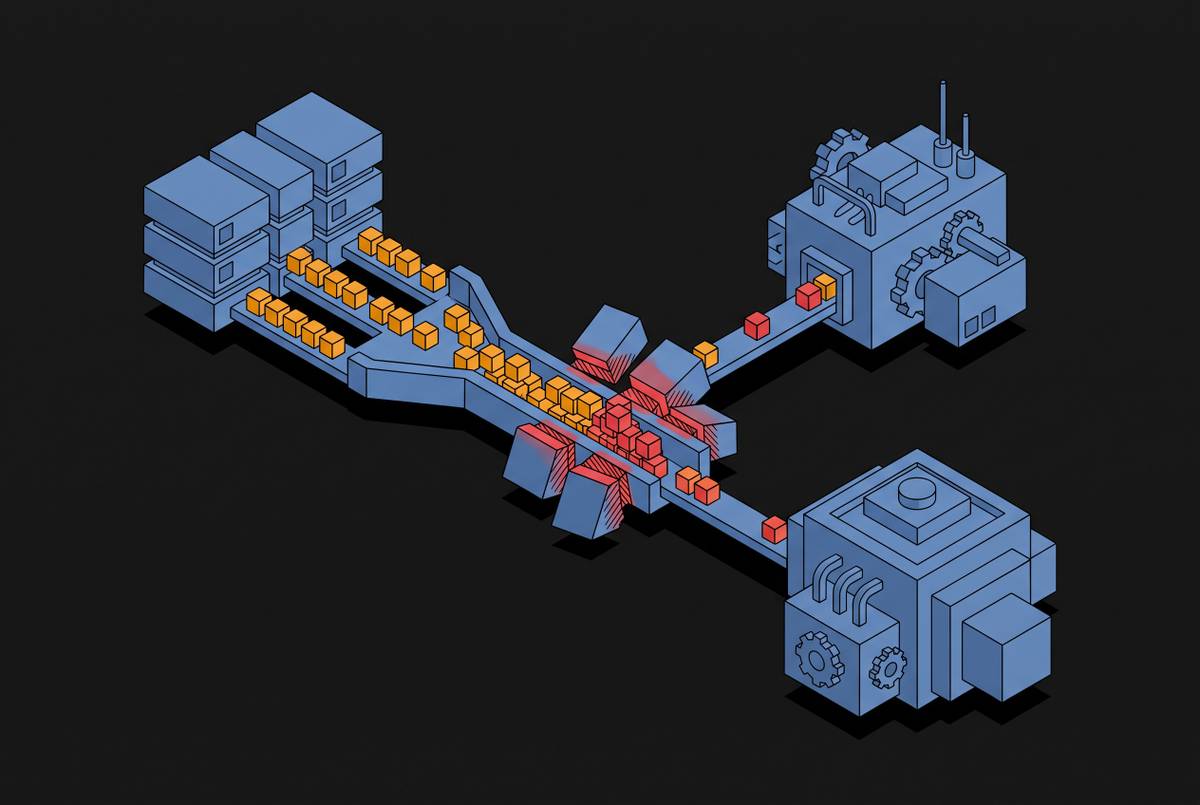
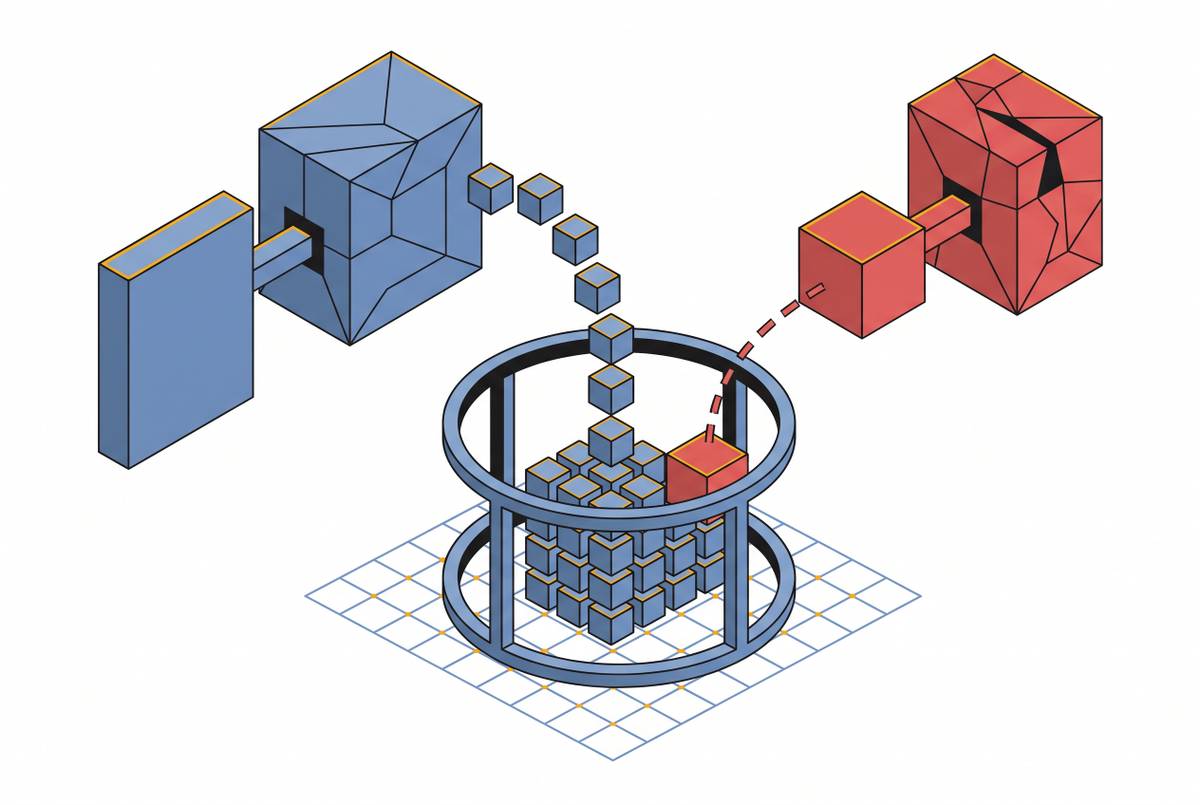
Over-stuffed context windows compress an agent’s ability to reason before they exhaust its token budget. For long-running agents, this is a systematic failure pattern. The engineering response is to diagnose where useful context becomes noise or loses its dependencies, apply a targeted harness change, and validate that change against the production traces that exposed the failure.
How context bloat degrades agent reasoning before the window fills
A long-running agent takes more steps while its answers become less consistent with earlier results. It still returns valid responses, but its tool calls drift and its progress slows. The window has not filled, so a capacity check reports no problem. Yet each increment of history adds noise that can weaken reasoning over the evidence already present. The failure begins below the advertised limit.
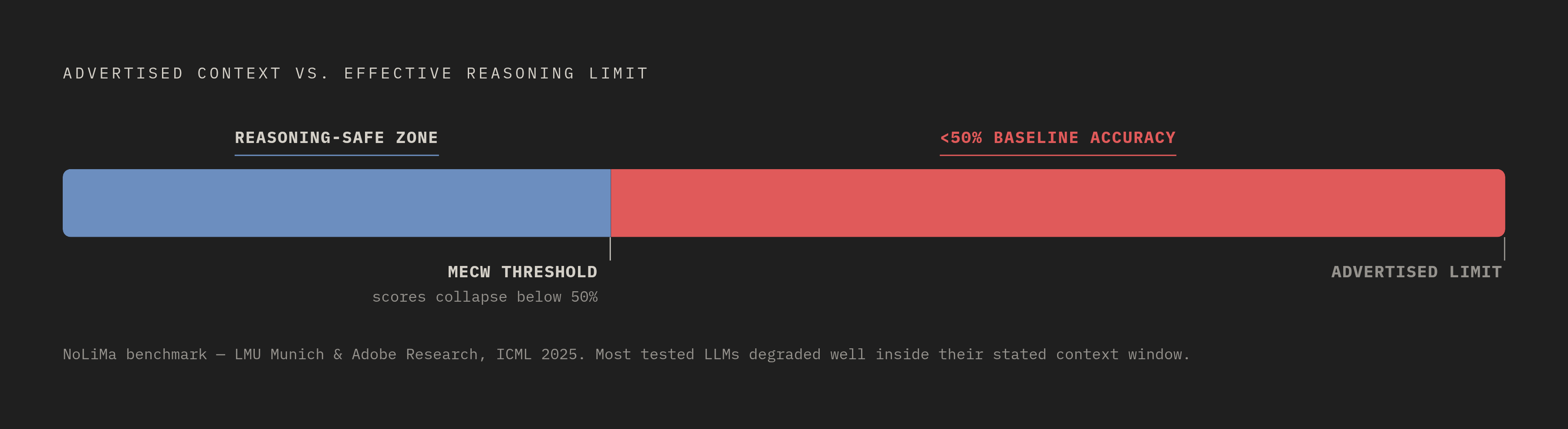
Advertised context size measures how much input a model can accept, which exceeds the amount it can reason over reliably. KV cache pressure and attention trade-offs help create that gap. Models tend to prioritize the beginning and end of context while neglecting material in the middle, so evidence does not receive equal attention merely because it fits. Full-context loading also scales compute cost quadratically with input length, regardless of the relevance of the loaded material.
The NoLiMa benchmark from LMU Munich and Adobe Research, presented at ICML 2025, removed literal keyword overlap between questions and needles to isolate reasoning demand. The vast majority of tested LLMs fell below half their baseline scores well inside most models’ advertised context limits. Finding an exact phrase and working through related evidence to reach an answer thus test different parts of the capacity a model can use. The operative constraint is the Minimum Effective Context Window, or MECW, which varies with task complexity and is smaller than the advertised window. Sizing an agent’s context budget against the latter measures the wrong boundary.
Why long-running agents hit this ceiling faster than single-turn systems
Single-turn systems reset context between queries that stand on their own, while an agent carries a record of its work forward. Each completed step appends messages, tool calls, and results. Without context management, this history grows monotonically across the run. Reasoning can thus get worse in the course of a normal run, even without unusual input. MatClaw’s architecture paper names progressive context loss as a main engineering problem when trying to keep materials exploration coherent across multi-day workflows.
The accumulation becomes more damaging when earlier context is wrong. An agent that retrieves a stale or incorrect fact can reinforce it through subsequent steps, spending compute on actions grounded in a hallucinated state. This is context poisoning, where history preserves an error and gives it repeated influence. Context distraction is different because even a history without that error can become an obstacle. Beyond a threshold, the model over-indexes on previous actions rather than synthesizing a new strategy, producing repetitive action loops.
Retries make this feedback loop particularly visible. Without explicit schema validation, an agent may treat a structurally broken response like a transient network error and retry both. Each retry adds tokens that make the next decision harder without correcting the underlying fault. The agent consequently continues operating as its performance gradually degrades. Its continued activity can look like continued competence unless the execution is inspected step by step.
Tool overload as a context-compression failure disguised as a tool-selection problem
A large tool registry consumes context before the agent has accumulated much execution history. Irrelevant schemas add noise to the same input from which the model must select a tool and construct valid arguments. Berkeley’s Function-Calling Leaderboard research illustrates this with a Llama 3.1 model that failed with a large toolset but succeeded with a relevant subset. The model’s capability did not change between those conditions. The tool context did, making the failure a case of reasoning compression rather than evidence of an inability to perform the task.
In production, tool misuse is visible in wrong arguments, missing required fields, and wrong data types. It is the most common agent-specific production failure mode, yet it rarely produces an obvious signal that explains the fault. Schema drift makes attribution especially important. If the schema presented to the model has become invalid, the resulting call does not establish that the model regressed. The harness supplied an invalid contract for the model to reason over, so the failure belongs at the context layer rather than being treated only as an API compatibility issue.
Passing fewer tools per call addresses the noise, but it is not a complete implementation plan. The harness must select which tools belong in the current step. Without that selection logic, the naive implementation loads the full registry again and preserves the cause of the failure.
Prompt ambiguity and hard compression as sources of referential breakage
Hard prompt compression scores each fragment on its own and keeps those that seem most relevant. That selection can preserve an answer string while deleting the bridge fact needed to interpret it. The referential dangling study identifies this as a structural failure of independent selection. The answer remains technically present, but the inference chain leading to it is broken.
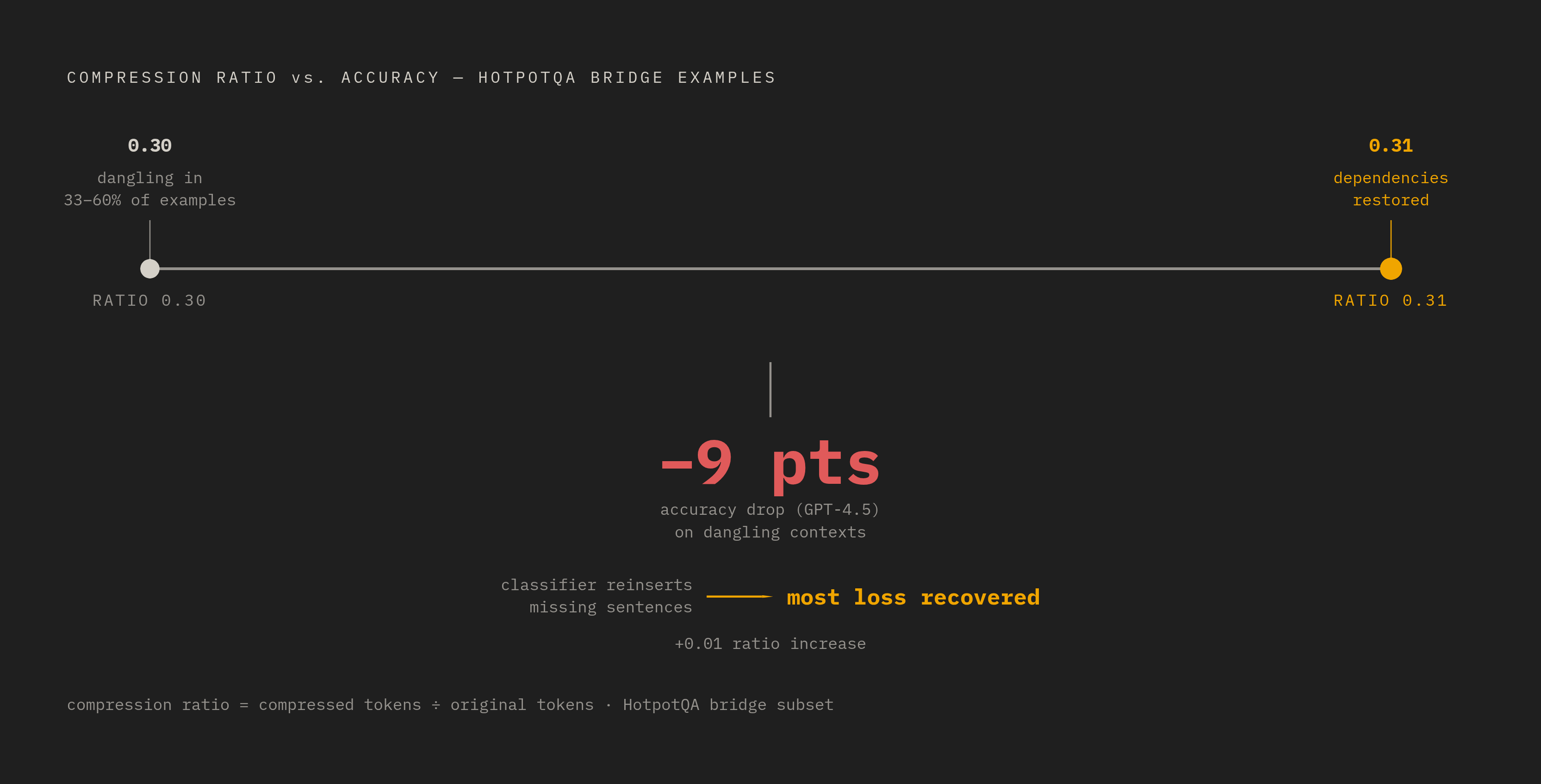
At a compression ratio of 0.30, all six hard compressors tested exhibited dangling on roughly a third to three-fifths of bridge examples in a shared HotpotQA benchmark set. Every document in a single-document question-answering benchmark contained at least one dangling reference. Reinserting the missing supporting paragraph while removing an equal-token non-supporting paragraph substantially improved accuracy. The result separates a shortage of tokens from a failure to select complete evidence. At the same budget, a context that preserves dependencies can support reasoning that a relevance-ranked context cannot.
The referential dangling study also found that GPT-5.5 was nearly 9 points less accurate on compressed contexts than on contexts retaining both supporting paragraphs. A classifier that ranked omitted sentences by whether they were needed to interpret retained text improved accuracy while raising the compression ratio only from 0.30 to 0.31. Prompt ambiguity creates a related obstruction without deleting anything. When instructions from multiple contributors accumulate and conflict, context clash weakens performance even at a modest token count, leaving the model with competing guidance.
What reasoning compression looks like in production traces
Diagnosis requires step-level traces. To be useful, the record must at least include each tool call, its arguments, any available intermediate reasoning, and the result of each step. OpenTelemetry-compatible tracing is an emerging standard target for agent runtimes, although the GenAI semantic conventions defining agent and tool spans remain in Development status. Latency and error rates for the run as a whole can miss failures of reasoning. An output can be syntactically valid while contradicting facts established earlier in the run.
In those traces, missing required fields and wrong argument types can be signs that schema constraints have less sway as context grows. Repeated identical tool calls point toward context distraction, especially when the agent re-executes history and stalls progress. A rising step count without a higher success rate after a prompt or context change reveals another form of regression. Semantic drift occurs when later outputs are still well formed but clash with earlier results. These signs show where to look, but more evidence is needed to blame the model.
Root-cause attribution is a search problem because the relevant evidence may appear long before the final bad output or span distant parts of the trace. Fault assignment must distinguish model, harness, and environment, then locate the responsible prompt, tool schema, workflow logic, or memory component where applicable. Automated attribution over full traces is needed because people reviewing them by hand can miss dependencies spread across the trace. LLM-as-a-Judge evaluation on sampled production traces can catch semantic drift weeks before user complaints, while score thresholds support quality-aware alerts. Because the same input can produce different tool sequences, evaluation must examine the path as well as the apparent correctness of the destination.
Harness levers that counteract context bloat without retraining
For tool overload, dynamic tool selection loads only the subset relevant to the current step. In Berkeley’s result, the model succeeded with 19 relevant tools and failed with 46. This is a targeted reduction of schema noise specific to tool selection. For schema drift, typed tool definitions using Pydantic or JSON Schema address the validity of what remains. Validation against the target LLM provider’s schema requirements before deployment catches an invalid contract before the model reasons over it.
For referential dangling, compression must optimize for referential completeness alongside relevance scores. The classifier-based restoration approach demonstrates that missing dependencies can be restored at near-zero additional token cost. This targets the broken bridge. For accumulated prompt ambiguity, versioning makes instructions deployable infrastructure that is traceable, testable, and rollback-ready. It gives gradual prompt degradation an inspectable change history that helps distinguish it from model drift.
Structured memory management changes how an agent carries information forward as its conversation history grows. The Continual Harness framework alternates between acting and refining its system prompt, sub-agents, skill library, and memory from trajectory data collected mid-episode. MatClaw uses a four-layer memory architecture designed to keep progressive context loss from happening across multi-day workflows. Both make memory organization part of the agent’s operating design rather than an afterthought when the window becomes crowded.
Memory-Augmented Compression offers a way to shorten verbose reasoning traces without training. It constructs abstract reasoning memories from historical traces and retrieves them as prefill-side scaffolds. Those memories let reasoning traces be compressed without the loss of accuracy that comes with aggressive generation-side compression. The framework formalizes the trade-off as the Context-Generation Substitution Law, in which explicit reasoning context substitutes for part of decode-time generation. Its target is chain-of-thought overhead.
KV cache pressure is a distinct problem, and MEMENTO from Microsoft Research is not a training-free harness fix. It trains models to segment reasoning into blocks, compress each into a dense summary called a memento, and attend only to mementos going forward. MEMENTO achieves roughly 2–3× peak KV cache reduction while maintaining accuracy across math, science, and coding benchmarks. Its dual information stream finding shows that memento KV states retain implicit information from the original block, distinguishing the method from naive truncation. This boundary matters because harness changes can ship without weight updates, so the base model, specialist adapters, and harness can each have their own release schedule.
Validating harness changes against production traces before shipping
A plausible fix is not yet a validated fix. Traditional logs cannot reproduce non-deterministic LLM failures, so span-based trace replay is a baseline requirement for agent changes. A harness provides a repeatable way to define golden tasks, replay tool calls deterministically, score runs with real rubrics, and block regressions in CI. Those tests must link back to past production traces. Synthetic benchmarks do not reproduce the particular noise, tool-call patterns, and accumulated context that triggered the original failure.
Step count can show whether a change helps an agent do its work better even when it still completes the task. If an agent averages 6 steps and moves to 9 after a prompt change, unchanged success rates conceal higher cost and latency. The harness should reject that change as a regression. Regression-aware optimization applies the same rule by rejecting proposed edits that make the agent worse at tasks it could already solve. It constrains harness changes much as parameter regularization constrains model training.
Replay also makes a proposed intervention reviewable. Engineers need to inspect what changed and why before release, including for automatic fixes. Otherwise, a change intended to remove noisy schemas may remove a needed tool, or compression may exchange bloat for broken evidence dependencies. Validation must test both the failure the change aims to fix and the things the agent should still be able to do. The goal is not the smallest context, but a context whose contents still support reliable reasoning throughout the run.