Retry Storms and Exponential Backoff Failures in Tool-Calling Agents
Agent systems amplify retry costs because LLMs resubmit full context and spawn shadow retry loops.
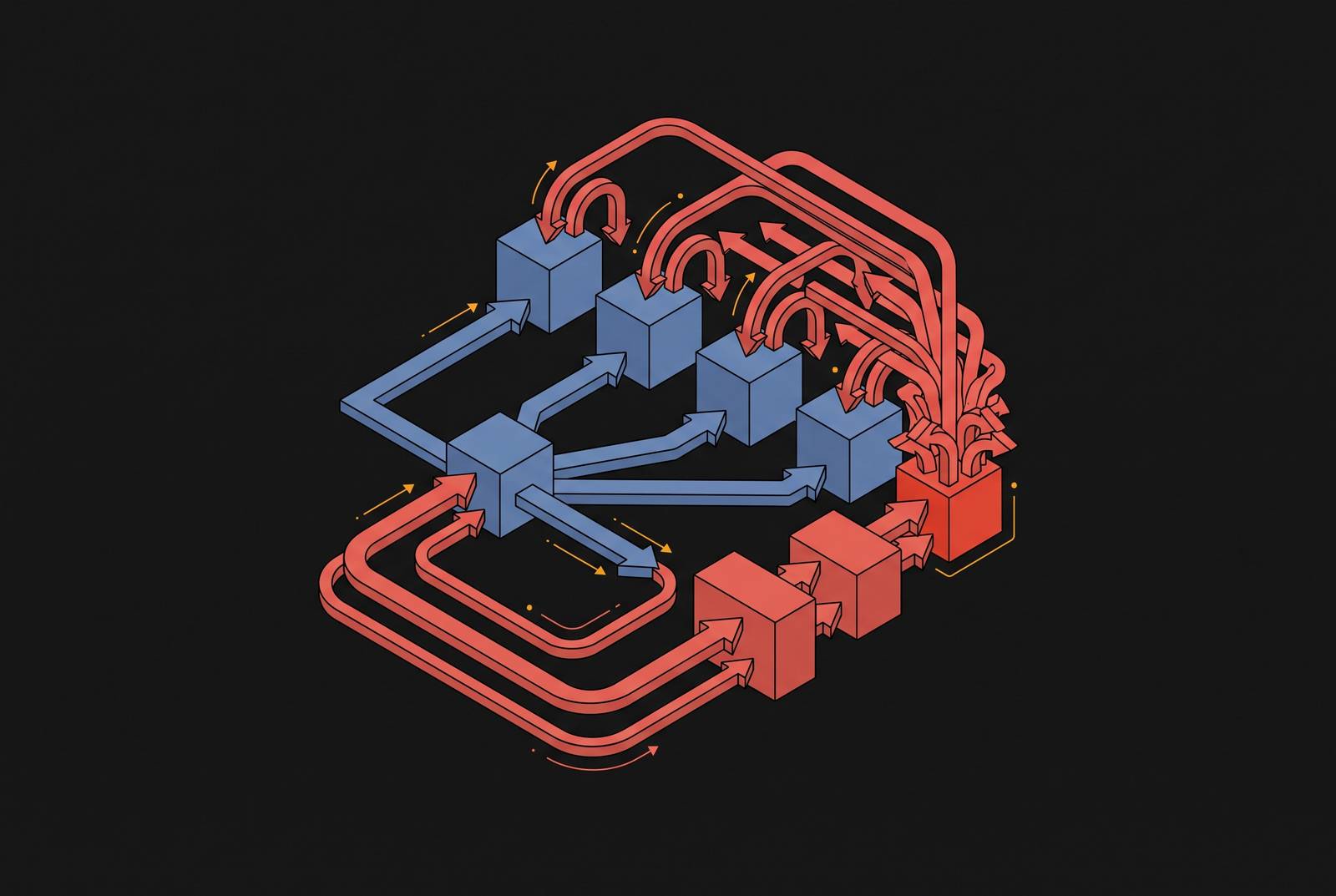
Retry storms in tool-calling agents cost more than a bad afternoon of API bills ValueStream AI - AI Error Handling Patterns 2026 AI Agent Retry Patterns - Exponential Backoff Guide 2026. They cost real money at a rate that microservice engineers would find absurd, and they do it because every retry resubmits full conversation context to the LLM, and because the agent itself may spawn a shadow retry loop independent of infrastructure-layer logic. That's the subject here: why the old playbook, exponential backoff, jitter, circuit breakers, is necessary in agent systems but nowhere near sufficient, and what actually contains the damage when a tool call starts failing in a loop.
Why agent retries are structurally different from microservice retries
Start with the baseline case everyone already understands. A retry in a traditional microservice costs one HTTP round-trip, and the whole decision, wait, retry, give up, lives in the infrastructure layer, invisible to the application logic above it. Nobody upstream even notices.
Agent systems break that assumption in two separate ways, and both matter. First, every retry resubmits the full conversation context to the LLM, so a retry loop that fires multiple requests isn't wasting a few HTTP calls, it's multiplying token consumption by the entire context window each time it fires.
Second, and this is the part infrastructure engineers tend to miss: the LLM itself can decide to retry, on its own, without asking permission. It sees the failure response sitting right there in its context window and calls the same tool again, which spins up a shadow retry loop that runs completely independent of whatever backoff logic lives in the tool layer. Nobody wrote that retry loop. Nobody is throttling it. It accumulates with every pass, too, folding each failed attempt into the context, so the model's next try goes out longer and noisier than the one before it, dragging more failure history along for the ride.
The dollar figure makes the stakes concrete rather than abstract. One documented case from tianpan.co logged roughly $2 in token spend over a 30-second window for a single runaway conversation before circuit-breaking cut that down to about a penny, a 200x reduction just from stopping the loop early TianPan.co - The Retry Storm Problem in Agentic Systems. And this isn't a rare edge case triggered only by exotic failures. LLM API calls fail 1 to 5 percent of the time from rate limits, timeouts, and server errors, and in February 2026, rate limit errors alone made up 60 percent of all LLM API errors recorded ValueStream AI - AI Error Handling Patterns 2026 AI Agent Retry Patterns - Exponential Backoff Guide 2026. That failure rate, multiplied across a production system running thousands of conversations, is where the amplification stops being theoretical.
The three amplification patterns that make agent retry storms escalate
Retry storms don't hit agent systems in one shape. They hit in three, and each one demands a different fix, so lumping them together as "retry problems" leads teams to patch the wrong layer.
Vertical amplification is the base case, retries piling up within a single tool call, and it's the one most engineers already recognize from prior systems. The agent-specific twist is the shadow loop described above: each failed attempt accumulates into context, so vertical amplification in an agent isn't just repeated calls, it's repeated calls with growing baggage.
Horizontal amplification is nastier. It happens across sequential tool calls where step N depends on what step N-1 returned. Each downstream step that receives a degraded or missing input fails in turn and kicks off its own retry chain, and the ugliest version of this doesn't even fail cleanly: the agent gets a partial result from some degraded upstream service, passes it forward as if it were whole, and the actual error becomes visible only several steps later. Finding the origin at that point means walking the entire trace backward, step by step, hoping the corrupted input left a fingerprint.
Recursive amplification is the one that breaks intuition. In multi-agent delegation trees, Agent A retries its entire workflow, including delegation to B, and B retries its own workflow, including delegation to C. The retry decision at the top of that tree happens at a completely different layer of abstraction than the failure at the bottom. Agent A has no visibility into how many downstream retries its single retry decision is about to trigger.
Error propagation makes all three patterns worse than they'd otherwise be. A hallucinated or corrupted output from one agent doesn't get flagged, it gets passed downstream as settled fact, so three specialized subagents can each produce confidently wrong answers, all internally coherent, with no exception ever raised anywhere in the chain. Nothing in the system knows anything went wrong. These three patterns, vertical, horizontal, recursive, are genuinely distinct failure modes rather than three flavors of the same bug, and the defenses that stop one won't touch the others.
Why naive exponential backoff is insufficient for agents
None of this is an argument against exponential backoff. It remains the correct baseline, full stop: wait_time equals base delay times two to the power of the attempt number, plus a random jitter term, and that randomness is what spreads retries out over time instead of letting many clients retry simultaneously after a widespread transient failure. Distributed systems research from AWS, cited in industry writeups on agent retry patterns, puts the reduction in retry storms at 60 to 80 percent once jitter is added to the backoff curve AI Agent Retry Patterns - Exponential Backoff Guide 2026. That's a real number and a real improvement, and it's worth taking seriously.
It also assumes a single-layer retry decision, which is precisely the assumption agent systems violate. One easy, high-value fix sits right alongside the backoff formula: check the Retry-After header. OpenAI and Anthropic both return the exact wait time on a 429 through that header, while Google instead buries the equivalent instruction inside the JSON response body as a retryDelay field, and using whichever value the provider actually gives you avoids guessing at a wait time longer than necessary.
But backoff alone has no answer for horizontal or recursive amplification, since it was designed for the vertical case and stops there. It operates entirely at the infrastructure layer, with zero awareness that the LLM might be running its own shadow retry loop inside the context window at the very same time. Worse, it cannot distinguish a transient 429 from a persistently broken tool schema, so it retries the permanent failure right alongside the transient one, wasting tokens and delaying the inevitable. That's the actual mechanism behind the phrase "actively harmful": backoff without classification doesn't just fail to help, it spends real money confirming a failure that classification would have caught on the first attempt.
Error classification as the prerequisite to any retry decision
Every retry decision has to start with a question backoff formulas don't ask: what kind of failure is this? Retryable failures are the clean case, transient 429s, 5xx server errors, network resets, timeouts, partial-stream cutoffs, and these are always worth one more attempt inside a bounded backoff window. Non-retryable failures are the opposite case: auth errors, validation failures, malformed tool schemas, requests flagged unsafe. Retrying any of these produces no recovery whatsoever, and in the case of a write operation, might produce a duplicate side effect on top of the original failure.
Then there's the category nobody's monitoring catches by default: silent failures. Quality degradation from a context window quietly overflowing, a prompt injection nobody noticed, upstream data that's subtly wrong, a model checkpoint that changed underneath the deployed prompt. None of these throw an HTTP error, so none of them trip a circuit breaker built to watch for HTTP errors. The system looks healthy the entire time it's producing garbage.
The scale of the underlying problem demands attention. That's not a rare tail event; it's a routine cost of doing business with these systems, so a formal decision framework is needed here more than in traditional software. BENCH2ROBUST, published by Amazon in August 2026, names the three choices explicitly: RETRY the same path, SWITCH to a different one, or ABSTAIN and escalate to a human when no viable path is left. Retry is one branch of that decision tree. Tool calling fails 3 to 15% of the time in production depending on model size and task complexity, and some agent workflows fail closer to 41% of the time, openlayer.com reports AugmentCode - Why Multi-Agent LLM Systems Fail OpenLayer - AI Agent Failure Modes AI Error Handling Patterns 2026: Circuit Breakers, Retries & Fallbacks for LLMs.
Circuit breakers in agent systems and the limits of the microservice pattern
The standard circuit breaker pattern is well understood: watch the failure rate for a service, trip the breaker open once it crosses a threshold, fail fast while the system cools down, then test recovery cautiously in a half-open state. A 10 percent failure rate inside a 30-second window is one concrete threshold used in production agent systems TianPan.co - The Retry Storm Problem in Agentic Systems.
Three things break when that pattern gets carried over from microservices to agents without modification. Granularity is the first: microservice breakers watch service-to-service calls, one clean boundary, but agent systems need breakers watching several boundaries at once, individual tool calls, workflow stages, per-conversation token budgets, and per-agent delegation chains, none of which map onto a single service boundary the old pattern assumes.
Non-determinism is the second, and it's the sharper one. When a microservice's circuit opens, the calling service gets back a clean, predictable error and handles it in code written in advance. When an agent's circuit opens, the LLM receives a tool failure inside its context and then decides, on its own, what to do about it, which might mean gracefully falling back, might mean hallucinating a plausible-sounding answer, or might mean inventing some workaround nobody asked for and nobody tested. The breaker tripped correctly. What happens next is out of anyone's hands.
Context accumulation is the third. Microservice retries are stateless, each attempt starts clean. Put together, these three gaps mean circuit breakers remain necessary in agent systems, they just have to operate at several abstraction levels simultaneously rather than sitting at the single tool-call layer the microservice version was built for.
The layered defense architecture that contains agent retry storms
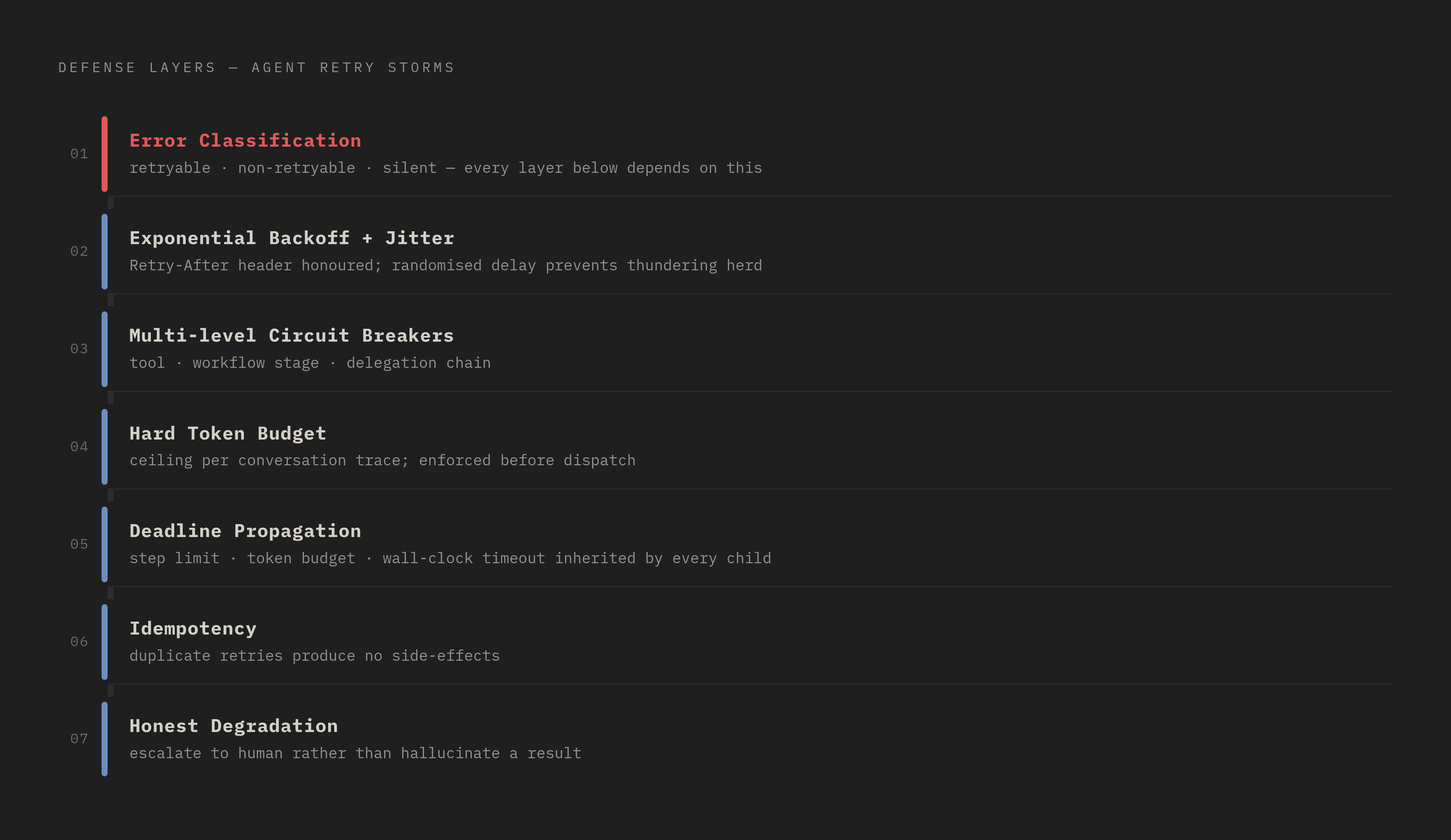
Error propagation compounds the damage: a hallucinated or corrupted output from one agent gets passed downstream as fact, so three specialized subagents each produce wrong answers with apparent coherence and no exception raised. At call time, layer one performs classification, sorting retryable from non-retryable before any backoff timer even starts. Layer two is the backoff itself, exponential with jitter, respecting whatever Retry-After signal the provider sends back. Layer three is circuit breakers implemented at multiple levels at once, separate breakers for individual tools, for workflow stages, and for delegation chains, rather than one breaker trying to cover all three.
Layer four is a hard token budget at the conversation level, a firm ceiling on cumulative consumption per trace so a retry storm physically cannot run away with unbounded compute. Layer five is deadline propagation: every execution path needs a defined maximum, whether that's a step limit, a token budget, or a wall-clock timeout, so retry decisions respect the remaining budget, not just the local failure count.
Layer six is idempotency, unglamorous but non-negotiable. Layer seven is honest degradation: when the retry budget runs out, the system needs to say so rather than serve up a hallucinated answer that some downstream agent will treat as settled fact and build on.
The pattern that ties all seven layers together is architectural rather than a coding habit: retry and fallback belong at the gateway, as a configured control, not scattered across application code as one-off loops bolted onto individual features. Keeping every retry attempt inside a single trace, an approach described in FutureAGI's Agent Command Center design, means the whole retry history for a conversation stays inspectable after the fact, instead of being smeared across logs nobody thought to correlate.
Tool schema drift as the failure category that makes retry loops structurally unsolvable
Some failures no retry policy, however well designed, can fix. Schema drift is the clearest example. A field named user_id quietly becomes member_id, or a field that used to be optional becomes required, and the model keeps generating the old key anyway, because every example, every trace, every few-shot prompt still sitting in its memory encodes the version that no longer exists AI Agent Retry Patterns - Exponential Backoff Guide 2026 AugmentCode - Why Multi-Agent LLM Systems Fail AI Error Handling Patterns 2026: Circuit Breakers, Retries & Fallbacks for LLMs. A dedicated 2026 paper on memory-induced tool drift examines exactly this mechanism, tracing how stale in-context examples and memory stores push agents toward generating obsolete tool call signatures long after the underlying API has already moved on AI Agent Retry Patterns - Exponential Backoff Guide 2026 AugmentCode - Why Multi-Agent LLM Systems Fail AI Error Handling Patterns 2026: Circuit Breakers, Retries & Fallbacks for LLMs.
BENCH2ROBUST offers a concrete instance of the failure and the recovery both. The model calls get_order_details, gets back a schema_drift error reporting an unknown field called items_v2, and switches over to get_orders_for_user instead, a fallback path that still returns usable order summaries even though the original call was dead on arrival.
What makes this category different from an ordinary bug is the asymmetry in how it fails. A classic software bug stops the process, throws an exception, and someone notices immediately. An agent hitting schema drift often just finishes the conversation anyway, wrong state and all, with no crash, no exception, and nothing forcing a human to look. As a result, operators end up trusting a broken system for far longer than they would have trusted broken code. Retry logic, no matter how well tuned, cannot repair a schema mismatch. It will happily keep retrying a permanently broken call until the token budget runs dry, because retrying is the only move it knows. The actual fix lives somewhere else entirely, in the prompt, in the memory store, in the tool schema itself, never in the retry policy layered on top of it. This is where the BENCH2ROBUST ABSTAIN decision matters: recognizing that no viable retry path remains and escalating is a better outcome than burning the token budget on repeated schema failures. This category of failure is addressed by "Learning Strategy-Aware Tool-Use Policies via Controlled Error Injection".
Reading retries as a diagnostic signal, not just an operational cost
Retry events, once logged properly, turn out to be some of the most honest data a production trace produces. Each one records exactly which layer failed, how many attempts it took, what each attempt cost in tokens, and whether the final answer actually recovered the user's original goal or just papered over the failure.
Retry-attempt rate broken out by provider and model, retry success broken out by attempt number, since attempt two recovering cleanly usually means the failure really was transient, while attempt three succeeding usually means something upstream has been degraded for a while, plus the added p95 and p99 latency from backoff, the rate at which requests hand off to fallback paths, and cost per trace that actually needed a retry to succeed are the metrics worth tracking. Turning that into practice means filtering specifically for retry-served traces, comparing their latency and output quality against the normal path, and alerting when retry success drops below whatever range counts as expected. The number to watch on a dashboard was never "retries happened," it's whether those retries actually recovered the user's request inside the latency and cost budget the system is supposed to respect.
When attempt two becomes the common path rather than the exception, the right response is to fix routing or fallback rather than raise the retry limit (chronic provider degradation hidden behind retries is a reliability failure, not a solved problem). Keeping every attempt inside one trace, with prompt token count, model version, and attempt index all visible together, is what makes an incident review answerable at all: did the retry actually work, and what quality did the person on the other end actually receive.
Retry storms sit downstream of all of that, a symptom rather than the disease. The taxonomy points at specification ambiguity, coordination breakdowns, and verification gaps as the actual root causes, and none of those get fixed by tuning a backoff curve. They get fixed by changing the harness itself, whatever layer, prompt, schema, memory, model, turns out to be where the real fault lives, because a retry policy aimed at the wrong layer doesn't just fail to help. It makes the failure more expensive to eventually find. The MAST taxonomy, presented at NeurIPS 2025 and validated across 1,600+ execution traces, maps 14 failure modes to three root categories, with multi-agent systems failing at rates between 41–86.7% in production; retry storms are a symptom, while specification ambiguity, coordination breakdowns, and verification gaps are the underlying causes that harness changes must address AI Agent Retry Patterns - Exponential Backoff Guide 2026 AugmentCode - Why Multi-Agent LLM Systems Fail AI Error Handling Patterns 2026: Circuit Breakers, Retries & Fallbacks for LLMs.
Sources
- AI Agent Retry Patterns - Exponential Backoff Guide 2026
- What Is a Retry Strategy? FutureAGI Guide (2026)
- The Retry Storm Problem in Agentic Systems: Why Naive Retries Burn 200x the Tokens - TianPan.co
- Retry, Switch, or Abstain? Learning Strategy-Aware Tool-Use Policies via Controlled Error Injection
- AI Error Handling Patterns 2026: Circuit Breakers, Retries & Fallbacks for LLMs
- openlayer.com