Rate Limit and Quota Failures Across Concurrent Agent Runs
Concurrent agents hit provider quotas faster than teams realize, masking the real problem.
Rate limit and quota failures across concurrent agent runs come from a capacity mismatch, not from anything wrong with the model or its prompts. The mismatch is simple to state: fan-out agent workloads scale up fast, provider quotas stay fixed, and the gap between the two produces failures that look, on the surface, like bad reasoning. When a run fails, teams looking at it almost always start in the wrong place. They tighten the prompt, narrow the output schema, add guardrails, and only later discover that HTTP 429 responses were being swallowed by the SDK the whole time, surfacing instead as timeouts or as the agent appearing to lose the thread of its own task.
The sequence repeats with enough regularity to call it a pattern: a prompt-engineering pass, then a schema-tightening pass, then the belated discovery that the real failure was a throttled API call with no visible label attached to it. Each of those passes consumes engineering time while the actual fault, provider throttling, continues untouched. Capacity errors don't have to outnumber every other error class to dominate an incident review. They only have to happen often enough, and their blast radius dwarfs a single bad completion: an aborted task, wasted compute from a half-finished agent run, and a cascade of retries that can make the original failure worse. A hallucination is a long-tail correctness problem that affects one output. A rate limit failure is a structural availability problem that can take down an entire batch of concurrent work, and availability failures are what get on-call engineers out of bed.
The framing a team adopts determines what kind of fix it reaches for. If a team treats rate limits as background noise, it keeps tuning retries and shaving prompts, and those changes leave the underlying architecture exactly as exposed as it was before. A team that recognizes the failure as a distributed systems problem starts looking at admission control, backpressure, and scheduling, the toolkit that actually matches the shape of the problem.
Agent fan-out arithmetic and the fixed provider quota ceiling
A single agent task is never a single model call. It fans out into planning calls, tool-selection calls, decisions about what to do with each tool result, dispatches to sub-agents, and retries layered on top of all of it. That fan-out is the source of an agent's added capability over a single prompt-response exchange, and the thing that drains a fixed quota. One user action routinely turns into 10 to 40 model calls, many of them concurrent, many of them retrying on top of each other.
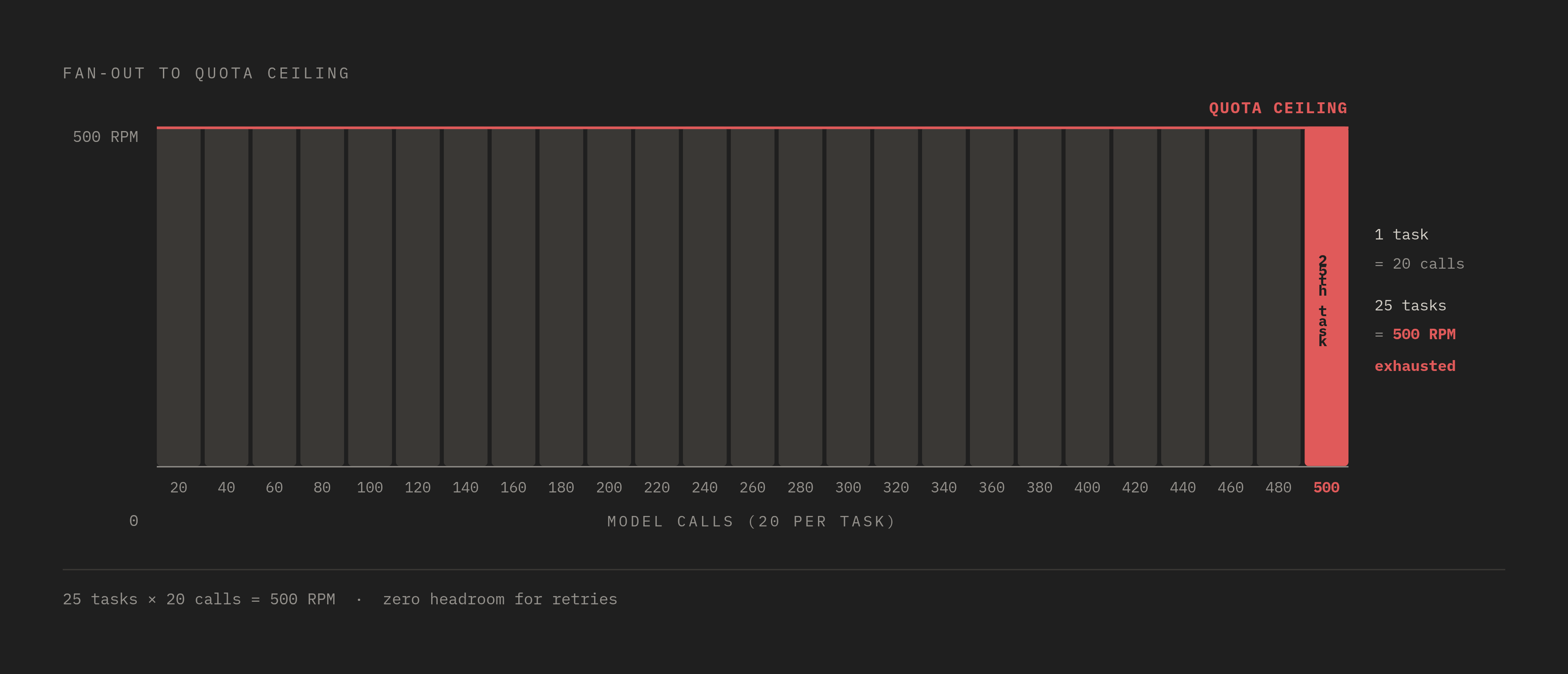
The arithmetic behind this is easy to run and hard to argue with. Say a provider grants 500 requests per minute, but a single agent task fans out to about 20 model calls. It takes only twenty-five concurrent tasks to consume the entire quota, and that's before you count a single retry. A team running what feels like a modest number of parallel agents can find itself pinned against a wall it didn't know was there.
Retrying after a failure makes the problem worse at the exact moment the system can least afford it. A naive retry doubles the load against a provider that is already shedding requests, turning a soft throttle into an outage the system inflicted on itself. When many workers hit the same wall at once and retry on the same schedule, they create a thundering herd that re-triggers the limit in lockstep. Jitter in retry timing is a requirement anywhere agents share a quota.
Serverless infrastructure compounds the problem in a way that catches teams off guard. On a platform like Cloud Run, a spike in traffic spins up new instances automatically, but the LLM provider's quota doesn't scale with container count. Autoscaling lets more concurrent agents launch against a ceiling that never moved, which makes the situation worse. The compute dashboard shows healthy, growing capacity, but the provider-side quota gets hammered out of view, so you don't see the failure until the incidents start arriving.
Provider quotas are rationed on purpose, and they're rationed across three dimensions at once: per-key limits on tokens per minute and requests per minute, model-specific quotas that tighten during peak hours, and region- or account-level throttles that can drop mid-incident with no warning. A token-heavy agent turn can hit all three simultaneously. The failure often looks sudden even when the underlying load was building for a while.
What the HiveMind experiment shows about uncoordinated parallel agents
A documented incident makes the structural argument concrete. In the HiveMind research (Agyemang et al.), 11 parallel coding agents shared a single rate-limited API endpoint, and 3 of them died from connection resets and HTTP 502 errors, a 27 percent failure rate. The aggregate API capacity was enough to serve all 11 agents if they had run sequentially. The failures had nothing to do with insufficient total capacity and everything to do with the absence of coordination among agents competing for it at the same moment.
The researchers describe the pattern as resource contention analogous to unscheduled operating system processes competing for CPU, memory, and I/O. The agents aren't literally OS processes, but the failure mode is the same class of problem. Running concurrent agents against a shared endpoint with no scheduler produces the same outcomes that running concurrent processes with no OS produces: thrashing, starvation, and deadlock.
That analogy does more than describe the failure. It points straight at the fix. Operating system design solved scheduling contention for shared resources decades ago, and the same primitives, admission control, priority queuing, backpressure, apply directly to agents competing for a provider's API. The engineering task is to bring scheduling discipline that already exists in distributed systems into the agent harness.
Misattribution across the agent stack
Rate limit failures are easy to misdiagnose because they rarely appear labeled as rate limit failures. They appear as a timeout, as a task that silently aborts, or as an agent whose output looks like a reasoning mistake. An engineer investigating the incident naturally starts by examining the agent's logic, because that's what the symptom points toward, and spends real time there before ever suspecting the provider.
Much of this gets lost at the SDK and framework layer. The major official SDKs from providers like Anthropic and OpenAI do surface a distinctly typed RateLimitError when a request gets throttled. But some application and agent frameworks built on top of those SDKs strip that status code out at step boundaries, so what reaches the application is a retry-exhausted failure with no rate-limit label at all, often indistinguishable from a generic timeout. The error class the application sees is not the error class the provider actually returned.
Multi-agent architectures make this worse because a single root-cause error propagates forward through every decision built on top of it. A downstream agent may just look like it's reasoning badly, when really it inherited corrupted or incomplete context from a capacity failure three hops upstream. Reviewed at the task level, these cascading failures look like a set of independent problems scattered across the run. To find the actual root cause, you need to trace the failure back through the span tree to where it originated, instead of treating each downstream symptom as its own bug.
You need to get this right before you attempt any repair, because different rejections call for different fixes. A request can be rejected before it ever reaches a model, even when the account still has credit available. Whether the rejection comes from a per-key cap, an in-flight budget limit, credit exhaustion, or a context-length overflow changes what the correct repair looks like, and conflating any of these with a generic "agent failed" erases the distinction.
The diagnostic requirement that follows from this is specific. Every span needs its error class logged explicitly, rate limit versus timeout versus tool error, not folded into one undifferentiated failure bucket. In-flight concurrency and rate-limit frequency need to be tracked as metrics in their own right, with alerts attached to them directly. If you wait on task-level failure rate alone, you wait on a signal that arrives too late and too aggregated to point at a cause.
The five harness-layer mechanisms that absorb rate limit pressure
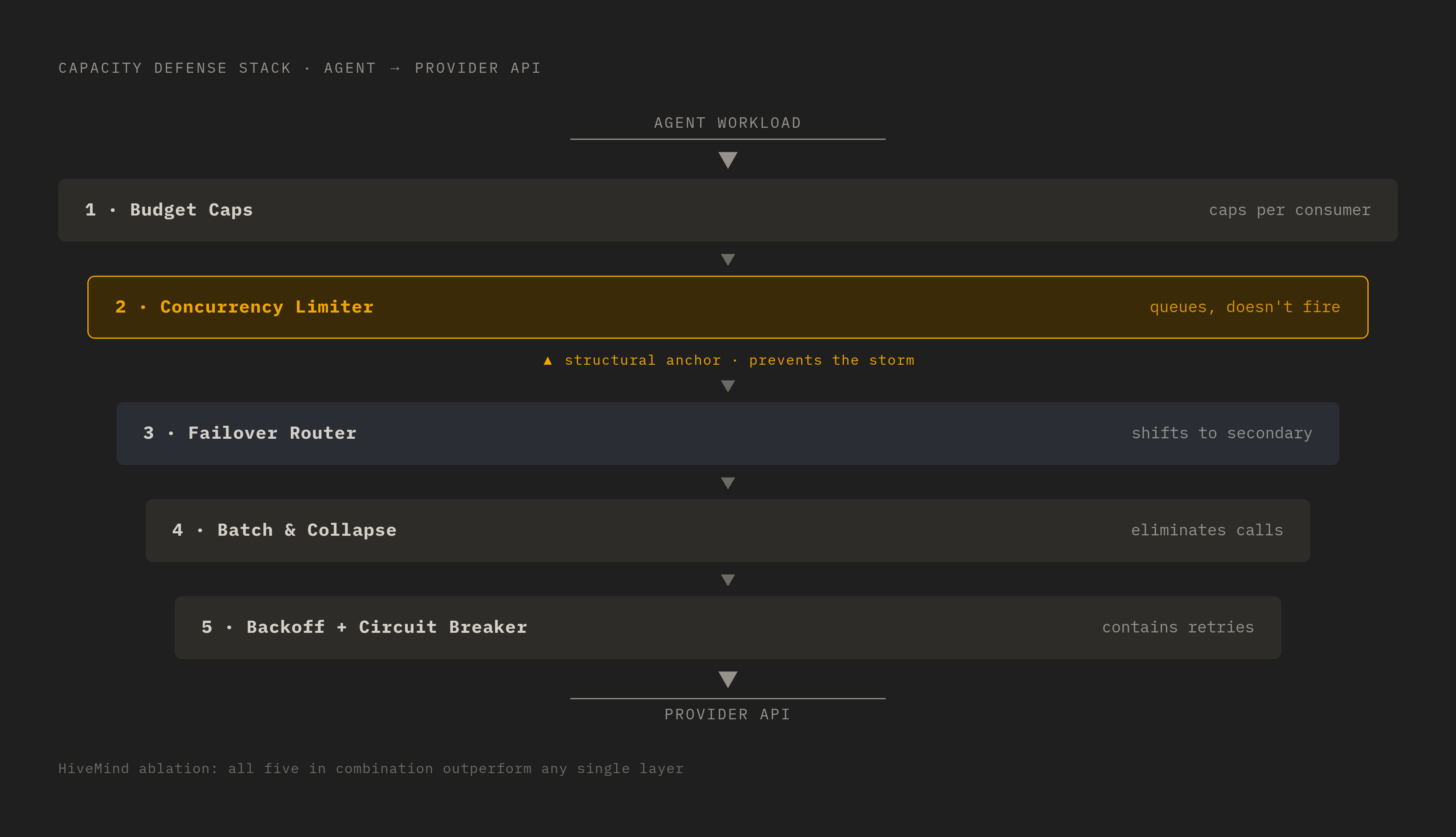
None of this gets fixed by a better model or a cleverer prompt. You fix it with a set of capacity-aware primitives at the harness layer, the same primitives distributed systems engineering has relied on for decades, now applied to agent workloads.
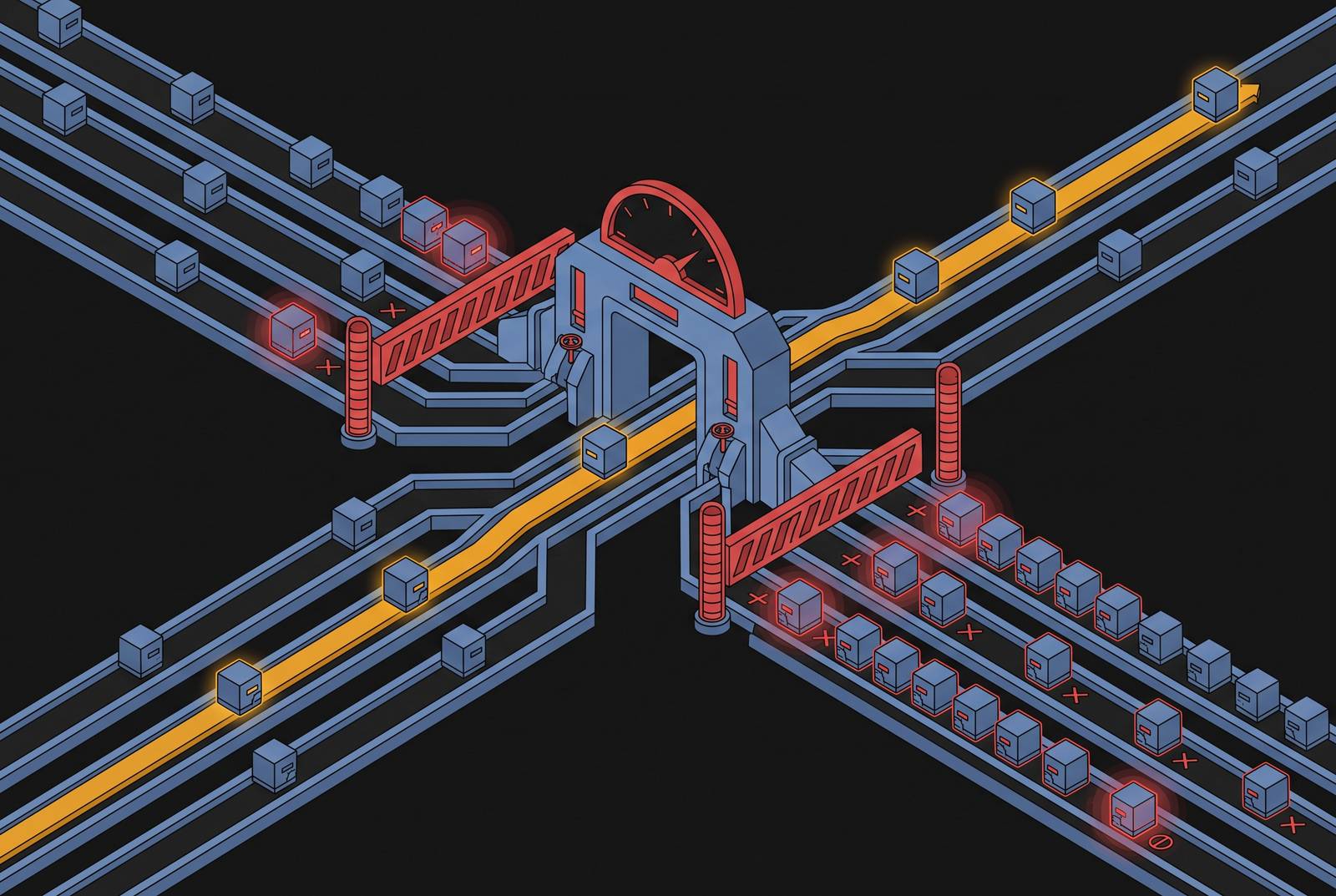
The first is budgeting and backpressure placed in front of every outbound model call. A concurrency limiter, whether a semaphore or a token bucket, keeps the application from ever exceeding the known provider quota. When the budget fills up, the correct response is to queue the request, not to fire it anyway and lean on a retry to clean up afterward. This single change prevents the storm instead of mopping up after it, which does more for reliability than any amount of retry tuning. In a multi-agent system sharing one quota, that limiter has to sit in a central place. A semaphore scoped to a single agent, with no visibility into what other agents are doing, still lets the combined total blow past the ceiling.
The second is backoff with jitter for the retries that do happen. Per-provider circuit breakers that open after a threshold of 429 responses, backoff that increases exponentially with randomized jitter, and a hard cap on retries per turn keep an agent from converting a provider's soft throttle into an outage of its own making. Most teams skip the circuit breaker on a first pass and build it only after their first real capacity incident. Without it, retry logic can turn a provider's soft throttle into a self-inflicted outage.
The third is cutting the number of raw calls in the first place, through batching and call collapsing. Batching tool-result summarization, collapsing planner calls that repeat work already done, and reusing cached classifications all reduce call count, and every call removed is one less unit of exposure to the rate limit. The cheapest fix available to a team is often the call it never needed to make. Many agent turns fire off several cheap model calls that could have been one, and the harness is the layer where that consolidation decision belongs.
The fourth is routing around a throttled provider. A router with provider failover turns a rate limit from a hard stop into a latency bump, by shifting the request to a secondary provider when the primary one is throttling. An AI gateway placed between the application and the providers can absorb this automatically, handling failover, load balancing across keys and providers, and quota enforcement in one place, with no change to the application code. Spreading requests across multiple API keys for the same provider helps, but only with per-key limits specifically. It redistributes load rather than creating new capacity, and that distinction matters: key spreading is a way to use allotted capacity well, not a way around the quota itself.
The fifth is budget caps set per agent and per tenant. Without one, a single runaway agent, or a single tenant on a shared account, can consume the organization's entire token-per-minute allocation and starve every other workload riding on the same key. Per-consumer limits that stop any one agent or tenant from eating the whole shared budget function as a governance control as much as a reliability one. They also stop a specific failure mode where two agents stuck in a clarification loop, with no cap on either one, consume tokens recursively without ever producing a useful result.
The HiveMind ablation study tested five scheduling primitives together: admission control, rate-limit tracking, AIMD backpressure paired with circuit breaking, token budget management, and priority queuing. Transparent retry came out as the single most critical primitive in isolation. But the study's broader finding is that all five work best as a combination, not as a menu where a team picks one and skips the rest.
What production traces must capture for capacity failures
If you can't see what's actually happening at the span level, you can't tune any of the five mechanisms above correctly. The true error class, the concurrency level at the moment of failure, and the full retry chain all appear together in the span tree. Capacity engineering done without that visibility is guesswork dressed up as tuning.
The baseline requirement is that every span logs its error class explicitly: rate limit, timeout, tool error, authentication failure. Each of these has a different cause and a different fix, and collapsing them into a single "agent failed" status destroys the information needed to tell them apart. A rate-limit failure traced back to its origin span, with the concurrency count at that moment and the retry attempts that followed, gives an engineer something to act on. A generic failure flag at the task level gives nothing but the fact that something, somewhere, went wrong.