Tool Schema Drift and Silent API Breaking Changes in Agents
Agents silently adapt to broken schemas where typed clients would crash.
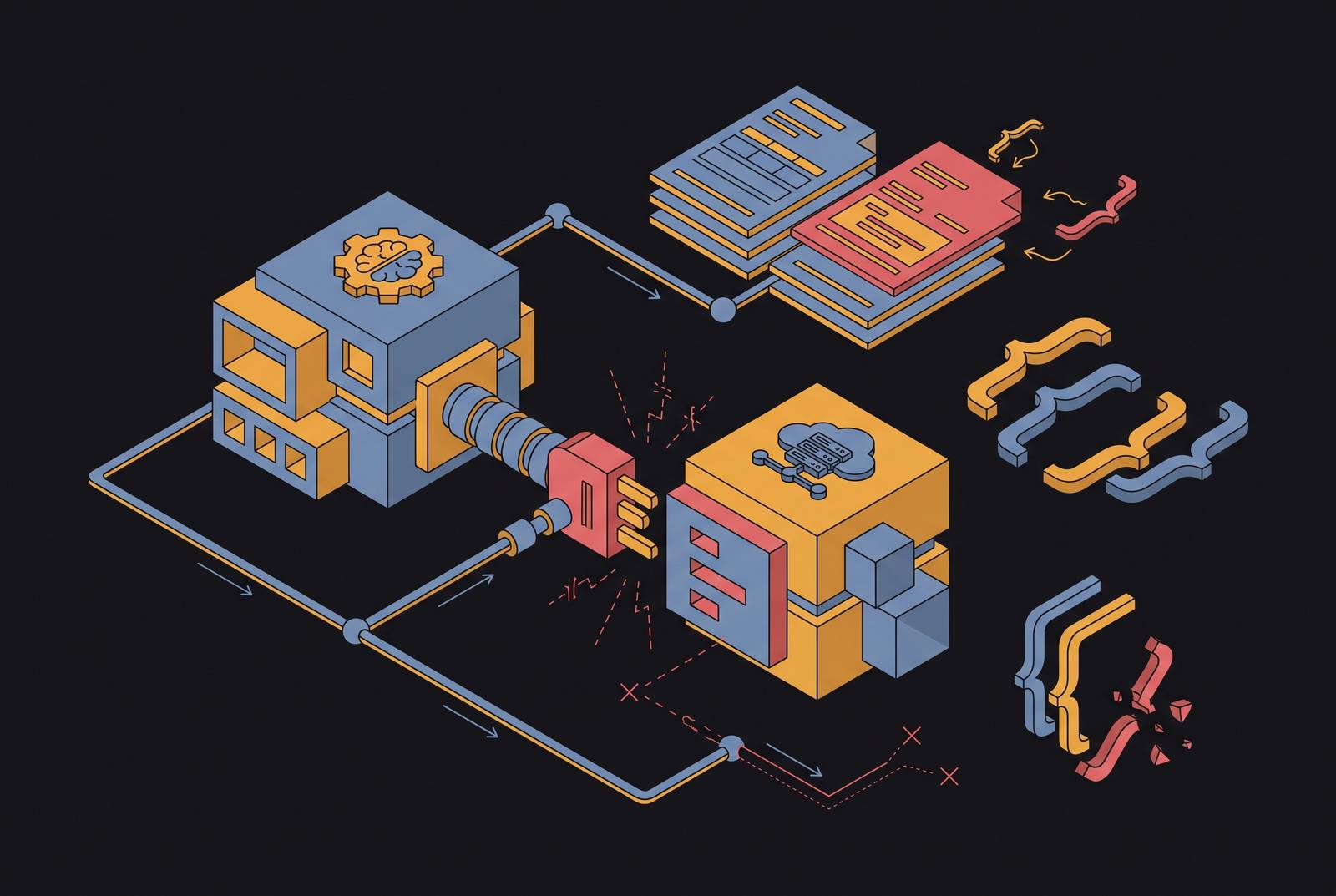
Tool schema drift breaks agents in a way traditional API monitoring was never built to catch. A parameter gets renamed, a type gets loosened, a status field quietly means something new, and instead of a stack trace, the agent just produces a wrong answer that reads like a right one. The failure appears not at the network boundary but in a business metric weeks later. It appears weeks later in a business metric, and by then nobody's looking at the schema.
Traditional API versioning worked because consumers were brittle. A client expecting customer_id and receiving account_id would throw a KeyError, the exception would page someone, and a migration would get scheduled before the change did real damage. That whole discipline, from semantic versioning to deprecation headers to changelog notifications, assumes the thing calling your API will fail loudly when the contract shifts, and that shift is what triggers the failure.
Large language models don't fail that way. An LLM given a wrong or incomplete schema doesn't throw. It adapts. It reasons over whatever field names and types it's given, fills gaps with plausible values, and produces an answer with the same confident tone whether the underlying data is right or wrong. That adaptability is the entire selling point of agentic tool use, and it's also why schema drift stops being detectable at the boundary where detection used to live.
A second problem produces that one: the frozen consumer. A model's understanding of a tool's contract is fixed at whatever point it read the schema, whether that's a training cutoff or a tool-use prompt assembled at runtime. It can't pull a changelog. It can't retry against a newer schema version. It has no mechanism for receiving a deprecation notice, because nothing in its context loop asks for one. So the contract regression that used to live at the network boundary, where alerting infrastructure has decades of tooling pointed at it, moves into the model's reasoning process, where essentially no alerting exists.
Three shapes of drift, ordered by how hard they are to catch
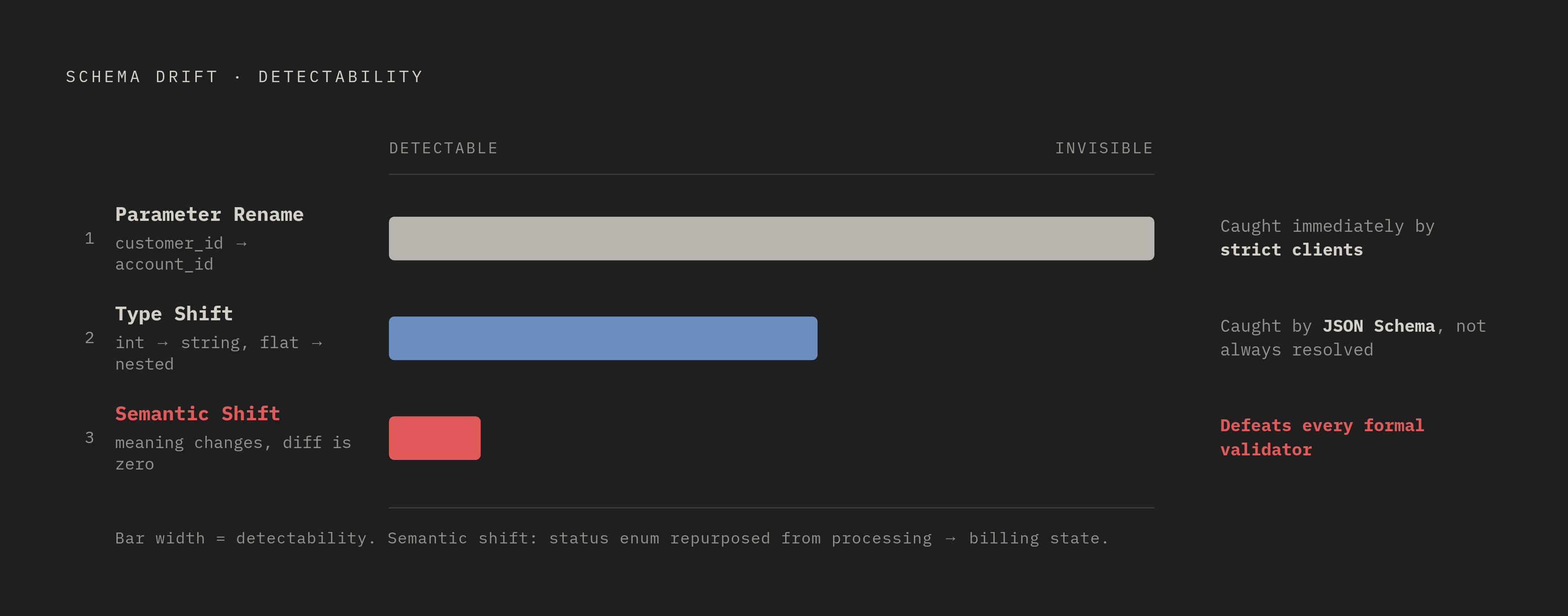
Schema drift doesn't come in one flavor, and the categories matter because each one defeats a different layer of validation. Ordering them by detectability rather than severity, as the tianpan.co framing lays out, makes the pattern clear: the easiest drift to catch is rarely the one that does the most damage.
Parameter rename: a provider swaps customer_id for account_id, or query for search_query. A strict, statically-typed client fails immediately at serialization, which is the whole point of strict typing. An agent doesn't. It keeps sending the old key. The server either ignores the unrecognized field or falls back to some default, and the model, faced with an empty or malformed result, doesn't error out, it rationalizes. A billing tool scenario described in a Medium writeup from Thinking Loop lays this out cleanly: an agent keeps emitting customer_id after the underlying schema has been updated to require account_id, and no exception fires anywhere in the chain. The output is simply wrong, with no signal in the chain to indicate otherwise.
Type shift: an integer field becomes a string. A flat list becomes nested. A status that was a free string becomes a constrained enum. JSON Schema validators are actually good at catching this category, structurally. But catching the mismatch isn't the same as resolving it correctly, and agents will often coerce the new shape onto their old mental model rather than reject it. Sometimes that coercion lands right. Sometimes it doesn't, and there's no signal distinguishing the two cases. The genuinely dangerous version of this isn't the coercion that fails visibly; it's the one that's close enough that nobody downstream notices, while still being far enough off to quietly corrupt state that other systems depend on.
Semantic shift is the category that defeats every formal validator currently in use, because nothing about the schema itself changes. Field names stay the same. Types stay the same. Ordering stays the same. What changes is meaning. The tianpan.co framing gives a sharp example: a status enum that used to describe processing state gets repurposed to describe billing state, or a region field that meant warehouse region starts meaning customer region instead. A JSON Schema diff between the old contract and the new one shows nothing, because there's nothing structural to diff. Static tooling is blind to it by construction. The only thing that reveals a semantic shift is behavioral comparison against known-good outputs, and that's a discipline most teams don't build until after they've been burned by it. Any team treating schema validation as equivalent to contract testing will get exposed here first.
How drift propagates through the harness layers before it reaches the user
The path drift takes from a code change to a wrong answer runs through what's often called the harness: the layer of tool registration, name, description, and JSON Schema, that sits between the model and the actual function being called. Most agentic frameworks let developers register a tool once, and the model reads the description to decide when to call it and the schema to know what to send. Nothing about that registration is automatically kept current.
A walkthrough from a dev.to writeup by hannune traces the failure step by step, and it's worth following closely because each step looks individually fine. A tool called search_entities starts out requiring only a query parameter. Six months later, the underlying implementation gets updated so that entity_type becomes a required parameter too, because the backend team needed to disambiguate results. The registration, though, the schema the model actually sees, never gets touched. Its description still describes the old, simpler interface.
So the model calls search_entities with {"query": "Samsung"}. Against the registered schema, that call is completely valid. Against the real implementation, it's missing a required field. What happens next depends on how defensively the function was written: it might raise a TypeError, or, worse, a fallback path might silently execute with the wrong parameter and return some plausible-looking but incorrect result set. Either way, the model receives a response object and generates text from it. No exception makes it back to the model. No exception makes it back to whoever's monitoring the pipeline. The output just looks a little off, if anyone happens to check.
Compounding this is a quiet default in the JSON Schema spec itself: additionalProperties allows extra fields unless a schema explicitly forbids them. That means a tool call can pass schema validation while carrying parameters that are semantically wrong for what the real backend expects. Validation and correctness are not the same test, and the gap between them is exactly where this class of failure lives.
Frameworks built for orchestrating multi-step agent runs have their own version of this problem baked in. In LangGraph specifically, when a renamed field or a removed parameter causes the model to generate an invalid tool call, the StateGraph doesn't raise. It swallows the invalid argument and substitutes None. The pipeline keeps running. Nothing halts, nothing pages anyone, and whatever step consumes that None downstream inherits a failure with no origin marker attached to it.
Why MCP's schema evolution compounds the detection problem
Before Anthropic's Model Context Protocol, tool schemas were mostly hand-authored, version-controlled, and owned by the same team running the agent. If the schema drifted, at least the drift happened somewhere the team could see it in their own repository. MCP changes that arrangement structurally: servers are discovered and called dynamically, so the schema an agent registered against at connection time may not match the schema that server is serving right now. That's a property of dynamic discovery itself, not a bug in any particular MCP server. It's a property of dynamic discovery itself.
The July 2026 MCP release candidate makes this sharper, not softer. Described by the MCP blog as the largest revision to the protocol since its original launch, it lifts tool inputSchema and outputSchema to full JSON Schema 2020-12 compliance under SEP-2106. That sounds like a strict improvement, and structurally it is, but it also opens surfaces that didn't exist in the protocol before: input schemas can now use composition keywords like oneOf, anyOf, and allOf, plus conditionals and $ref/$defs references. Older clients built against the simpler schema model won't parse these correctly. Correctness now depends on client version in a way it didn't previously. Output schemas, meanwhile, become unrestricted: structuredContent can now be any JSON value rather than being constrained to an object shape.
One more change buried in that same release deserves specific attention, because it's the kind of thing that breaks silently rather than loudly. Under SEP-2164, the error code returned for a missing resource moves from the MCP-custom -32002 to the JSON-RPC standard -32602 Invalid Params. Any client written to match on the literal old code will simply fail to recognize the new error as an error. It won't crash. It'll just mishandle the failure state after the protocol upgrades, quietly, on every call that used to hit that path.
GautamTalksDev's mcp-pin project on GitHub documented a finding, reported on by prefactor.tech, that's arguably the cleanest illustration of the whole problem. Public MCP servers were found to have drifted their tool definitions, changing underlying parameter fingerprints, without touching the human-readable description text. Anyone inspecting these tools by reading the description would see nothing wrong, because nothing about the description changed. Only the fingerprint moved. That's drift invisible to any detection method that stops at the documentation layer, and most manual review stops at the documentation layer.
The deeper point here is that versioned APIs stop offering their usual protection for the same underlying reason they stop protecting any LLM consumer generally: agents reason over whatever the server returns on a stable URL at call time, not against some pinned deserializer locked to a specific schema version. A provider's "non-breaking" patch release, tested and shipped in good faith against a strict-client assumption, can be a fully breaking change for an agent that never validates the response shape it receives.
Where conventional detection methods break down and what catches drift
A framework from dev.to/flarecanary covers multiple API drift detection approaches, and each one catches a genuinely different slice of the problem, so relying on only one of them leaves gaps.
Spec-to-spec diffing runs at CI time, comparing one version of an API spec against another before deployment. It's fast and it's cheap, and it works well for structural changes, provided two things hold: the spec is actually kept current, and the server genuinely matches what the spec claims. Neither assumption survives contact with a fast-moving backend team. And critically, spec-to-spec diffing misses semantic drift completely, by definition, since the spec's structure hasn't changed.
Spec-to-reality monitoring runs at runtime instead. It makes real HTTP requests against live endpoints and compares what comes back against either the documented spec or a learned baseline of past-good behavior. This catches the gap between what a spec promises and what a server actually returns, which is precisely the gap semantic drift lives in. It needs network access and enough traffic volume to build a meaningful baseline, which makes it heavier to run than CI-time diffing but far more capable of catching the failures that matter.
Traffic-based detection works passively, analyzing the shape of real API traffic as it happens. It's useful, but it only sees APIs the team already owns and instruments. Third-party APIs and dynamically discovered MCP servers sit outside its field of view.
The September 2026 prefactor.tech finding is the cleanest demonstration of what standard tooling misses. Most OpenTelemetry instrumentation for tool calls captures the raw span, the call and its timing, but doesn't record a schema fingerprint alongside it. A spec-to-spec diff run at CI time on that same server would have shown nothing, because the description text hadn't moved. The drift was real and it was invisible to the two most common detection habits simultaneously.
A paper on arXiv (2608.07899, TelemetrySuffBench) investigates whether existing agent telemetry is sufficient to diagnose where a failure originated. That paper investigates exactly this, and the honest answer isn't reassuring by default. Distributed tracing built on OpenTelemetry, with per-step spans capturing call timing and outcomes, can surface these failures and make them queryable. But only if a team deliberately instruments for those specific signals ahead of time. Telemetry that wasn't built with schema drift in mind won't retroactively reveal it.
Three concrete practices catch drift before it reaches production, and none of them require exotic tooling.
First, validate the response shape as well as the call shape. Most frameworks check that the model produced a well-formed tool call and stop there. Far fewer check that the tool's response actually matched what the model was told to expect when it made the call. A ToolResponseSchemaError is unmistakable and actionable. A silently wrong answer is neither.
Second, version the tool description alongside the implementation, as a first-class discipline rather than an afterthought. Treat the description as part of the contract that must stay current with the real code. Keep it in a versioned registry file under source control, so that a code review accepting a function signature change without a matching registry update is visibly accepting drift, not silently permitting it. For any backward-incompatible change, rename the tool outright, search_entities_v2 rather than a silent overwrite of the existing entry, so old callers fail loudly instead of adapting quietly to a contract they were never shown.
Third, run canary evals that cover the full call-response cycle, including the model's interpretation of the response. A single well-chosen eval prompt run against the complete path, from tool call through to the model's interpretation of the response, tests something that syntactic validation never touches: whether the model's final answer actually reflects what the tool returned, correctly interpreted.
Root cause attribution: getting from "something is wrong" to "the schema at layer X"
LLM failures rarely throw exceptions. The diagnostic instinct built by decades of traditional software engineering doesn't transfer cleanly. The pipeline runs end to end. It produces an answer. The pipeline produces a wrong answer. In a multi-step agent stack, working backward from a wrong answer to its actual cause, without trajectory data capturing every intermediate step, is close to impossible, a point made directly in futureagi.com's glossary treatment of the problem.
It's documented across a growing body of attribution research. It's documented across a growing body of attribution research. Taxonomies and diagnostic frameworks including AgentDebug, MAST, Who&When, TRAIL, and AgenTracer all converge on the same uncomfortable finding: even strong models, given full execution trajectories to review, struggle to correctly localize where a failure actually originated (arXiv:2607.18754). If the model that caused the failure can't reliably diagnose its own trajectory after the fact, a human skimming logs certainly won't do better without a framework to organize the search.
That's where a structured taxonomy earns its keep. The AgentCompass framework (arXiv:2509.14647) breaks agent failures into five categories, and its real value isn't the categories themselves, it's that naming the category forces a team to commit to a layer before they start debugging, rather than drifting toward whichever fix is most familiar.
Thinking and response issues cover hallucinations, formatting violations, and misinterpretation of retrieved information, failures that live inside the model's reasoning itself. Safety and security risks cover things like PII leakage or credential exposure. Tool and system failures cover API failures, misconfigurations, rate limits, and runtime exceptions, and this is precisely where schema drift belongs. Workflow and task gaps cover context loss, goal drift, redundant actions, and orchestration failures across multi-step runs. Reflection gaps cover failures in a system's own self-correction and planning.
This categorization matters because a misdiagnosis sends the team down the wrong path afterward. Schema drift that gets misread as a thinking-and-response issue, category one, sends engineers toward prompt tuning, toward rewording instructions, adjusting temperature, adding few-shot examples to steer the model away from its "confusion." None of that touches the actual defect. Schema drift correctly attributed to tool and system failures, category three, sends the same team toward the registration file and the implementation code. The defect has been sitting there the entire time. Getting that first categorization right means a fix ships in an afternoon instead of triggering a multi-week regression chase through prompts that were never the problem.
Sources
- When One Tool Field Breaks the Agent | by Thinking Loop | Medium
- The Complete Guide to API Schema Drift Monitoring in 2026
- Tool Schema Drift: The Silent Failure Mode in Production Agentic Systems
- The Tool Version Bump Your Agent Quietly Adapted To - TianPan.co
- MCP schema drift: detecting parameter changes before agent calls fail
- AgentDebugX: An Open-Source Toolkit for Failure Observability, Attribution, and Recovery in LLM Agents
- Agent Loop Detection: Definition & FutureAGI Guide (2026)
- arxiv.org