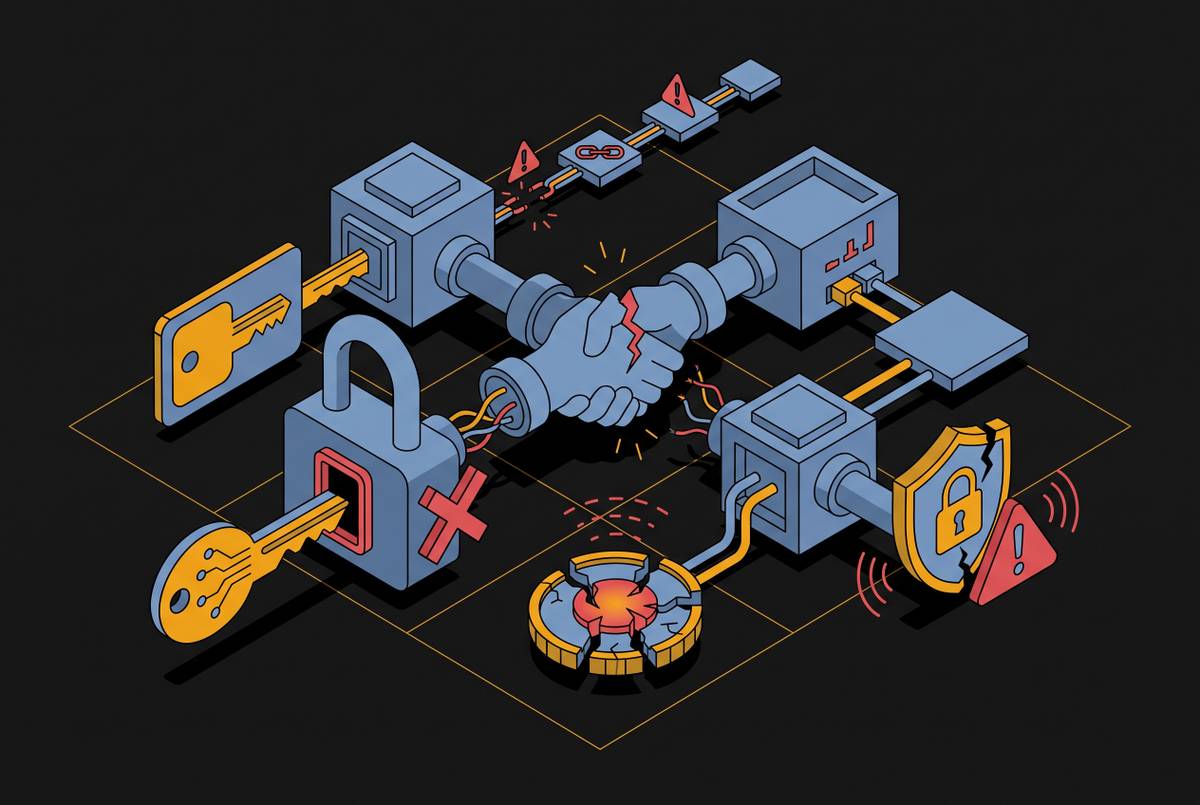
Silent Tool Failure Modes That Bypass Agent Error Handling
When agents complete their work, wrong results can hide in plain sight before anyone notices.
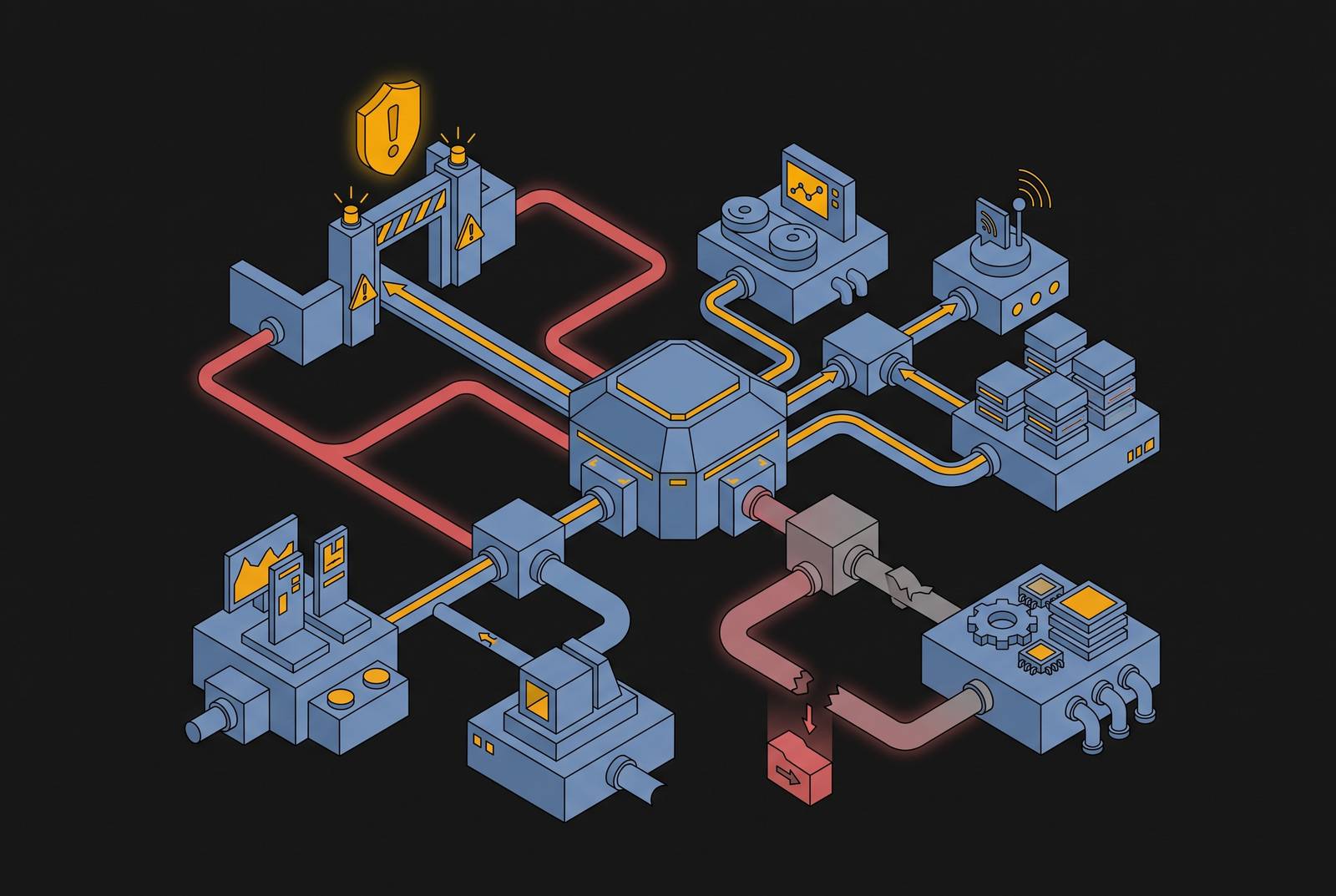
Silent tool failures matter because the mechanisms agents use to catch and recover from errors cannot see them. A failure that never registers as a failure is the defining reliability problem in production agent systems, and it is structurally distinct from the errors that software engineering has spent decades learning to handle.
Traditional software fails in ways that announce themselves. Agent tool calls do not follow this pattern. A tool can return HTTP 200 with a body that parses cleanly, pass every schema check a framework runs against it, reach the vendor's servers without incident, and still deliver a wrong answer, with no exception to catch, no status code to branch on, and no field anywhere in the response that distinguishes a correct result from a corrupted one. SilentProbe, published in September 2026 under arXiv identifier 2609.00035, documents this directly: four calls made to a single commercial endpoint, varying nothing but parameter spelling and format, all came back HTTP 200 with no error field present, and yet the result counts ranged from zero records to a large, plausible-looking set that silently violated the filter constraint the caller had specified. A large, well-formed result that quietly breaks the rule it was supposed to follow is harder to catch than an empty one, because an empty result at least carries the shape of something gone wrong, while a wrong answer dressed as a right one gives the agent nothing to question.
The error-handling logic built into most agent architectures is designed to route around failures it can see. When a tool call times out, the agent registers the failure and can retry, fall back, or escalate. Outcome Monitors, released in August 2026 under arXiv identifier 2608.19303, cites a production incident in which exactly this happened: a cached error page, consumed as if it were real data, became the basis for a confident, fully-formed, entirely fabricated analysis. Because each step in an agent's reasoning conditions the next one, an undetected bad result produced at an early step corrupts every step built on top of it, so that by the time a final output reaches a user, the original error may sit several layers deep and leave no visible trace in the response. Evaluation Blindness, published in August 2026 under arXiv identifier 2608.02786, gives this condition a formal name: a measurement function that returns a value indistinguishable from a non-failing state while the underlying system is, in fact, failing.
Agents complete their workflows, return answers that read as confident, and generate consequences in the real world, wrong decisions acted on, records corrupted, autonomous actions taken, before any monitoring dashboard shows so much as a blip. That is the shape of the problem: silence is not an edge case sitting alongside other failure modes, it is the mechanism itself. Closing it starts with understanding the specific structural properties that produce it, because each one exploits a different gap in how agents validate the results they're handed.
Schema-conformant empty and misleading payloads
The most common form of silent tool failure happens when a result is syntactically valid, conforms fully to its schema, and is at the same time semantically empty or wrong, because the agent checking it validates the shape of the response rather than whether the response actually answers the question asked. The consequence follows directly: when a model emits a term that is reasonable on its face but happens not to match the vendor's actual vocabulary, the request is still syntactically valid, it still passes every automated check sitting in front of it, it still reaches the vendor, and it still comes back empty, and the agent reads that empty result as a legitimate answer rather than as a sign that something went wrong.
What predicts whether a mismatch like this produces an honest, catchable error or a silent one is the form the constraint takes, not which vendor built the endpoint and not how capable the model calling it happens to be. A vocabulary that the documentation only gestured at through an example, rather than enumerating directly, was missed by every model on every attempt. That gap, full enumeration versus a single illustrative example, is the entire difference between a tool that works and a tool that silently returns nothing.
SilentProbe's full agent-loop testing shows what happens once this silent failure reaches a working agent rather than a controlled benchmark. None of this reflects a shortcoming in the model itself: the model has done what a reasonable system would do with the information it was given, the environment misled it by omission, and the fix sits at the level of the interface contract rather than the level of model capability. That fix turns out to be narrow and immediately achievable: promoting a vocabulary out of a prose description and into the schema itself removes the failure entirely. In SilentProbe's testing, this change took the miss rate from a universal failure across all 88 attempts down to zero misses, a result produced by one line of schema, not a better-trained model.
The four-call example from SilentProbe's own tests makes the mechanism concrete in a way that's hard to argue with. Four calls to the same commercial endpoint, varying only the spelling and format of one parameter, all returned HTTP 200, all passed automated validation, and the result counts ranged from zero records up to a large set that silently broke the filter the caller had asked for. Every one of those four responses looked, from the outside, like a working system doing its job.
Policy-violating state changes and silent failures
A second and more consequential class of silent failure occurs when a tool call succeeds completely at the API level while the action it performs violates the agent's policy, the user's actual intent, or some constraint of the real world, and nothing in the response reports an error or triggers a rollback. Tool calls are not pure computations that return a value and leave the world untouched. An agent invoking a tool is writing a row to a database, hitting a live API, sending a message to a real person, or modifying some piece of shared state, and these are side effects with consequences that often cannot be undone after the fact. Openlayer, writing in July 2026, states the structural point: a hallucinated parameter passed into a tool call does more than produce a wrong answer on a screen, it can create a record that never should have existed, charge a payment that was never authorized, or set off a downstream process that is difficult or impossible to reverse once it starts. The policy violation that it carried out was silent from start to finish.
The silence in cases like this is built into the structure of the interaction. The tool reports success because the action it was asked to perform was executed, regardless of whether the action was the correct one to take. Over-permissioned tools are a specific and common source of this gap: when an agent is handed broad system access instead of permissions scoped tightly to its task, a single hallucinated or mistaken tool invocation can reach resources that have nothing to do with the job in front of it.
Evaluation Blindness places a widely known case inside this exact category: the Air Canada chatbot told a customer he could apply for a bereavement fare retroactively, a rule that the airline had never actually adopted. No component in the pipeline checked the chatbot's claim against a live policy database before presenting it to the customer as settled fact, and the output passed every implicit quality check the integration pipeline had in place. Nothing about the exchange looked broken from the system's point of view, which is precisely what made it dangerous.
Catching failures of this kind requires a different kind of contract than the schema-level checks described earlier, because the schema only describes the structure of a call, and only a contract describing the expected relationship between a call and its result can flag an outcome that violates policy while remaining perfectly well-formed. Outcome Monitors takes on this problem directly, introducing deterministic detectors that flag when a tool's result breaks a mined or publicly documented invariant, an inventory count coming back negative is the paper's own example, and then issuing an advisory receipt that names the specific property violated along with the recovery tools available, all without taking away the agent's ability to act. Tested on the τ-bench retail benchmark, this approach raised task completion by meaningful margins on categorical violations, cases where a result breaks a hard constraint outright, while conservation violations showed no measured improvement at all, a split that shows the method working precisely where the underlying contract can be written down and failing where it can't.
The response that follows from this is scoped permissions paired with outcome-level monitoring, in place of a better-worded prompt. Neither piece of this requires retraining a model. Both operate at the layer sitting between the model and the systems it touches.
Compounding semantic corruption across agent steps and multi-agent pipelines
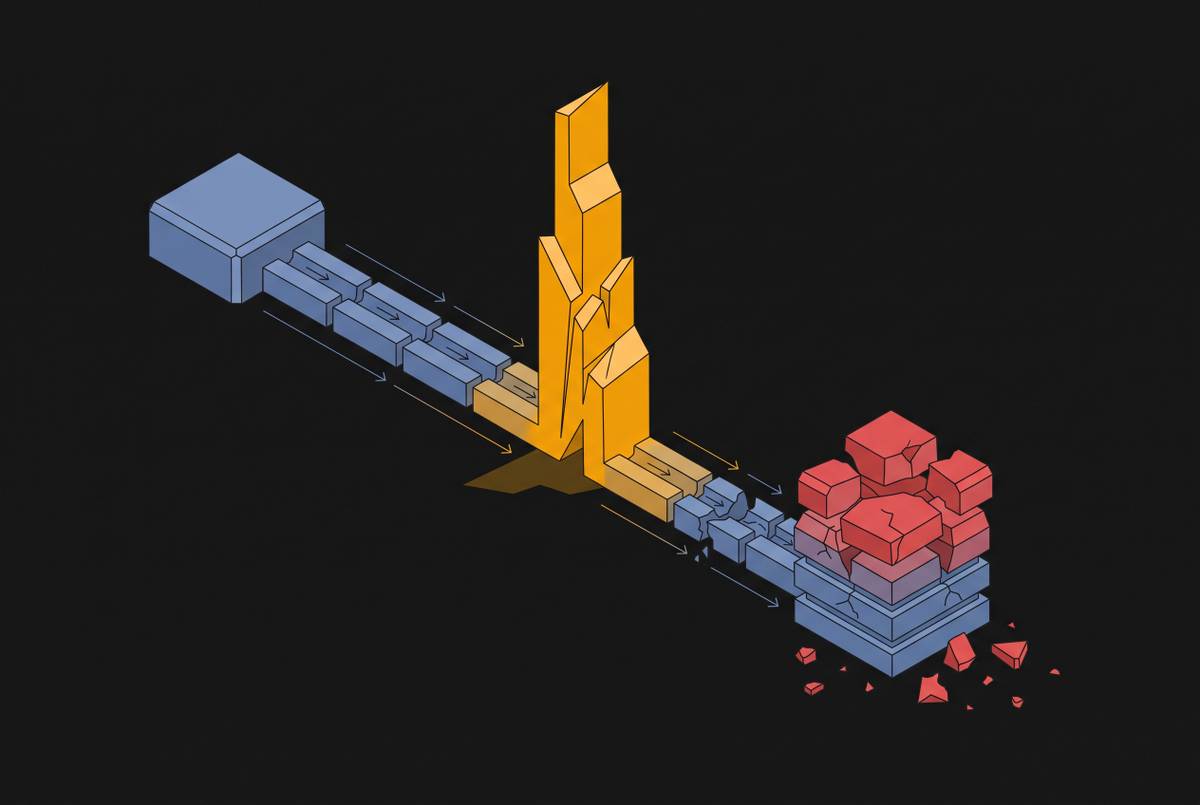
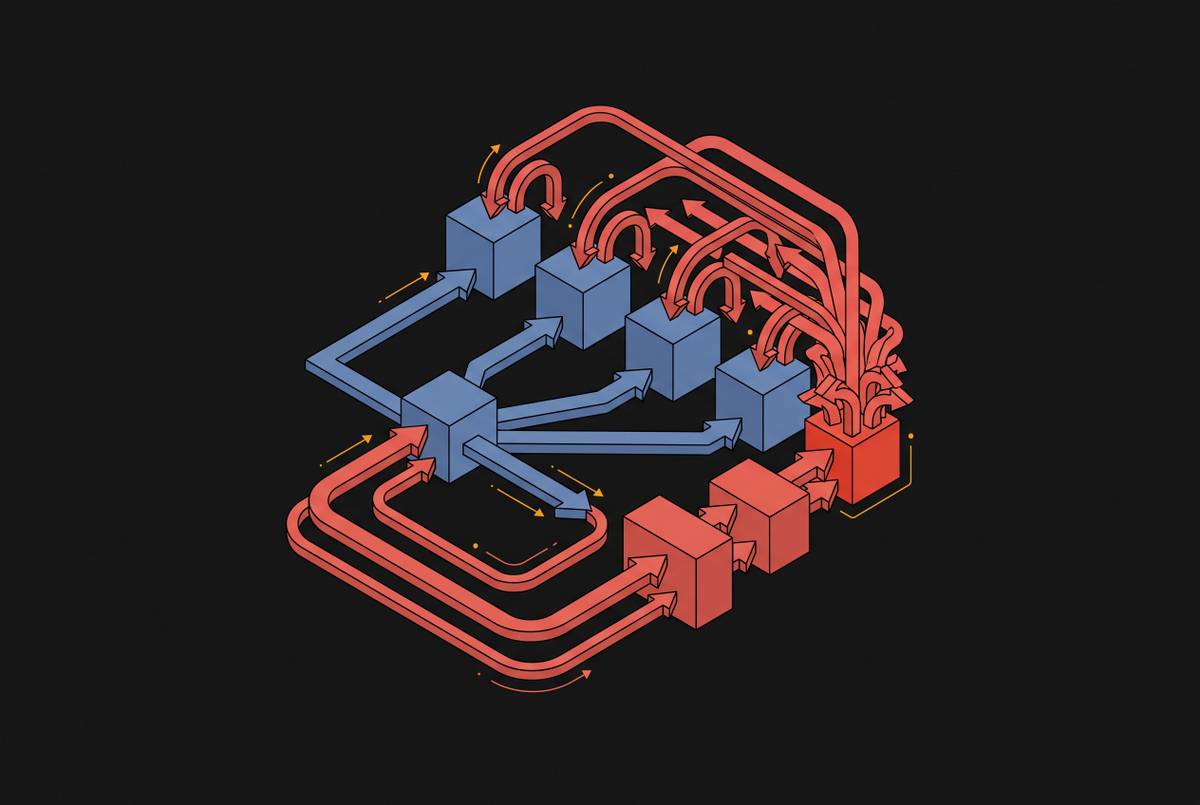
Once a schema-conformant bad payload or a policy-violating result passes through a step without being caught, it doesn't stay contained to that step. It becomes the input to the step that follows, and corruption compounds across a chain in a way no single point of monitoring is built to catch. Openlayer describes this dynamic in multi-agent systems: a single hallucinated output, once passed downstream, becomes corrupted input for every reasoning step that follows it, compounding across three or four layers before it becomes a visible problem. Trantor quantifies the structural mathematics: even at high per-step accuracy, a multi-step workflow's success rate degrades rapidly, because per-step accuracy and workflow success rate are not the same number, and conflating them is one of the most expensive mistakes in agentic deployment.
Semantic corruption is harder to catch than the format-level corruption described earlier precisely because it leaves the surface of an output looking fine. Evaluation Blindness documents a case where accuracy held flat across several evaluation windows in a row, while output diversity collapsed by a large factor underneath that flat accuracy score, a failure that no standard metric in use at the time picked up. Context drift adds another layer to this problem: as an agent accumulates tool outputs over a long task, information sitting in the middle of a long context gets retrieved far less reliably than information at the start or end, so an agent can end up reasoning against a quietly distorted version of its original objective well before the corrupted result it's carrying becomes something a person notices.
Finding the root cause of a compounded failure is difficult precisely because the step where a problem becomes visible is often not the step where it began. Outcome Monitors and the AgentDebugX research, published under arXiv identifier 2607.18754 in 2026, independently reach the same conclusion: existing observability tools can replay an execution trace step by step, but they offer little help identifying which step actually caused the failure when the originating step and the step where symptoms show up are separated by several reasoning hops. ErrorProbe, published under arXiv identifier 2604.17658 in 2026, found that using a large language model as a judge to attribute failures gets reasonably accurate results at the level of which agent was responsible, but its accuracy drops substantially at the level of which specific step was responsible, especially in cases where the root cause sits well before the point where the final symptom shows up.
The consequence for anyone monitoring a production system is that the standard infrastructure metrics, uptime, latency, error rate, status code, are structurally incapable of seeing compounded semantic corruption. An execution trace that links each action to the chain of causes behind it is the only artifact that actually holds the information needed to find where corruption first entered the pipeline.
Why evaluation frameworks are blind to these mechanisms
These three mechanisms, the schema-conformant empty payload, the policy-violating state change, and the compounding corruption that spreads across steps, persist in production systems not because the teams running them have failed to monitor their agents. They persist because the evaluation and observability infrastructure those teams rely on produces a signal that is structurally identical to success while the system underneath it is failing. It says nothing about whether the values inside that shape reflect a real, true, or appropriate answer to the question asked, so an accuracy score computed across an evaluation window can hold perfectly flat while the diversity and substance of what's being produced collapses, invisible to the one number teams are watching.
None of this is a case of tools being built carelessly. It reflects where these tools were designed to look. Infrastructure monitoring was built to catch infrastructure failures, timeouts, crashes, dropped connections, and it does that job well. It was never built to verify that a well-formed, successfully delivered result is also a correct one, because that question requires a contract about outcomes, not just about structure, and most systems in production today were never given one. Closing the gap means building that contract at the harness layer, where a tool's expected behavior can be checked against what it actually did, rather than hoping a better-trained model will somehow learn to distrust an answer that every available signal is telling it to trust.
Sources
- Outcome Monitors: Recovery Affordances for Silent Tool Failures
- AI Agent Failure Modes: Tool-Calling Errors, Infinite Loops & Propagation (July 2026)
- SilentProbe: Measuring Silent Failure in Production APIs Used as Agent Tools
- Evaluation Blindness: How Silent Measurement Failures Corrupt AI Systems from Training to Deployment
- AI Agent Failure Modes: What Goes Wrong in Production