Prompt Regression Detection in Agent CI/CD Pipelines
How to catch silent failures when AI agents change their prompts.
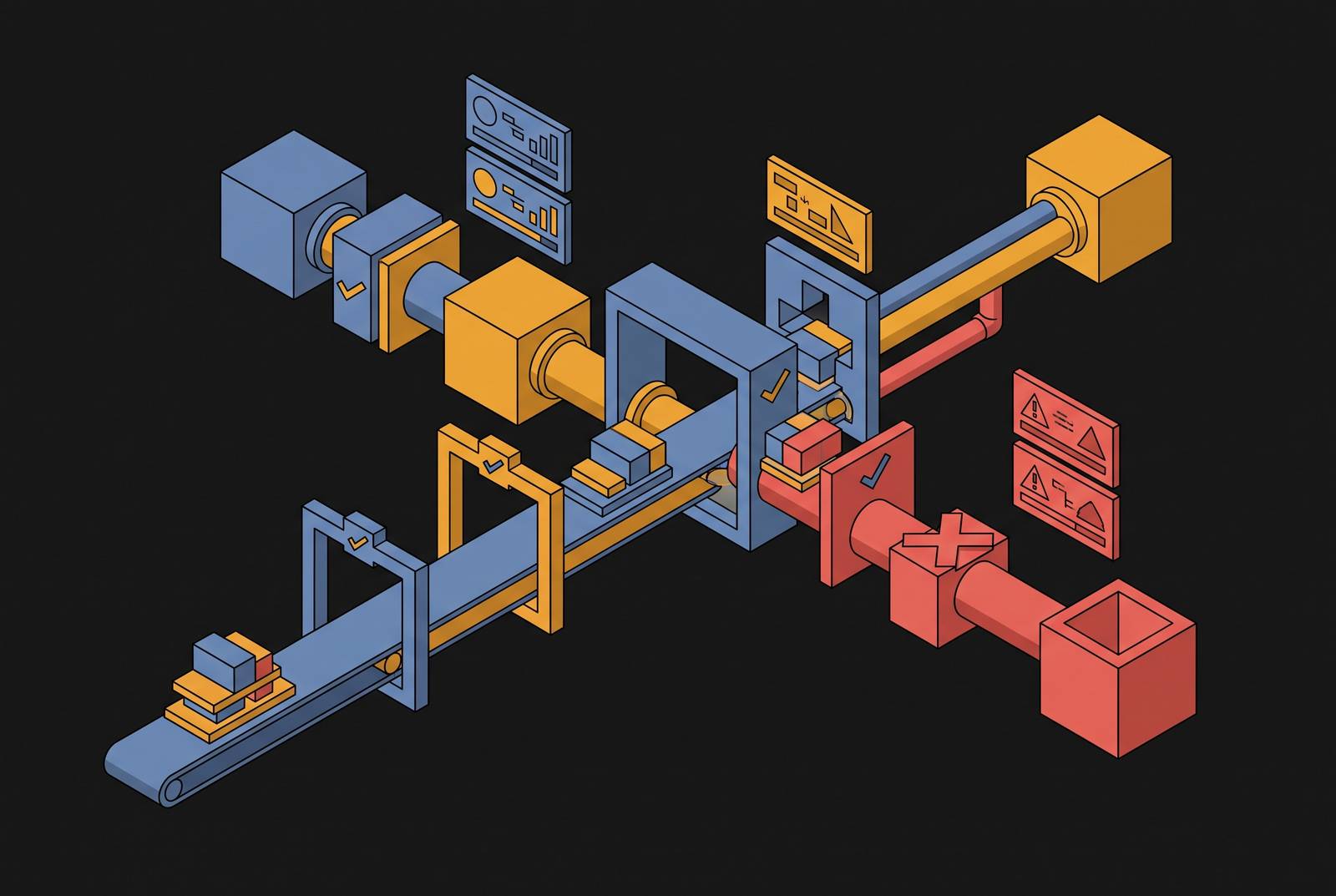
An engineer notices a chatbot giving a wrong answer to a specific customer question, opens a hosted console, and rewrites a line in the system prompt to fix it. No pull request gets filed. No test suite runs. The fix ships the moment the engineer hits save, and it quietly breaks three other behaviors that were working fine an hour earlier. Nobody finds out until a different customer complains about a different problem, and by then the connection between the edit and the new failure is already lost.
That pattern repeats across nearly every team running agents in production, and it persists because prompts get treated as configuration rather than what they actually are: application logic. A system prompt determines what a model does on every request in the same way a function body determines what code does on every call. A one-line change to that prompt can shift downstream behavior more severely than a one-line change to a function, yet the code change runs through linting, unit tests, integration tests, and review, while the prompt change runs through none of it. The build stays green, the regression ships silently, and the first signal anyone gets is a user complaint. This is a structural gap, not a discipline failure: prompts typically live outside the code repository entirely, so the pipeline has no way to see them, let alone test them. Closing that gap starts with a simple shift in how a prompt version is treated: as a build artifact that has to earn its way into production, exactly the way a compiled binary does.
What makes prompt regressions hard to catch without instrumentation
Catching a prompt regression is harder than catching a code regression because agent behavior is probabilistic and spread across multiple interacting layers, and a change that looks fine in a quick manual check can still be quietly wrong across the input space the engineer didn't try. LLM outputs vary from call to call even on identical input, because sampling introduces randomness into the exact wording of a response even when the underlying meaning holds steady. That alone rules out the assertion-equals testing that works for deterministic code: there's no single correct string to check against.
Manual review doesn't close the gap either. An engineer testing a prompt change by hand will try the cases already in mind, not the edge cases sitting in the long tail of real traffic, and a handful of spot checks can't establish whether the new version is better or worse than what's currently live. Running conventional unit tests alone compounds the blind spot, because unit tests check whether code executes correctly, not whether a model chose the right tool, stayed grounded in its context, or hallucinated a plausible-sounding answer.
The failures worth worrying about in agent systems rarely look like errors, since a system can misbehave without ever tripping an error handler. A request can return a successful HTTP response full of fabricated content, a tool call can carry malformed arguments the model never flagged as wrong, and an agent can get stuck retrying the same broken step dozens of times before giving up, all without tripping a single error handler. None of that appears in a status code. All of it appears in a support ticket.
The scale of the risk isn't hypothetical. Researchers at Stanford and Berkeley documented that GPT-4's behavior measurably changed between March and June 2023, with performance on tasks including code generation and math dropping significantly between versions. If a model can drift that much while its public label stays fixed, a prompt sitting in a console with no version history at all can drift just as far, with far less visibility. An engineer fixing one edge case with a targeted prompt tweak can just as easily break several other behaviors that were never touched directly, because the combinatorial space of inputs a prompt governs is far too large for any single person to hold in their head during a spot check.
Three failure categories recur often enough to anchor what any regression gate has to be built to catch. Tool schema drift happens when a downstream API changes its schema without a matching update to the agent's tool description, so the model keeps generating arguments that no longer validate, and the errors stay silent because nothing in the pipeline is watching for them. Prompt ambiguity introduces a single wrong judgment early in a multi-step reasoning chain, and that error propagates through every decision that depends on it, turning one bad instruction into a cascade of unrelated-looking failures. Workflow loops occur when an agent repeats the same broken step over and over, technically succeeding at each HTTP call while never making progress and never surfacing an error a monitoring system would catch. Each of these categories will matter again later, because the fix for one looks nothing like the fix for another.
The prerequisite: versioning prompts as first-class artifacts
None of the gating discussed so far is possible until prompts exist as tracked, versioned artifacts rather than text sitting in a hosted UI. A team that edits prompts by hand in a platform console has nothing for a pipeline to compare against, nothing to diff, and nothing to roll back to. Effective CI/CD for agents cannot be built on top of that workflow. Treating configuration, meaning prompts, tools, scenarios, and model choices, as versioned code is the precondition for every gate that follows.
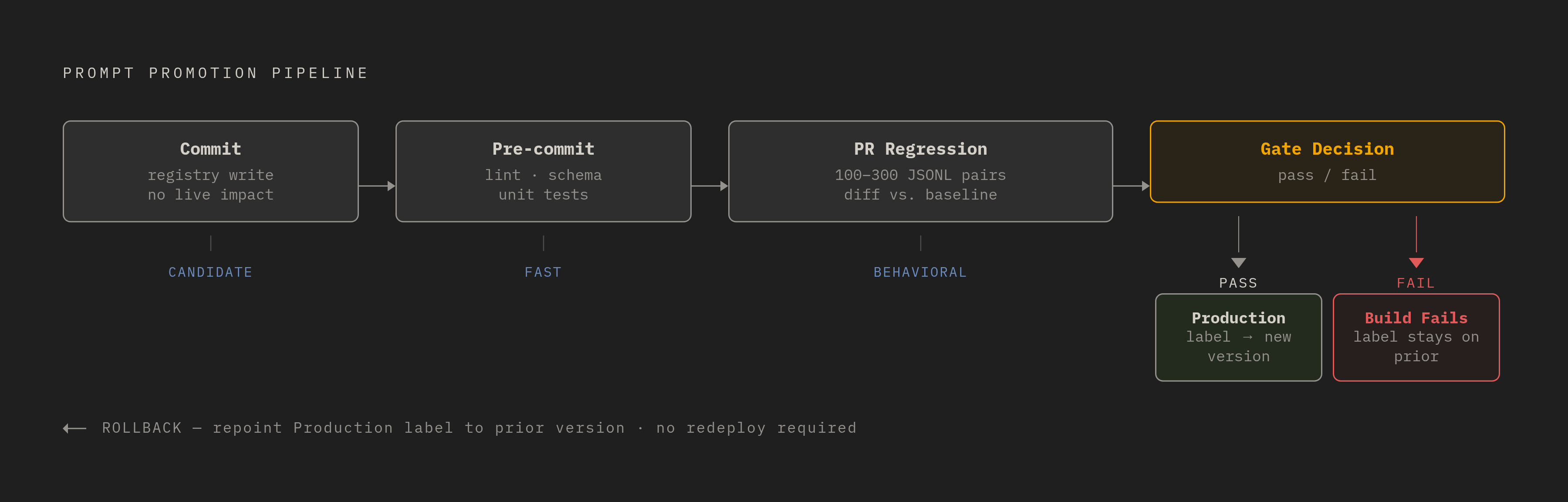
In practice, that means every prompt lives in a registry as a tracked template with an immutable version history, commit messages explaining what changed and why, and deployment labels such as Production, Staging, and Development, each pointing to one specific, addressable version. An engineer proposing a new prompt commits it as a candidate version without touching what's live. Committing a version doesn't deploy it; promotion to a label is a separate, gated action, so a bad idea can sit in the registry indefinitely without ever reaching a real user.
That separation is what makes rollback trivial. Reverting a bad prompt means repointing the Production label back to the prior version, not shipping a new build or touching application code at all, because the application fetches whichever version currently holds the live label at request time. A rollback that used to require a deploy now takes the same amount of time as flipping a pointer.
It's worth being precise about what versioning does and does not accomplish on its own. Versioning and gating are two separate jobs, and a working pipeline needs both: a registry can tell an engineer exactly which version is currently live, but it has no mechanism to stop a worse version from becoming the live one. A label that reads "Production" only confirms what's currently deployed. It says nothing about whether that version ever passed a test, and proving that requires the versioning system and the evaluation gate to share a programmatic interface so that promotion can be conditioned on a passing score.
A useful illustration of the mechanics: a candidate prompt gets committed to the registry under a new version number, a gate runs an evaluation suite against that candidate, and only a passing result triggers the API call that reassigns the Production label. Nothing about that flow requires exotic tooling. The distinction that actually matters when choosing among them is whether a given tool can enforce an eval-based gate on its own or whether it only tracks versions and leaves the gating logic to be built separately.
Building the evaluation gold set that the gate runs against
A gate is only as reliable as the baseline it checks new versions against, and that baseline is a curated gold set: a repository of structured input-output pairs defining what a correct response looks like for the specific use case the agent serves. Every regression score the pipeline produces is a delta measured against this set, so building and maintaining it is a genuine engineering task rather than a one-time setup chore.
A production gold set typically holds somewhere between 100 and 300 highly diverse, mutually exclusive prompt-response pairs, a range chosen deliberately: large enough to produce statistically meaningful results, small enough that a CI run doesn't become a bottleneck every time someone opens a pull request. Each record in that set needs four components to be usable by an automated pipeline: the input prompt, the expected output, any context the model requires to answer correctly, and the criteria by which a response gets judged. These records are typically structured as machine-readable JSONL, which lets the pipeline parse and feed them to the evaluation suite asynchronously rather than one at a time.
Building that set well means sourcing it from more than one place. Some entries come from synthesized ideal responses to standard queries and deliberately adversarial edge cases designed to probe where the model is weakest. Others need to cover ambiguous inputs that should trigger a clarifying question rather than a guess, and out-of-domain requests the model should decline gracefully instead of hallucinating an answer. The most valuable entries, though, tend to come from production itself: real failures observed in live traffic, converted into new gold set records so the baseline keeps growing from what actually goes wrong rather than only from what an engineer imagined might go wrong. A gold set that never absorbs new production failures ages out of relevance as the application encounters inputs its original test cases never anticipated, so the maintenance loop, meaning periodic review, correction, and merging of new real-world cases back into the set, has to run continuously rather than once at launch.
The way each record gets checked also has to account for the fact that LLM outputs are probabilistic, so an exact-match assertion is the wrong tool for almost every case. Evaluation platforms like promptfoo handle this with a tiered assertion model. The cheapest and fastest checks run first: deterministic string checks, such as confirming a response contains or excludes a specific phrase, which cost nothing in terms of extra model calls. Where a deterministic check isn't precise enough, the pipeline moves to semantic similarity scoring, a vector-based comparison that measures how close two responses are in meaning even when the wording differs entirely. Where semantic scoring isn't sufficient, especially for open-ended or nuanced outputs, a secondary model acts as a judge, scoring the candidate response against a written grading rubric. This is the most expensive tier, in both cost and latency, and it's reserved for cases the cheaper tiers can't resolve on their own.
Agents built on retrieval-augmented generation need one further layer, because a hallucination can slip through a retrieval pipeline dressed up as a properly sourced answer. The RAG Triad, meaning faithfulness to the retrieved context, relevance of the answer to the original question, and groundedness of the answer's individual claims in that context, guards specifically against that failure mode, checking not just whether an answer sounds right but whether it's actually anchored in the material it claims to be drawn from.
The PR-level regression gate: what runs, when, and what blocks a merge
Everything built so far, the versioned prompts, the gold set, the tiered assertions, exists to support one specific checkpoint: the gate that runs on every pull request and decides whether a proposed prompt change is allowed to merge. Teams that ship agent changes with confidence have converged on treating this as the single most important gate in the pipeline, because it's the last automated check before a human reviewer signs off and the change moves toward production.
The stages leading up to that gate build on each other. At pre-commit, running locally on an engineer's machine, linting and schema validation catch malformed prompts and configs, and a fast subset of unit-level tests runs in seconds, giving quick feedback before anything reaches shared infrastructure. Once a pull request opens, CI runs the full suite of unit and integration tests against deterministic logic, runs a parallelized subset of the behavioral regression suite against the gold set, and produces a diff view comparing the candidate's outputs against the current production baseline so a human reviewer can see precisely what shifted, not just that something did. If that suite passes, the version moves to a promote stage where it earns the Production label; if it fails, the build fails and the label stays where it was, since promotion here means reassigning a pointer, not pushing a new deploy.
None of this requires specialized infrastructure at the orchestration layer. Standard CI runners, whether GitHub Actions, GitLab CI, or CircleCI, handle the scheduling and execution fine; the evaluation platform the CI job invokes needs to be purpose-built, not the runner itself. A GitHub Action, for instance, can trigger the eval suite on every pull request and block the merge outright if quality drops below a configured threshold, which is the mechanism that makes the whole exercise worth running: the build fails specifically because the change made things worse. That's a concrete, binary block that stops a merge, unlike a warning comment left for someone to read later.
What the gate checks goes beyond a single aggregate quality score. Tool selection accuracy confirms the model invoked the correct tool for a given scenario rather than a plausible-sounding wrong one. Hallucination rate confirms the output stays grounded in whatever context was provided. Behavioral drift checks, surfaced through the diff view, catch unexpected shifts in tone, output format, or refusal behavior that a single score might average away. If an assistant that used to ask a required clarifying question stops asking it, or fails to call a tool the scenario clearly demands, the build fails automatically rather than waiting for a reviewer to notice the omission by eye.
This gate has no baseline to compare against the first time it runs. Establishing that baseline is exactly the gold-set work described above: the first version scored against the gold set becomes the reference point every future candidate gets measured against, and that reference has to be re-earned periodically as the gold set itself absorbs new production failures.
Attributing failures to the right layer before deciding what to fix
A failing gate tells an engineer that something regressed. It says nothing about where the regression originated, and guessing wrong at that stage wastes engineering effort and can introduce a second problem on top of the first. The three failure categories introduced earlier turn out to require entirely different fixes depending on which layer produced them. Tool schema drift is a harness problem, and the fix is updating the tool description to match the API's current schema, not rewriting the prompt around it. Prompt ambiguity is a prompt-layer problem, and the fix is revising the prompt itself and validating that revision against the gold set. Workflow loops often trace back to orchestration logic, so the fix is in routing or retry behavior rather than the model or the prompt.
Getting that attribution right is genuinely difficult. The Who&When benchmark found that even state-of-the-art models achieve only 14.2% step-level accuracy when attributing failures from logs alone, which sets a low bar that any automated attribution approach has to clear before it's worth trusting. Several research approaches have pushed past that baseline. AgentScope uses what its authors call neural invariants to abstract agent behavior, which lets it both localize the specific step where a failure originated and classify what kind of failure occurred, outperforming LLM-as-judge approaches on accuracy and on how interpretable the resulting diagnosis is. Continual Search treats attribution as an iterative search across execution artifacts, expanding the evidence it retrieves substantially by the fourth turn of investigation while approaches that don't search progressively plateau far earlier, which suggests that the depth of evidence gathered drives diagnostic accuracy more than the sophistication of any single check. REFLECT targets a narrower but especially dangerous case: silent failures, where nothing raises an error even though the agent has already gone wrong, using intervention-supported attribution over the full agent trace to catch what a status-code check never would.
The MAST taxonomy offers a useful classification reference here, grouping failures in multi-agent LLM systems into specification flaws, inter-agent misalignment, and weak verification, each of which implicates a different layer of the system and therefore a different remediation path. The sharpest framing of this whole question comes from Raj et al., whose interaction-centric taxonomy asks directly whether a given failure is attributable to the model, the harness, the environment, or the grader, treating that classification as the diagnostic step that has to happen before any fix gets chosen. That question, model or harness, turns out to matter at the largest scale observed: both Anthropic and OpenAI have reported that the reliability gap in their production systems was a harness gap, and that investing in infrastructure around the model paid off more than investing in the model itself.
Replaying production traces as the gold standard for regression prevention
A curated gold set of synthetic and semi-synthetic scenarios is necessary, but it can never fully anticipate what real users will actually ask, in what order, with what typos, under what edge-case combinations of context and tool state. The highest-fidelity check available to a team is a replay of an actual production trace. It's a replay of an actual production trace: the exact sequence of inputs, tool calls, and intermediate states a real user generated, run again against a candidate prompt version to see whether the new version handles that specific, previously observed situation as well as the version currently in production did.
Building that capability requires observability infrastructure that captures full traces in production, not just final outputs, so that a trace can be replayed faithfully rather than approximated after the fact. Every span in that trace needs to carry the prompt version that produced it, so that when a regression turns up later, an engineer can trace it back to the exact version and the exact commit that introduced it rather than guessing across several candidate changes. Production failures that surface this way become the most valuable additions to the gold set described earlier, closing the loop between what actually breaks for real users and what the next candidate version gets tested against before it ever reaches them.