Prompt Versioning and Rollback for Production Agents
Treats prompts like deployed code, not text files, with versioning and rollback built in.
A one-word edit turned "summarize the issue" into "summarize the issue concisely," and the resulting behavioral regression wasn't traced back to that single word until real damage had already accumulated. That incident captures the whole problem with how most teams treat prompts: as strings to tweak in a text editor. Prompts running in production agents carry the same operational weight as any other deployable artifact, and they need the same discipline: immutable versions, environment pinning, evaluation gates, and rollback that takes seconds rather than a redeploy.
Most teams live in a specific gap. Prompts get edited in place, hardcoded into application code, shipped alongside unrelated feature changes, with no rollback path beyond someone's memory of what the wording used to say. This works fine in a demo. A prototype has one developer, one environment, and forgiving stakes: if the agent says something odd, someone shrugs and fixes it in the next commit. Production has none of that slack. Multiple people touch the prompt, multiple environments run different versions, and a bad change reaches real customers before anyone notices.
Four failure modes appear once hardcoded prompts hit production scale. Untracked changes let small edits silently alter behavior with no history to consult when something breaks. Coupled deploy cycles mean a single-line prompt tweak requires the same full application redeploy as a database migration. Environment drift sets in as dev, staging, and prod prompts diverge with no clean way to promote a tested version upward. Isolated testing isn't possible; a team can't evaluate a prompt change without spinning up the entire agent stack, tool calls and all, to see how new wording behaves.
What a production-grade prompt needs to capture
Treat every prompt as an immutable, versioned artifact. Once a version is published, it's never edited in place. Any change, however small, creates a new version with its own identifier. This single rule eliminates the "wait, what did it say before" problem that turns debugging into archaeology.
Semantic versioning gives that rule structure. A major version bump signals a behavioral or output-contract change, something that could break downstream parsing or alter what the agent is allowed to do. A minor bump can signal a capability improvement, and a patch can cover small wording fixes that don't change intent. Anyone scanning a version list should be able to tell, at a glance, how risky a given change is without reading the diff.
Metadata matters as much as the text itself. Every version should carry an author, a timestamp, a stated rationale for the change, and the evaluation results tied to it. Stripping any of that out turns the version history into a list of strings with no way to judge which one is safe to promote.
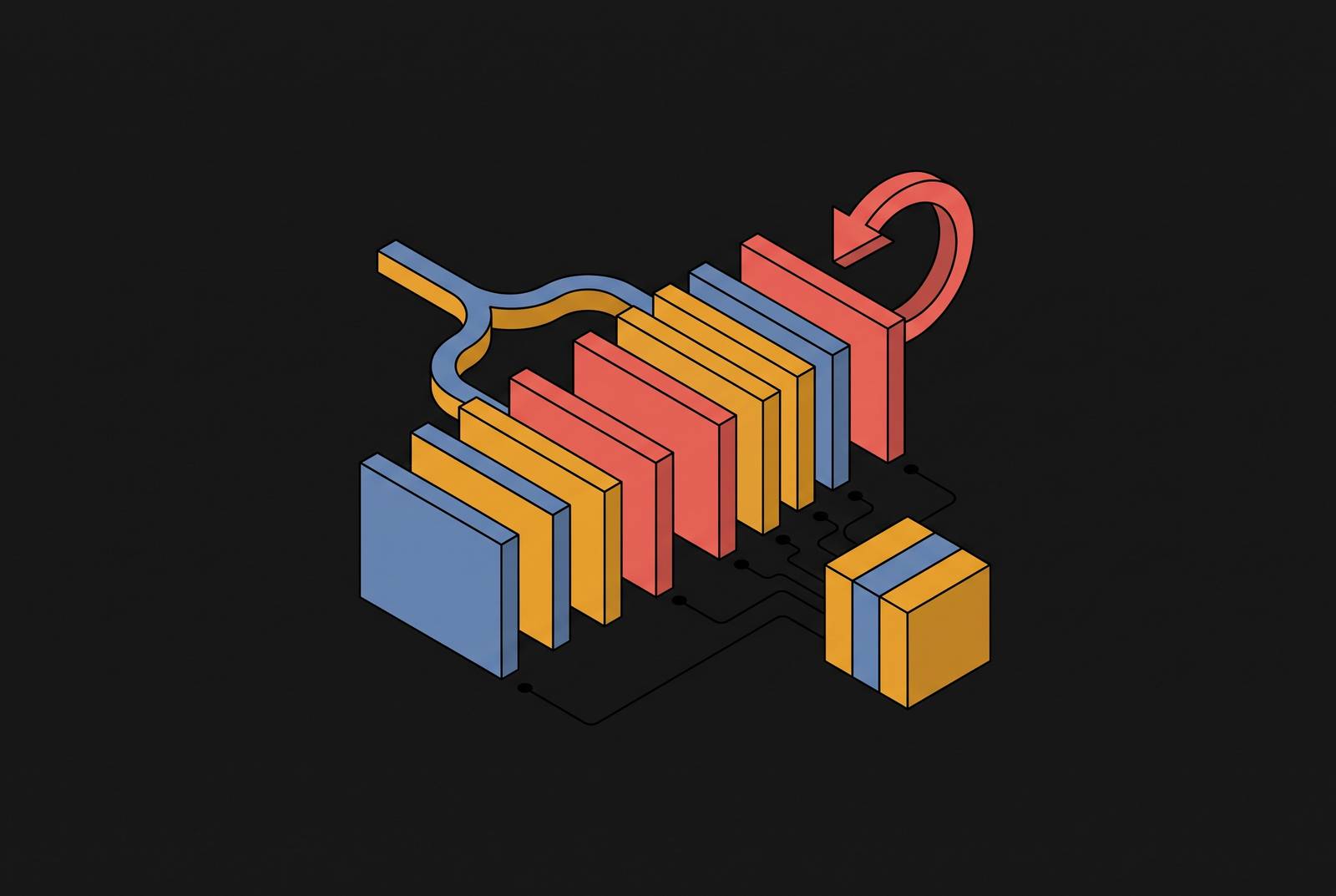
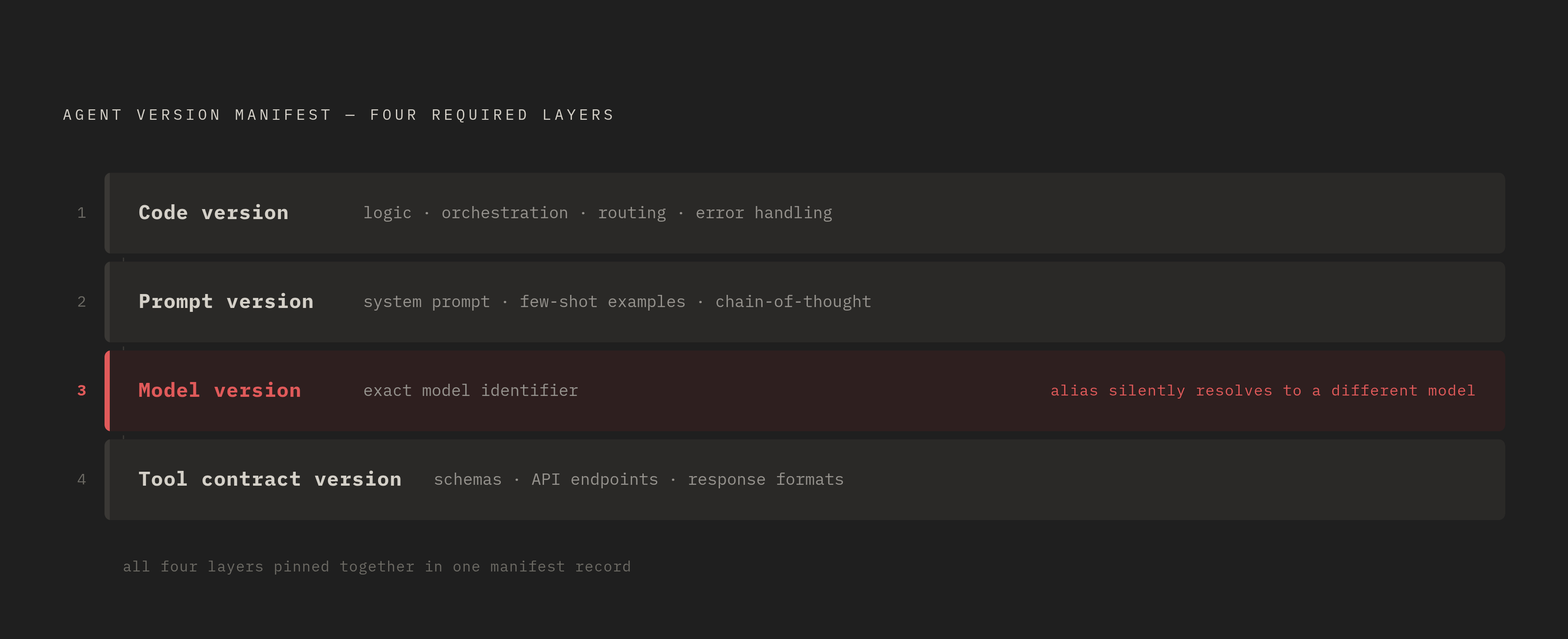
None of this works, though, if "prompt version" is treated as the only variable that determines agent behavior. It isn't, because a reliable version record has to capture four layers together, not just the prompt. A reliable version record has to capture four layers together, as an agent version manifest, covering the code version (application logic, orchestration, routing, error handling), the prompt version (system prompt, few-shot examples, chain-of-thought instructions), the model version, and the tool contract version (schemas, API endpoints, response formats for every tool the agent calls). The model layer deserves particular caution: pin an exact model identifier, not an alias. An alias can silently resolve to a different underlying model the moment a provider retires the version behind it, and that kind of change is invisible in any diff a team controls.
Why Git alone is not enough for prompt versioning
Git is a reasonable place to start, and it's not being dismissed here. Small engineering teams get real value from it: familiar tooling, built-in history, PR-based review that catches obvious mistakes before they ship. The trouble is structural.
Non-engineers get locked out first. Product managers and domain experts often do the most valuable prompt iteration, since they're closest to how customers actually phrase requests and where the agent's tone lands wrong. If that work requires a pull request, it slows to a crawl, and handoffs to engineers become a bottleneck instead of a formality.
Mixing prompts into code commits hides changes that deserve their own visibility. A commit that bundles a refactor, a bug fix, and a prompt wording tweak loses the specific thread of how the prompt evolved. Reviewing that history later means picking through unrelated diffs to find the one line that actually changed the agent's behavior.
Iteration speed breaks down too. Every prompt change through Git requires a PR, a review, and a deploy. That's a fine tempo for code. It's far too slow for prompt experimentation, where a team might try a dozen variations in an hour to see which one holds up against tricky inputs. And Git has no native concept of environment-pinning: nothing about the tool tells you which version is actually running in staging versus production at this moment. There's also no built-in evaluation integration. Version control from a general-purpose tool stays record-keeping. It tells you what changed and who changed it, but it doesn't tell you whether the change was good.
The iteration workflow itself doesn't fit an IDE or a standard build pipeline. Prompt work needs test inputs, model access, and side-by-side output comparisons, none of which live comfortably in a code editor. Git as the source of truth for prompt history is fine. Git as the operational interface for running prompt management day to day is not, and that gap is what an external registry exists to fill.
The external prompt registry as the enabling infrastructure
Move prompts out of application code and into a centralized registry. At runtime, the agent fetches the active prompt by reference, a name and a version tag, rather than loading a string that was compiled into the build. That single indirection is what unlocks everything downstream.
Promotion and rollback stop requiring a code redeploy. Behavioral iteration on the prompt decouples entirely from the application's release cycle, so a team shipping a new agent capability doesn't have to wait for the next sprint just to fix a wording issue discovered yesterday. Product managers and customer success teams gain the ability to adjust prompts through a management interface without pulling an engineer into the loop, which widens who can safely contribute without widening who can break the build.
A practical version of this pattern stores prompts as versioned YAML files, capturing the name, version, created_at, author, changelog, the template text itself, the model it's paired with, and inference parameters together in one record. Structured that way, prompt changes become reviewable git commits with diffs that show exactly which words changed, which is the readability Git review was always good at, minus the deploy coupling that made it unworkable for fast iteration.
Gating promotion with evaluations before any version reaches production
Versioning without evaluation is just record-keeping. Knowing that a later version differs from an earlier one tells you nothing about whether the newer version is actually better. The two practices have to connect for versioning to function as active quality management rather than a filing system nobody consults until something goes wrong.
Eval-gated promotion works by building a dataset from real production traces and customer interactions, then replaying those historical inputs against the new prompt version before it goes anywhere near live traffic. Score checks run as binary pass/fail, tied to concrete requirements rather than a subjective sense of whether the output "looks fine." A new version has to clear that gate before it's even eligible to move up an environment.
This replay setup enables two distinct workflows. Regression testing confirms the new version doesn't degrade performance on inputs the agent already handled correctly. Failure-case improvement takes known failures, adds them explicitly to the dataset, and iterates on the prompt until it passes consistently against exactly the cases that used to break it.
Running prompt tests in CI, triggered whenever a new version enters the registry and before it's eligible for canary rollout, catches the obvious failures: lost required structure, dropped context, downstream parsing breaks. That said, LLM non-determinism means not every regression is catchable this way. A model can pass a fixed test suite and still behave unpredictably on a slightly different phrasing of the same underlying request, so CI gates narrow the risk without eliminating it.
Deployment patterns for rolling out a new prompt version safely
Blue-green deployment is the simplest starting pattern. Two identical environments exist side by side, all traffic runs through blue, and the new version deploys to green. Green gets tested in isolation, and once it looks solid, traffic switches over. If green misbehaves, traffic switches back to blue, and the failure never reaches most users.
Agents complicate this pattern in a way that stateless web services don't have to deal with: the switch needs session awareness. A user mid-conversation can't have their next message suddenly routed to a different prompt version without breaking the continuity of that conversation, since the new version has no memory of what was said under the old one.
Three options handle this. Draining connections means waiting for active conversations to finish naturally before switching, which works cleanly when conversations are short. Sticky sessions with version tagging let existing conversations stay pinned to the old environment until they end on their own, while new conversations start on the new version immediately. State migration, exporting a conversation's state and transforming it to fit the new version's schema, is available but rarely worth it: it's the nuclear option, and it usually causes more trouble than it solves.
Smoke tests need rethinking for agents too. A /health endpoint returning 200 confirms the service is up. A real smoke test sends representative queries and checks that responses fall within expected behavioral bounds, not that they match an exact string, since agent outputs vary by design even when everything is working as intended.
Canary release rounds out the pattern: route a small slice of production traffic to the new version, watch the metrics that matter, and only ramp up further if behavior holds. If metrics degrade, the rollout stops before most users are ever exposed to the regression.
Rollback as a pointer change, not a redeploy
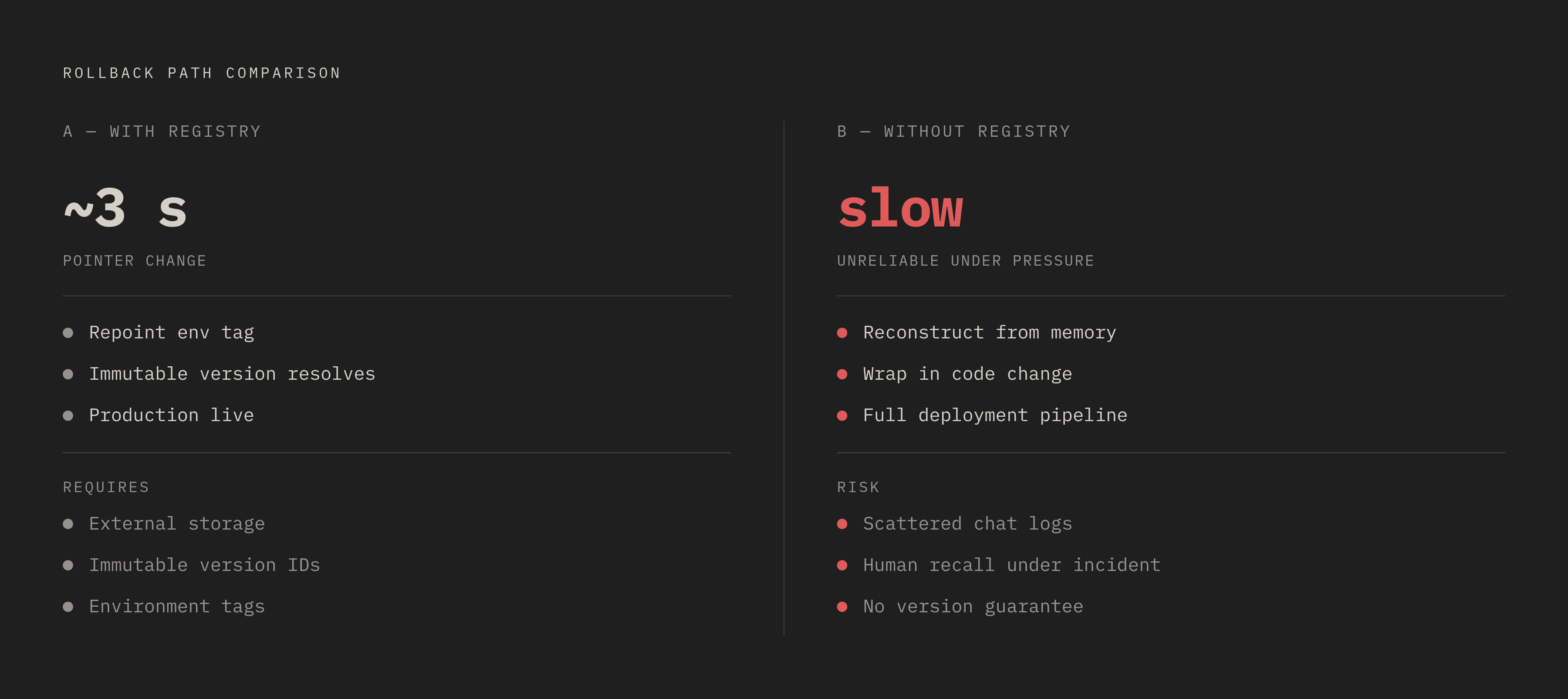
Because old versions stay immutable and available in the registry, rollback becomes a matter of repointing the production environment tag back to a previous version. That's a configuration change, not a deployment. It's measured in seconds.
Three things have to be in place together for this to work: external storage, immutable version identifiers, and environment tags that map a version to where it's running. Remove any one of the three and fast rollback stops being possible, because the system either has nowhere to point, no record of what to point back to, or no old version left intact to point at.
Compare that to the alternative, which is what most teams without this infrastructure actually do: reconstruct the old prompt from memory or from scattered chat logs, wrap that reconstruction in a code change, and push it through a full deployment pipeline. That process is slow under normal conditions and actively unreliable under pressure, when the team doing the reconstructing is also the team trying to stop an active incident.
Rollback doesn't automatically solve everything, though. In-flight conversations that accumulated state under the bad version don't get fixed just because the pointer moved. That needs explicit planning, and the same sticky-session or connection-drain logic used during rollout applies here on the way back down.
Diagnosing which layer caused the regression before rolling back
Knowing a run failed is not the same as knowing why it failed. In a multi-step agent, the visible failure, the error message a user sees or the ticket that gets filed, often sits several steps downstream from whatever actually caused it.
The prompt text, the model version, the tool contract, and the workflow or orchestration logic that strings steps together can each cause a regression independently. Rolling back the prompt when the real cause was a silent model version change fixes nothing, and neither does the reverse. Diagnosis has to precede rollback, or the team risks reverting the wrong layer while the actual cause stays live.
A single-step LLM call keeps root cause analysis relatively contained: inspect the prompt, inspect what was retrieved, and the answer is usually visible. A multi-step agent trajectory needs step-level traces, per-step evaluator scores, and the ability to diff a failed run against a successful one at each stage of the pipeline.
The difficulty here isn't theoretical. A major retailer's postmortem on incident analysis found a persistent attribution error rate of around 10%, where the model blamed a technology simply because it happened to be mentioned somewhere in the incident thread, not because it was actually responsible. That kind of misattribution makes rolling back the wrong layer an easy mistake to make under time pressure.
How the tooling landscape supports this workflow in practice
No single tool covers registry storage, evaluation gating, deployment orchestration, and step-level tracing, which tend to come from different places, so teams typically compose several tools rather than adopt one platform that does it all. The pattern that holds across implementations, regardless of which tools fill which role, is the same one running through every layer above: prompts live outside application code as immutable, versioned artifacts, evaluation results gate promotion between environments, deployment respects the stateful nature of conversations instead of treating agents like stateless web requests, and rollback works by moving a pointer rather than rebuilding a memory of what used to work. Teams that build toward that pattern, whatever specific tools they wire together to do it, get the thing that matters: a production agent that can be fixed in seconds when it breaks, and a record precise enough to say why it broke.
Sources
- Prompt Versioning: The Complete Guide — Agenta Blog
- How to Version & Rollback LLM Agent Prompts
- AI Agent Versioning and Rollback | Zero Downtime
- LLM Prompt Versioning and Rollback Strategy for Production
- Deployment, Versioning and Rollback for Prompts and Models (AI Engineering Series, Part 28)
- Prompt Versioning and Lifecycle Management in 2026
- langwatch.ai
- launchdarkly.com