Retrieval Latency and Its Effect on Context Quality Under Load
Slow retrievals degrade context quality, compounding failures across planning and tool use.
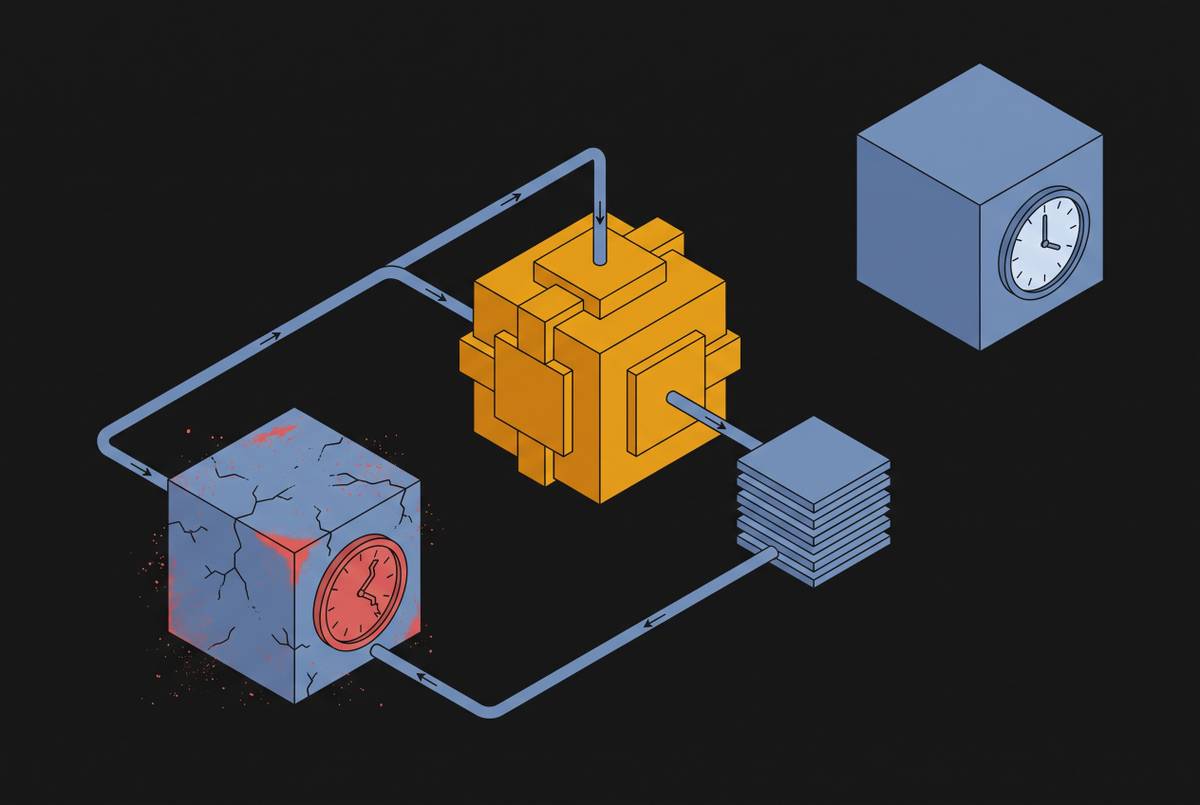
Retrieval latency under production load changes more than response time. It changes the evidence an agent has available when it decides what to do next. Retrieval latency and context quality therefore need to be managed as one harness engineering problem, because failures in either can compound across planning, tool use, and workflow completion.
Why retrieval latency and context quality are the same problem under load
Consider an agent that takes too long to answer and still chooses the wrong tool sequence. Earlier retrievals were incomplete, so its working memory lacked a fact needed for the next decision. The agent queried again but still lacked the missing fact. What looks like a reasoning failure at the end of the run began with the evidence available upstream.
This is the practical meaning of co-degradation. Slow or dropped retrievals do not merely postpone a response when they also leave the context incomplete or polluted with poor results. They change the basis for subsequent decisions. Treating latency as a speed problem and context quality as a separate relevance problem misses that connection, allowing a local improvement to shift the failure elsewhere in the harness.
How context accumulation creates a latency–quality pressure axis
Long-horizon sessions accumulate tool evidence, stale observations, and failed attempts. As those tokens build up, inference costs more and takes longer, while the model must find the evidence it needs among material that no longer helps. Availability alone does not make evidence usable. Relevant information in the middle of a long context can degrade model performance even when it remains inside the advertised context window.
Du's 2026 memory survey formalizes agent memory as a write–manage–read loop. Writing adds observations and tool results, management sets what stays available, and reading provides the evidence for the next decision. Without active management, the material that builds up crowds or overflows the window. The loop connects latency and quality because the same material that increases processing work can also make the next useful fact harder to locate.
Large, unfiltered tool responses make that connection concrete. Ingesting them into the prompt inflates Time-To-First-Token and weakens attention over core instructions, making subsequent retrieval slower and less likely to surface the right chunk. The problem begins at the ingestion boundary. Once irrelevant payloads enter working memory, later steps must work through them or remove them. Removal introduces its own costs, so the write–manage–read loop needs to account for both what enters context and how its layout changes.
What retrieval adds on top: provider heterogeneity and quality loss under load
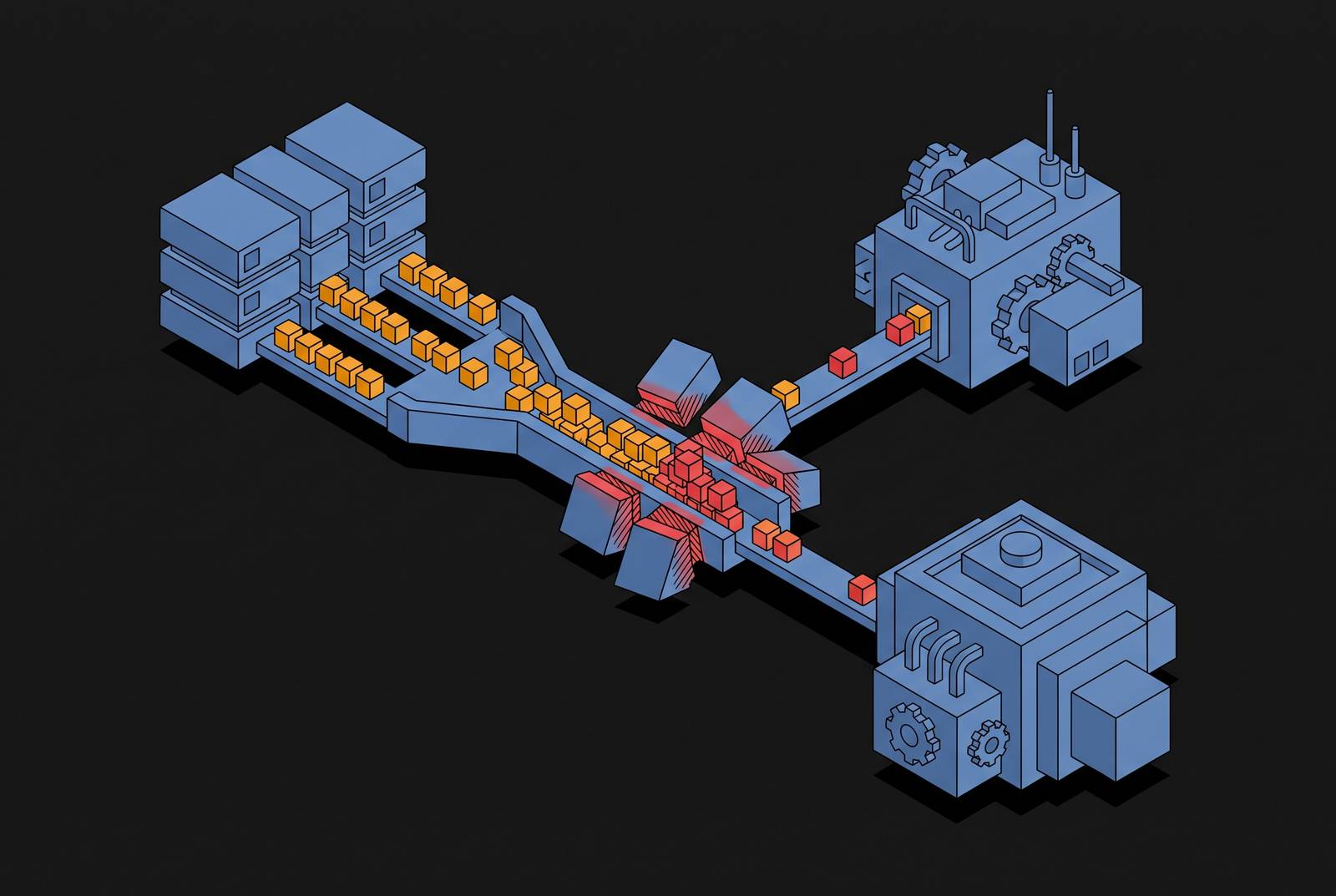
Agents may access different search APIs, retriever backends, or LLM endpoints through a shared interface, yet functional equivalence does not imply equal latency, reliability, or answer quality. When the load is high, slow providers can also return poorer chunks. Those results enter the agent's working memory, where poor evidence can affect decisions after the retrieval call. A successful response from a provider is therefore not sufficient evidence that retrieval served the task.
LQM-ContextRoute, introduced by Chu et al. in 2026, identifies a routing design that can make this worse. Additive-reward routers let low latency make up for poor answer quality, so a fast-but-poor provider can beat a slower, stronger one. Speed then conceals an evidence deficit. The paper ranks providers by expected answer quality per service cycle and uses that score along with query-specific quality estimation and feedback. Its latency-quality matching design outperforms additive-reward routing in high-heterogeneity conditions, where provider quality differs substantially.
MatClaw's engineering team dealt with another limit that varies by provider by using internal multi-needle retrieval tests to set conservative context caps for each provider. They addressed quality degradation from long contexts by changing the harness configuration while keeping the same model. Provider differences shaped the operating boundary itself.
How co-degradation propagates: the three compounding failure paths
The first failure path moves an apparent retrieval fix into planning. An agent can retry an incomplete retrieval, yet still lack the critical fact needed to choose the right tool sequence. It may hallucinate a substitute or repeat steps. MAST's grounded analysis of multi-agent system traces identifies step repetition and unawareness of termination conditions as common workflow-loop failures, with repetition accounting for 15.7% of failures. In a retrieval latency spiral, another query adds work without stabilizing the evidence needed to stop.
During long workflows, intermediate outputs can pollute conversation history, and dynamic tool retrieval based on the latest scratchpad can follow that pollution toward progressively less appropriate tools. Compression can make the loss harder to detect. VISTA's portal-link scenario illustrates the underlying risk, as a large inbox export crowds out a small result block containing an exact URL. Blind to block sizes, the agent compresses away the URL and sends a broken link, turning a context management failure into an incorrect tool output.
An agent may still return a 200, with normal latency and unremarkable token counts, while its answers gradually deteriorate. Restoring response time or reducing retries does not establish that the evidence reaching the model is sufficient. This silent quality collapse can persist because the visible operational signals report completion while leaving correctness unverified.
These paths implicate different parts of the harness. Planning needs the missing fact, tool selection needs an undistorted working state, and monitoring needs evidence of semantic failure. A fix confined to the retrieval call cannot establish all three conditions.
Why cache invalidation makes naive context management a false fix
Truncating or compacting the prompt appears to address both processing cost and evidence dilution. But changes to the prefix can invalidate the KV cache and add pre-fill work and cache-miss penalties that cost more than fewer tokens save. TokenPilot, introduced by Xu et al. in 2026, makes this trade-off explicit, showing how aggressive truncation or compaction breaks prompt prefix continuity and can leave a system slower and more expensive.
TokenPilot treats prefix continuity as a hard constraint. Its Ingestion-Aware Compaction stabilizes prefixes at ingestion, while Lifecycle-Aware Eviction defers removal until a segment's residual utility expires. Token reduction remains useful within those constraints. The framework's evaluations on PinchBench and Claw-Eval show substantial cost reductions while maintaining competitive task performance, including a 61% cost reduction in continuous mode on PinchBench. The lesson for harness engineers is to evaluate context interventions on token reduction and cache alignment together, rather than accepting a smaller prompt as proof of improvement.
What a context-aware agent needs to manage this pressure itself
Sound context management requires state the agent cannot reliably infer from prompt text alone. An agent needs block size, recency, archive status, and remaining budget to decide whether to keep content available, yet without those signals it must guess or depend on fixed external rules. This is a runtime visibility gap. A proprioceptive state layer makes the condition of working memory visible to the agent that must use it. That visibility lets the agent choose which evidence to retain and which to compress.
VISTA, introduced by Xu et al. in 2026, supplies a training-free, model-agnostic version of this layer. It exposes per-block metadata through a runtime dashboard and lets agents archive large stale blocks as recoverable, full-fidelity payloads. Exact details need not disappear during compression. On LOCA-Bench, the approach roughly doubles Gemini-3-Flash's score to 50.7%, and the gains grow under context pressure and carry over across model backbones. Its ablations identify the dashboard itself, alongside archive and recovery tools, as a driver of improvement.
Bi-Temporal Memory Engine's 2026 work also supports using context for the current step rather than keeping the full history in the active window. Retrieving only what the step needs gives better accuracy with less context pressure. The same principle extends beyond memory management. The latency-quality router uses quality and load information for each query, with no allowance for speed to make up for weak answers.
The vLLM Semantic Router project's Workload–Router–Pool architecture extends this reasoning to inference routing. It identifies routing policy, workload characterization, and pool topology as coupled, so a policy tuned for one combination can be suboptimal for another. Fixed rules omit that changing relationship. Across context management, retrieval routing, and inference routing, the common design principle is quality-aware, state-informed choice.
What engineers need to instrument to see co-degradation before it becomes a failure
Engineers need to preserve context state at each decision step along with run duration and total tokens. Engineers need to know how large the context was at each step and what it held, including which retrieved chunks and tool outputs were there. They also need the content delta between consecutive steps. That delta connects ingestion, compression, archiving, or removal to the next decision, making it possible to distinguish evidence that never arrived from evidence that was later lost.
Retrieval traces should pair latency per provider with the quality of the chunks returned. A provider-level timing metric alone cannot reveal whether faster service is filling the window with weaker evidence. Engineers also need the cache-hit rate across turns. Read together with context changes, it shows whether a token-reduction intervention coincides with lost cache reuse.
Establishing what the context contained when the agent made its next decision and whether that content was sufficient requires the full sequence of decisions, tool calls, retries, errors, and intermediate outputs. Completion status cannot supply that evidence. AgentDebugX's 2026 closed loop formalizes the dependency, with Detect identifying step-level errors, Attribute locating root causes, Recover proposing ranked fixes, and Rerun regenerating the trajectory around the failure point. Each stage depends on enough intermediate state to locate the first divergence.
AgentRx's 2026 work shows why preserving a full trace is necessary but not sufficient. One-shot constraint generation over long trajectories becomes brittle through context dilution, so step-by-step constraint evaluation against an auditable log is required for reliable localization. Its results improve step localization by 75% on average over prior work. Evaluating each step against its available evidence prevents the final incorrect answer from obscuring the earlier decision where the trajectory first went wrong.
Treating co-degradation as a harness engineering problem, not a model problem
Upgrading the model or expanding its context window does not directly repair prompt structure, retrieval routing policy, context management rules, or tool-response ingestion. Those are harness decisions, and they determine the evidence the model receives. Missing evidence remains an upstream engineering defect. A model change may alter behavior, but it does not establish that the responsible layer has been identified or corrected. Engineers therefore need to identify which harness decision made the next step operate on insufficient context.
The discipline is to reproduce the failure by replaying its trace, attribute it to the responsible layer, and make a targeted change. Historical traces then provide the basis for validating outcomes before shipment. A passing isolated test is not enough. A prompt restructure, routing update, or eviction rule can fix one symptom while leaving the pressure that produced it intact.
The strongest implication of the research is that these interventions are repeatable and auditable. Context metadata, cache-aligned ingestion, quality-aware routing, and step-level attribution can be examined with the rigor applied to code review and testing. That makes co-degradation an engineering problem with observable causes. Progress comes from establishing which evidence was available, which harness decision changed it, and whether the correction survives the trajectories that previously failed.
Sources
- LLM Agents Are Latent Context Managers: Eliciting Self-Managed Context via State Proprioception
- Memory for Autonomous LLM Agents:Mechanisms, Evaluation, and Emerging Frontiers
- TokenPilot: Cache-Efficient Context Management for LLM Agents
- The Workload-Router-Pool Architecture for LLM Inference Optimization: A Vision Paper from the vLLM Semantic Router Project
- [2605.14241] Latency-Quality Routing for Functionally Equivalent Tools in LLM Agents
- MatClaw: An Autonomous Code-First LLM Agent for End-to-End Materials Exploration
- AGENTRX: Diagnosing AI Agent Failures from Execution Trajectories
- Less Context, More Accuracy: A Bi-Temporal Memory Engine for LLM Agents Where a Lean Retrieved Context Beats the Full History