Embedding Model Mismatch Between Indexing and Query Time
Configuration changes can silently degrade retrieval quality without triggering system alerts.
Embedding model mismatch between indexing and query time can break retrieval while the surrounding pipeline continues to report success. Preventing it requires more than checking vector dimensions. Teams must distinguish configuration incompatibility from semantic drift, observe embedding versions within production traces, and validate model migrations against real queries before switching traffic.
Why embedding mismatch is hard to see coming
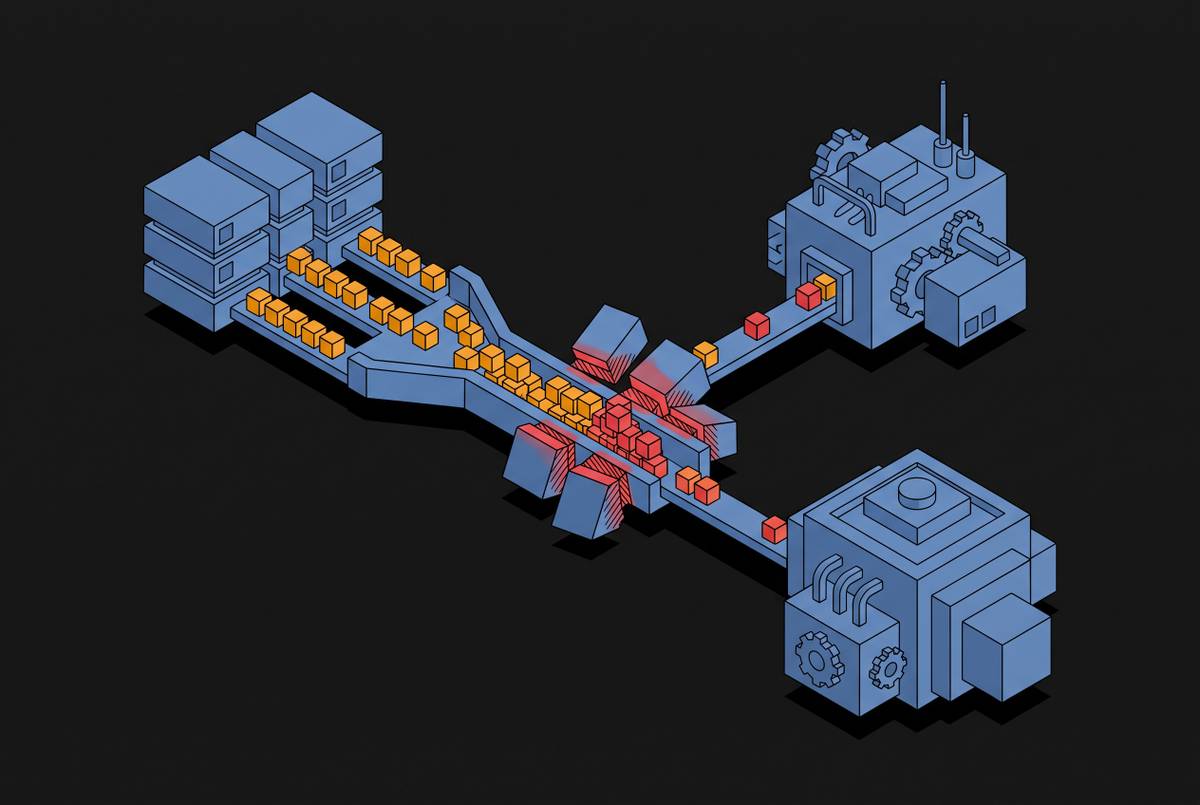
The most dangerous retrieval failures do not interrupt execution. The pipeline runs, vectors return, scores look plausible, and latency remains normal. Unlike a crashed service or a thrown exception, this failure offers no immediate operational signal. A system can therefore remain technically functional for weeks while supplying context that does not answer the query.
The damage does not stay inside retrieval. Bad context changes the LLM’s output, which can change the tool calls that follow. A trajectory-level evaluator may catch the resulting agent error, but the symptom does not identify its origin. Localizing which layer changed requires span-level versioning across embeddings, retrievers, and tools.
The two structurally different ways mismatch breaks retrieval
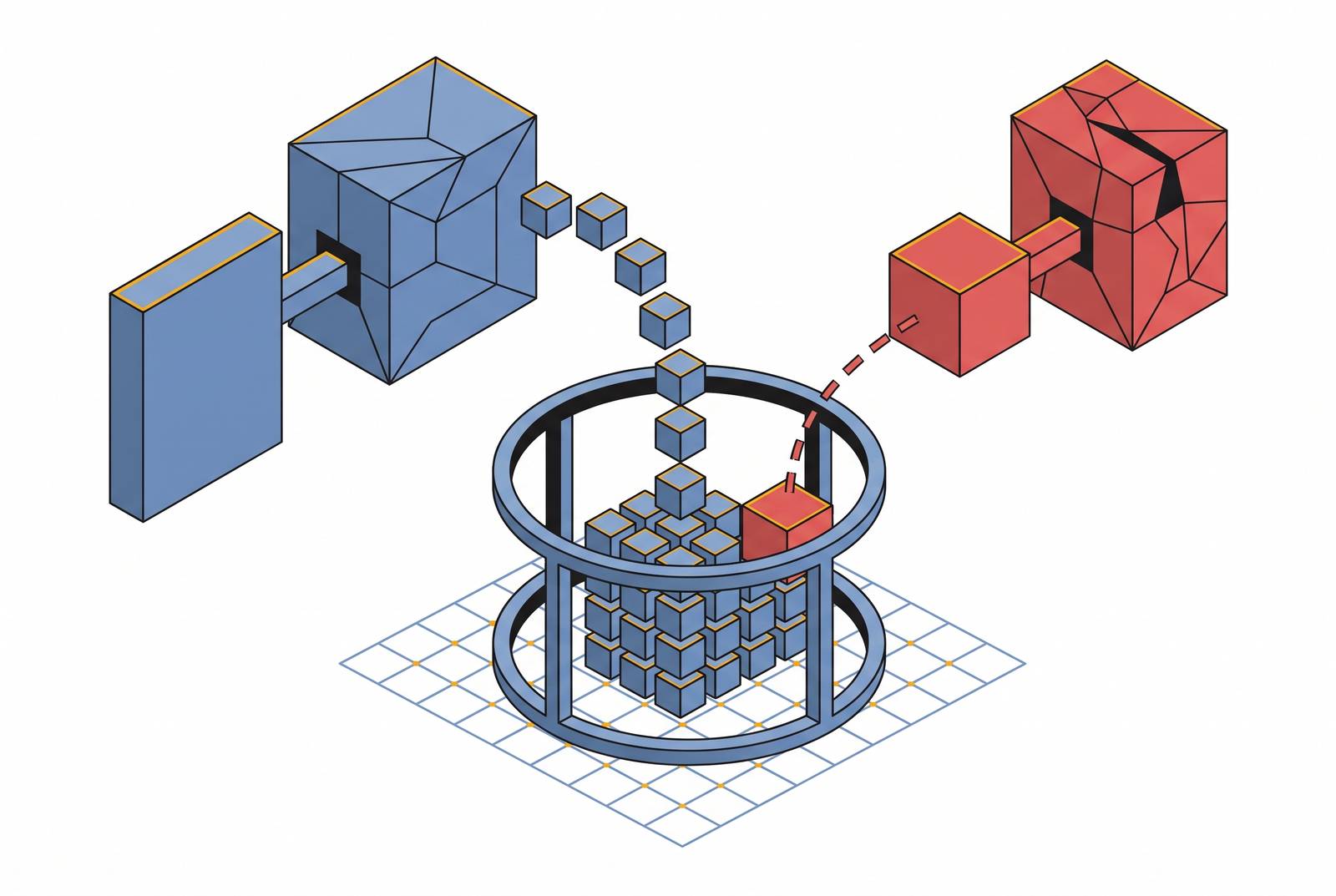
Hard mismatch begins with incompatible vector dimensions. A Matryoshka model can produce different output lengths depending on its configuration, so indexing and querying with different output_dimensions settings produces incompatible vectors even when the model name is identical. Elasticsearch validates dimensions at both write time and query time. A mismatched query vector produces an explicit HTTP 400 error. This failure announces a configuration problem at the search boundary.
Equal dimensions, however, do not establish compatibility. Two different models can both produce vectors with 1,536 dimensions but put meaning in different places within that space. The vector store takes the query and ranks the results by cosine similarity because the shapes match. Yet those scores compare coordinates that do not share the same semantic basis. Dimension validation checks compatibility of vector lengths alone.
Soft mismatch has a different underlying cause. The embedding model can remain unchanged while the meaning represented by incoming queries moves away from the meaning represented in the index. A legal RAG system indexed on case law from one period may struggle with terminology from a later regulatory cycle. Its embedding configuration remains consistent, but the domain’s distribution of meaning has shifted. Retrieval works when the system is deployed, then gets worse over weeks.
These distinctions require separate responses from the outset. Hard dimension mismatch is a configuration problem, but checking for same-dimension cross-model incompatibility means checking model identity as well as shape. Soft semantic drift still calls for monitoring and changes to the architecture even when both checks pass. Treating every case as a malformed-vector problem leaves the least visible failure largely unexamined.
The conditions that actually trigger mismatch in production
Partial re-indexing is the most common operational trigger. When a model changes, teams may re-embed new or recently updated documents while leaving historical documents encoded by the old model. The resulting index appears intact because the documents and vectors are present. However, query scores now compare vectors drawn from incompatible spaces. The migration has changed only part of the corpus, while the query-time encoder applies to every search.
Model lifecycle events create the same exposure externally. Hosted embedding endpoints can receive minor revisions that change their output distribution without changing the model name or version string visible to the caller. Deprecation can make the transition more explicit without making it simpler. When the query pipeline moves to a replacement encoder, every stored vector produced by the previous model becomes part of the migration obligation.
Configuration changes can introduce incompatibility within one model. With a Matryoshka model, the exact failure path is to index documents using one output_dimensions value and construct query embeddings using another. Loading the same model with mean pooling for indexing and cls pooling for queries produces incomparable vectors even at the same nominal dimension.
Adding to the corpus can cause mismatch even without a declared migration. New documents use whichever model is current, while the historical corpus retains its original embeddings. An index that was consistent at launch slowly becomes a mixed-model collection unless new documents use its embedding configuration. A 2026 empirical study of LLM migrations found that RAG applications change a median of seven files and substantially more lines of code than prompt-only changes because the replacement model invalidates the existing index.
Why temporal relevance adds a failure dimension that dimension-checking cannot catch
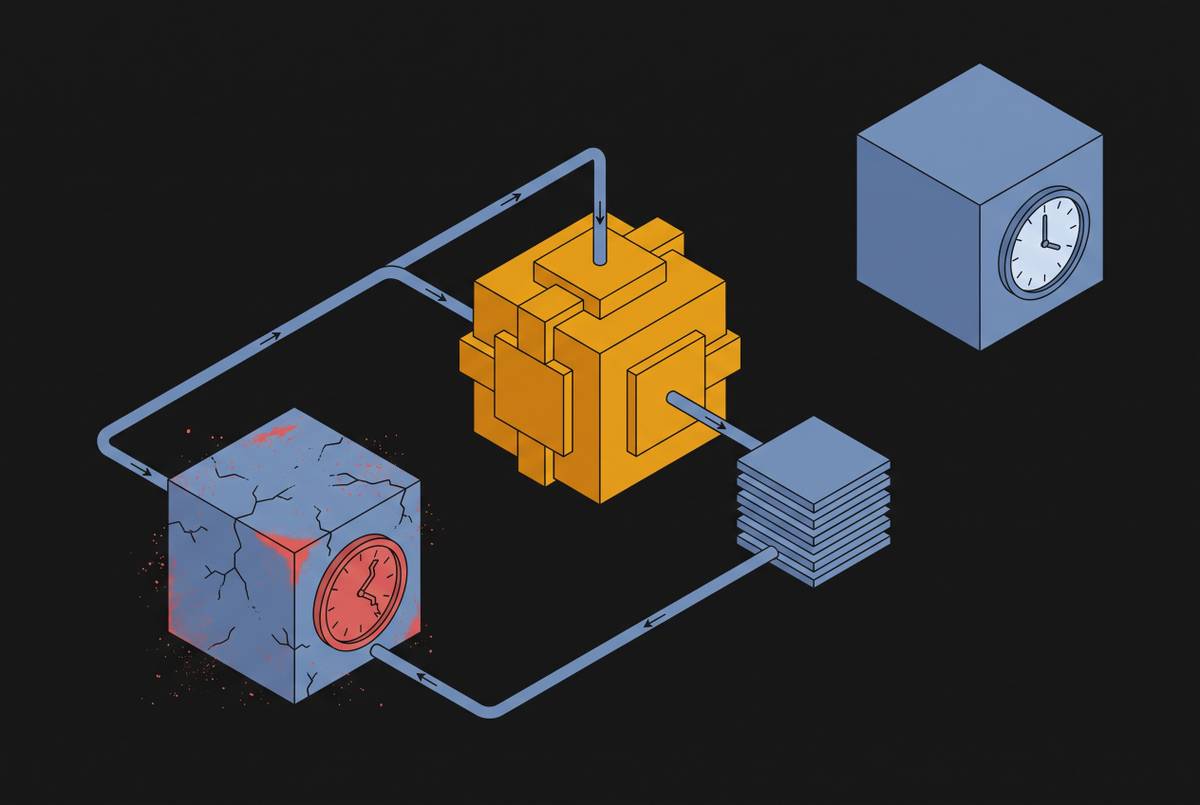
Correct configuration does not make relevance permanent. A version-pinned, fully re-indexed pipeline can still return the wrong evidence when terminology, context, or the meaning of a query evolves. Standard vector search measures semantic similarity under a fixed scoring function. That function does not, by itself, express the changing usefulness of a passage over time. A document can remain close to a query while becoming less useful as evidence.
OceanBase and Ant Group’s research formalizes this problem as time-decayed vector search. In agent memory, freshness-sensitive RAG, and rapidly evolving domains, relevance depends on both semantic similarity and temporal freshness. An older passage may be highly similar to a query yet less useful than a newer passage. Standard cosine similarity cannot express that distinction on its own. The problem persists even when every vector has the correct dimension and comes from the intended encoder.
Splunk’s 2026 analysis identifies temporal reference failure as a category in which embeddings capture the subject but miss time-specific qualifiers. A query for a specific quarter’s revenue can retrieve documents about revenue generally, missing the quarter-specific information. Length mismatch compounds this problem because a short query embedding can sit far from a long document embedding even when the document thoroughly answers the question.
Metadata filtering before search and recency reranking after retrieval treat time as an additional layer rather than a native part of the semantic relevance signal. In particular, post-retrieval reranking works with a candidate set that may already favor older material. The same analysis concludes that these failures are rarely solved by swapping encoders alone and calls for architectural fixes such as metadata filtering, reranking, or multi-granularity chunking. Configuration hygiene is necessary, but it does not define relevance.
Why mismatch does not show up in CI or offline evals
Fixed evaluations test a narrower system than production exposes. CI and offline evaluations can test the query-time model on synthetic or fixed query sets without checking whether the production index used the same model, dimensions, or pooling configuration. A passing score then describes performance on that evaluation. It also says little about terminology or temporal references that emerge later.
Drift separates the initiating change from its visible consequence. The model passes evaluation, deployment is uneventful, and operational dashboards remain green while retrieval quality weakens. By the time the product shows a clear decline, the period in which the change was easy to isolate has passed. Diagnosis is hindered by the absence of a record connecting production behavior to the configuration active when it occurred.
Traditional recall can make that gap harder to recognize. Researchers at CWI, EPFL, MPI-SWS, and Google demonstrate that standard recall penalizes an algorithm for omitting mathematically close objects even when those objects are semantically irrelevant. So a score can reward a match with the embedding geometry even when the results fail to meet the user’s information need. If that geometry no longer tracks what is relevant, recall may stay the same or even improve while retrieval becomes less useful.
Operational monitoring has a similar blind spot. Standard APM tools cannot distinguish a retrieval step that returns the right chunks from one that returns plausible but wrong chunks when both have normal HTTP responses and latency. Agent-level evaluation may expose the eventual output error, but it does not supply the missing retrieval evidence. The detection gap spans both quality measurement and the trace record needed to explain a regression.
What reliable detection actually requires: span-level versioning and embedding-aware metrics
The detection requirement is to make embedding configuration observable within every retrieval span. Each span needs the embedding model name, exact version, output dimension, and pooling configuration. These fields make configuration changes visible in the production record. Without them, a trace can show that retrieval ran while omitting the information needed to explain why its behavior changed.
A well-instrumented RAG trace records the vector DB, retrieved chunks, prompt template version, and model identifiers on the relevant spans, with versioning across embeddings, retrievers, and tools. This connects an output symptom to the components that produced it. Dataset-level evaluation can show that quality fell, while span-level evidence can show which layer, time, and query cohort were affected.
Embedding-aware metrics add a signal before output quality visibly deteriorates. Cosine similarity baseline tracking computes similarities between query embeddings and retrieved document embeddings, then follows their rolling average and standard deviation. Changes in that distribution can expose drift earlier than end-to-end quality scores. But similarity values that look right also make mismatch hard to spot, so this statistical signal cannot take the place of semantic evaluation.
Semantic Recall, introduced in research at SIGIR, provides a more appropriate retrieval-quality measure. It evaluates against semantically relevant objects that exact nearest neighbor search could theoretically retrieve, excluding irrelevant neighbors from the ground truth. This avoids rewarding retrieval merely for reproducing misleading geometric proximity. Traditional recall is therefore the wrong primary metric for detecting mismatch, even when it remains useful for assessing agreement with nearest-neighbor results.
Unit evaluations assess discrete retrieval steps, regression suites assess subjective output quality, and continuous production trace sampling exposes drift as real queries change. Trace replay then allows a captured retrieval trace to be compared against a new model or configuration before promotion. Traditional logs cannot reproduce non-deterministic retrieval failures, so replay offers a way to check them that aggregate scores and request records cannot.
Migrating embedding models without stopping the world
Once incompatibility is confirmed or a model change is planned, remediation must preserve service while rebuilding the index. The foundational rule is full re-embedding whenever the embedding model, output dimension, or chunking strategy changes. Interpolation and padding do not make incompatible vectors comparable. For large corpora, token volume is substantial, and the operational window can extend across days or weeks.
Re-embedding and rebuilding the graph each have their own costs. Tongji University and Ant Group’s research identifies “residual reachability” in graph-based ANNS indexes, where old and new model vectors retain part of their similarity structure because they describe the same underlying objects. That structure can reduce reconstruction cost when migrating the graph index. It does not remove the need to encode the corpus with the replacement model. The opportunity is cheaper rebuilding.
The recommended migration pattern keeps both indexes observable in parallel. Dual-writing during the transition prevents documents from being lost while leaving the old index queryable. A throttled historical backfill populates the new index without a bulk reindex competing with production traffic. Shadow evaluation then runs a fixed set of real production queries through both indexes and compares retrieval quality before read traffic moves.
A/B routing sends a fraction of reads to the new index with per-query recall recording, followed by slice-by-slice production cutover. Those recall results need the semantic interpretation established earlier rather than an assumption that nearest-neighbor agreement proves usefulness. Replay validation against real production traces is essential because synthetic query sets do not reproduce the query distribution that exposes these failures.
Embedding models should be pinned to exact version identifiers rather than floating aliases, with the model name, exact version, output dimension, and pooling configuration stored in index metadata. Query-time validation can then assert consistency before executing a search. That check blocks a known class of configuration errors, but continuous trace sampling is still needed to catch changes in relevance that no version identifier can show.