Missed Memory Writes and Silent Context Loss in Long Sessions
Silent memory failures hide inside successful model calls until production traces expose them.

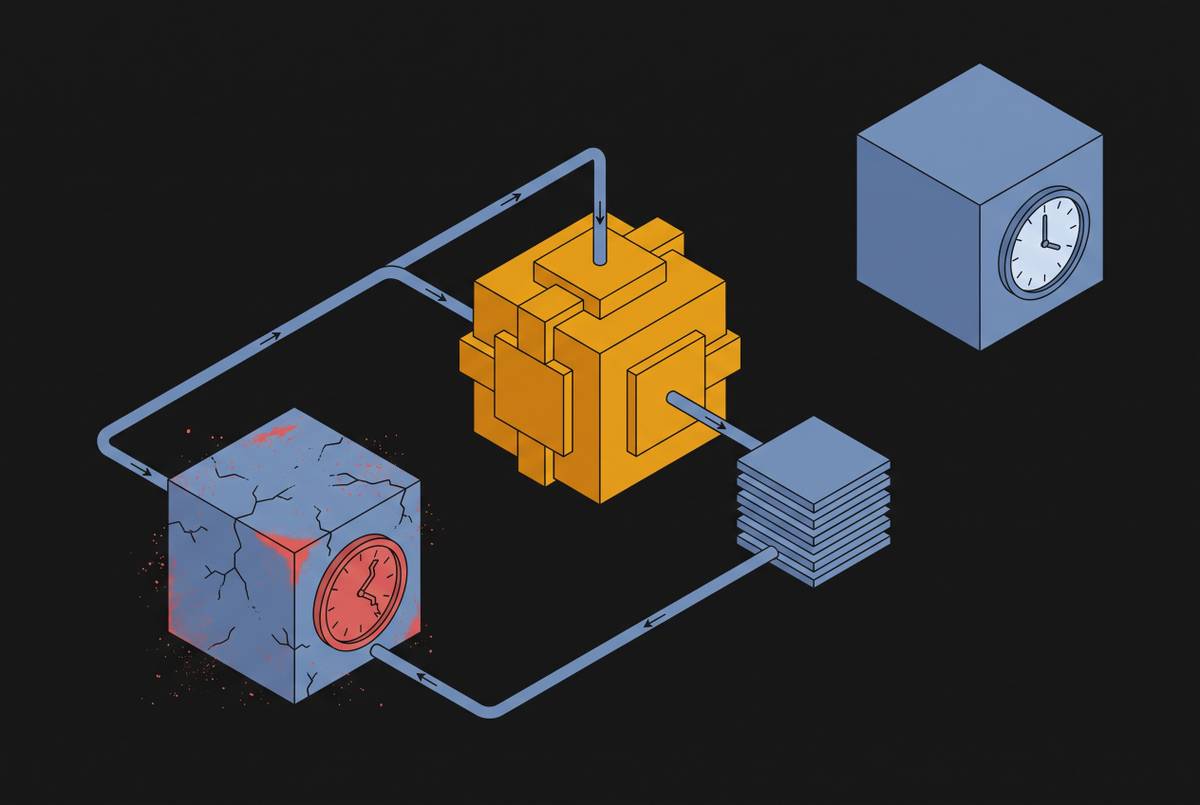
Missed memory writes and silent context loss in long sessions are failures in how the system is built, beyond the scope of edge-case bugs. A successful model call can conceal a broken continuity system. Catching these failures requires systematic inspection of production execution traces, followed by layer-specific diagnosis and replay validation, rather than reactive debugging after the agent has already lost its bearings.
Why memory writes fail without raising errors
An LLM is a stateless function that receives an input sequence, produces output, and discards its intermediate computation. The context window is the only memory available during a call, and it disappears when that call ends. A 2026 paper formalizes the architectural point by describing a causal transformer layer as mathematically equivalent to a stateless differentiable neural computer whose controller has no recurrent internal state. Continuity therefore belongs to the system around the model.
A hook can fail to fire, retrieval can return nothing, or compaction can remove the reasoning that connects earlier decisions. The next call can still produce a valid completion with a clean status code because it processes the input it receives. The model has completed the call even when the system around it has left out history it needs. Better error handling around inference cannot, by itself, detect that omission.
The four ways memory fails in long-running sessions
Helwig’s August 2026 record shows four ways memory failed in a production session that ran for months. The work covered a 633,000-line codebase under a single logical Claude Code session line since January 2026, with the memory subsystem continuously instrumented since July 2026. These patterns give engineers a vocabulary for separating failures that otherwise look like a forgetful agent.
Knowledge loss occurs when context compaction preserves a plan but summarizes away its rationale. The agent resumes fluently, yet no longer has the connective tissue needed to follow a long arc of work.
Repeated work happens when the agent proposes work that is already done. In the Helwig record, three consecutive sessions independently re-proposed a subsystem that was already built and sitting dormant, despite the relevant design documents being present in context each time.
Context degradation happens when efforts to keep the agent from forgetting inject too much retrieved material. Blocks that are only sometimes relevant become learned-noise, and irrelevant context measurably degrades model output.
Silent memory death occurs when the index, embedding server, or hook pipeline degrades while the rest of the system continues to trust it. It is the meta-failure that conceals the other three, allowing memory artifacts to become stale with “no crashes, no error messages,”.
Why session amnesia and organizational ignorance are two different problems that require two different fixes
Before locating a fault within that taxonomy, diagnosis must distinguish lost knowledge from knowledge the agent never had. Session amnesia follows from the model’s stateless operation when the surrounding system fails to carry information between calls or runs. The agent’s working context loses the conversation history, the user preferences, and the state of tasks that are done. Users then have to re-brief it at the start of each session. That behavior signals a continuity problem.
Organizational ignorance is different because perfect session recall would not resolve it. An agent may remember every exchange but have no governed metric definitions, data lineage, or business policies. It may not know what “adjusted revenue” means at a particular company or which data source is authoritative. Remembering a conversation does not supply knowledge that was never available within it.
Diagnosis therefore requires distinguishing an agent’s loss of an available fact from its lack of access to the required knowledge in the first place. Session memory addresses the former, while the latter requires organizational knowledge infrastructure. Most session memory tooling addresses only session amnesia. Deploying it against organizational ignorance produces minimal accuracy improvement because the missing capability was access to organizational knowledge.
What silent failures cost in production — and why the signal arrives late
Silent failures allow harm to accumulate before a user complaint or wrong output exposes it. Salesforce CRMArena-Pro (2025) reports that agents achieve only a fraction of their single-turn success rate on multi-turn enterprise tasks. It finds that the hardest part is gathering information through multi-turn clarification. That finding places the problem in the handling of information across an interaction, rather than treating every poor result as a standalone model-quality issue.
The consequences also extend beyond task completion. Compaction can silently erase standing safety constraints over long horizons. Vendor guidance therefore prescribes cross-session artifacts to supplement compaction. A session can keep running fluently after losing a rule that was meant to apply to all later work. The missing constraint becomes apparent only when later behavior depends on it.
Shi et al. (July 2026) formalize a related failure called ghost memory, in which old, current, and transition facts coexist and remain mixed through retrieval. A former address, outdated access policy, or deprecated tool schema can then support a confident answer as though it were current. This is a state coordination failure. By the time a user notices stale answers, repeated proposals, or degraded output, many sessions may already have run against broken memory. The cost grows during that delay because successful completions provide no substitute for deliberate instrumentation.
Why treating memory as infrastructure — not a feature — is the prerequisite for catching failures
A memory feature can be built and shipped, but a memory service must also be operated. That difference shapes whether a failure comes as a surprise in a user report or is a known condition with a health gate and a plan for what to do. Helwig’s August 2026 record makes persistent agent memory an infrastructure concern and applies reliability engineering to it. The operational requirements include actionable health checks, heartbeats, freshness objectives, and alerting that respects the operator’s attention. Retrieval quality alone does not establish that this infrastructure is healthy.
The Helwig record reports 78,933 hook invocations and 85 recorded failures, zero silent. The great majority of failures occurred in the first three weeks of instrumentation, with one since and none in the final stretch. The central design choice was telemetry that prevented any enumerated failure mode from passing unrecorded. This is a bounded reliability claim about defined failures. Its value is that breakage became visible and attributable.
If the memory subsystem goes dark, a missing heartbeat must become a recordable event. Freshness objectives address a related distinction between a subsystem that responds and one whose contents remain current. Alerts must fire only when needed to keep their meaning, since too many teach operators to ignore them. Treating memory as infrastructure means engineering both detection and the attention needed to act on it.
What production traces reveal that logs and unit tests miss
A production trace exposes the linked execution chain that isolated log events cannot explain. An agent run has tool calls, retrievals, and state injections whose results go into a context window with limited space. Expected state must reach the operation that needs it, even when each operation returns successfully. Unit tests of individual components do not establish that the same chain held during a long production session.
The evidence is concrete. A trace may show a hook invocation with no corresponding retrieval hit, or a compaction event followed by a prompt that lacks an expected convention. A session-start record may carry a stale freshness timestamp for the memory index. These are gaps between expected continuity and actual execution, even when no operation throws an exception. Standard APM tools need agent-aware instrumentation to expose tool-call failures, context truncation, and runaway loops.
Helwig’s injection precision instrument reports zero false fires over a ten-day period, with the denominator intact. A record of returned material alone leaves out the denominator needed to check whether injection happened only when expected. The trace must capture what was injected and what the instrument expected, rather than treating every nonempty result as success. It must also label the responsible components, including the model, harness, memory subsystem, tool, and environment. Without those labels, a failed outcome shows what went wrong but leaves it unclear where to make a fix.
Attributing a memory failure to the right layer before attempting a fix
Attribution starts with the health gate, which establishes whether the memory subsystem is alive. A failed gate directs attention to subsystem health before any interpretation of recall quality. Helwig’s record traces three production incidents from instrument readings to structural fixes using discriminated failure modes. The session-start gate named what was broken and how to fix it, rather than emitting a generic memory-unavailable signal. Per-hook heartbeats also kept a record of when each hook was active.
The next step is to inspect the hook invocation record for evidence that the write fired. This separates a failure to persist information from a failure to retrieve information that was successfully stored. Without that distinction, changing retrieval can leave a missed write untouched. The record of the write is therefore a diagnostic boundary.
The third step is to inspect the retrieval trace for the correct state-role fact. Repeated work points toward the retrieval layer when the anti-recurrence store was not consulted or returned a miss. Ghost memory calls for a wider check because retrieval may return evidence that mixes current, historical, and transition states. Shi et al. (2026) distinguish bank maintenance, retrieval, and answer-time resolution for this reason. Repairing the bank alone leaves the failure intact if retrieval and the answer model still lack the signals needed to prefer the live value.
The final step is to inspect the injection log for evidence that the retrieved fact reached the prompt. Context degradation calls for a check of injection-gate calibration, while knowledge loss calls for a look at compaction logic and the conventions meant to survive it. Silent memory death instead exposes a health-gate or heartbeat-monitoring gap. These mappings guide inspection without making the visible symptom sufficient proof of cause. Since LLMs struggle with root-cause attribution in complex, long traces, step-by-step trajectory evaluation with an auditable log of constraint violations is more reliable than asking the model to diagnose itself.
Validating a harness fix against historical traces before shipping it
Once attribution identifies the responsible layer, the proposed fix must face the execution history that exposed the defect. Re-running the agent in a live environment does not establish that the repair held. Inference is not bitwise reproducible, tools read changing state, and a new run rarely follows the same multi-step trajectory. A successful retry may therefore leave the original failure uncorrected. Historical replay supplies a regression gate by testing the run that failed.
Chronicle’s evaluation offers a bounded demonstration of this approach. On a benchmark of six recorded failures with simulated model boundaries, full replay is bit-stable across repetitions. Cut-point tests fail on faulty code and pass on guarded and benign changes for all six incidents. However, the evaluation uses only deterministic simulated boundaries, so its core claim about non-deterministic replay remains unvalidated in live settings. Teams should treat it as a promising engineering primitive.
A compaction-convention fix should be replayed against a compaction-event trace, while a retrieval-index fix should face a trace containing a ghost-memory retrieval failure. A health-gate change should be tested against the record of what happened in a silent-death incident. Helwig’s principle is to avoid deploying a harness change without regression testing, because fixing one failure while creating another is net-negative. Production traces thus serve both as diagnostic evidence and as the basis for testing a repair, closing the gap between noticing degraded behavior and demonstrating that its cause has been addressed.
Sources
- Memory as Infrastructure: Reliability Engineering for Persistent Agent Memory in Months-Long LLM-Assisted Development
- A-TMA: Decoupling State-Aware Memory Failures in Long-Term Agent Memory
- TRAJDEBUG: Tracing Error Lifecycle to Identify Critical Failures in Long-Horizon Agent Trajectories
- AGENTRX: Diagnosing AI Agent Failures from Execution Trajectories
- Root-Cause Attribution Is a Search Problem: Continual Search for Long-Horizon Agent Failures