Branch Collapse in Conditional Agent Workflows
Architectural flaws, not reasoning gaps, cause agent workflows to collapse into failed branches.
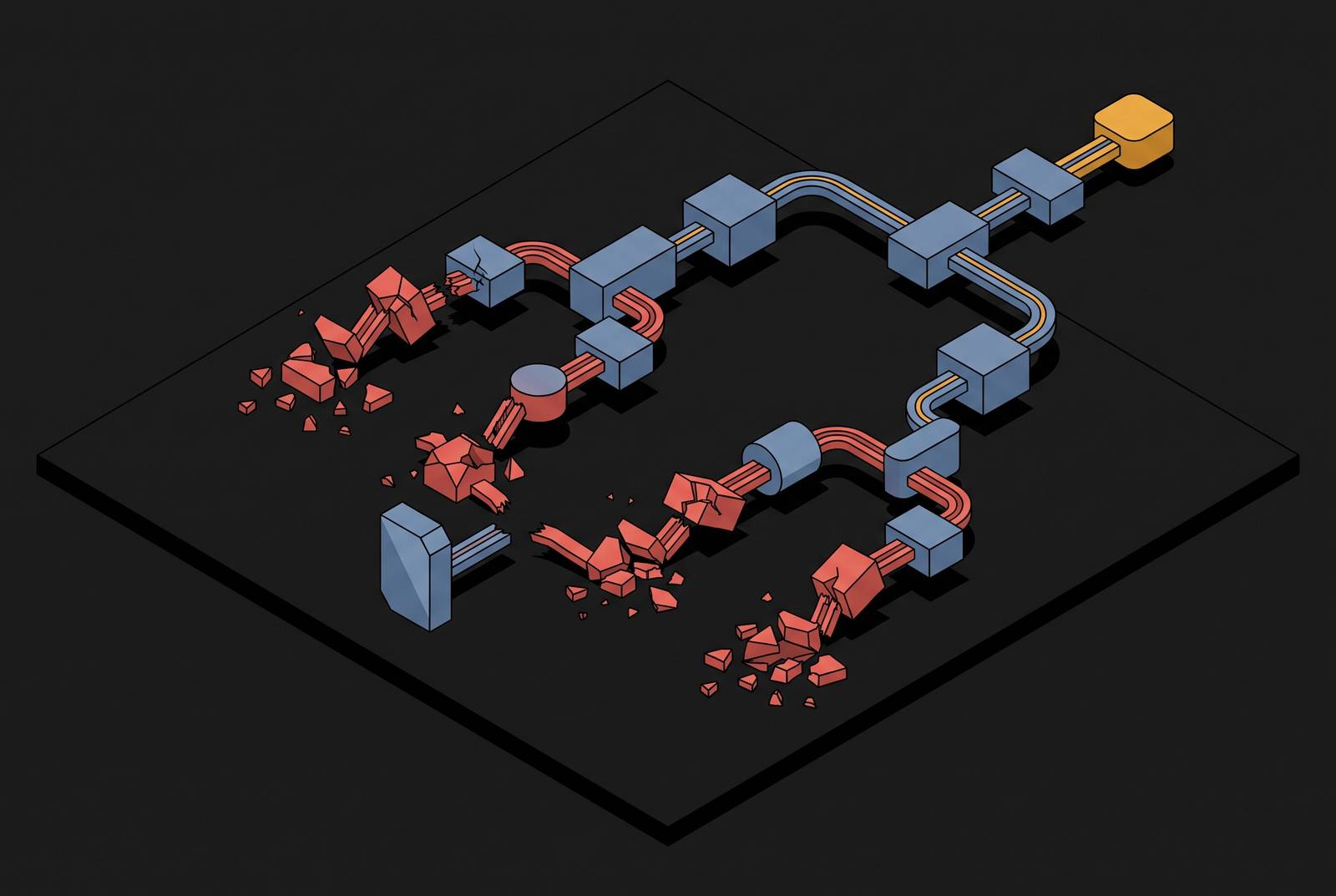
Branch collapse in conditional agent workflows is a specific, mechanically reproducible failure in which a workflow falls into a single degenerate path or stalls out.
Why branch collapse is not random misbehavior
Watched from outside, a collapsed branch looks like the agent simply lost the thread: a conditional workflow that was supposed to check a condition and route accordingly instead lands on the wrong path, or on no path. That appearance leads teams to spend engineering time on the wrong fix. A better prompt gets written, the auditor gets swapped out, the model gets upgraded. None of it touches the actual cause, because the actual cause sits in the architecture of the workflow itself: each branch decision depends on an intermediate output that can be wrong, or unenforced, or both.
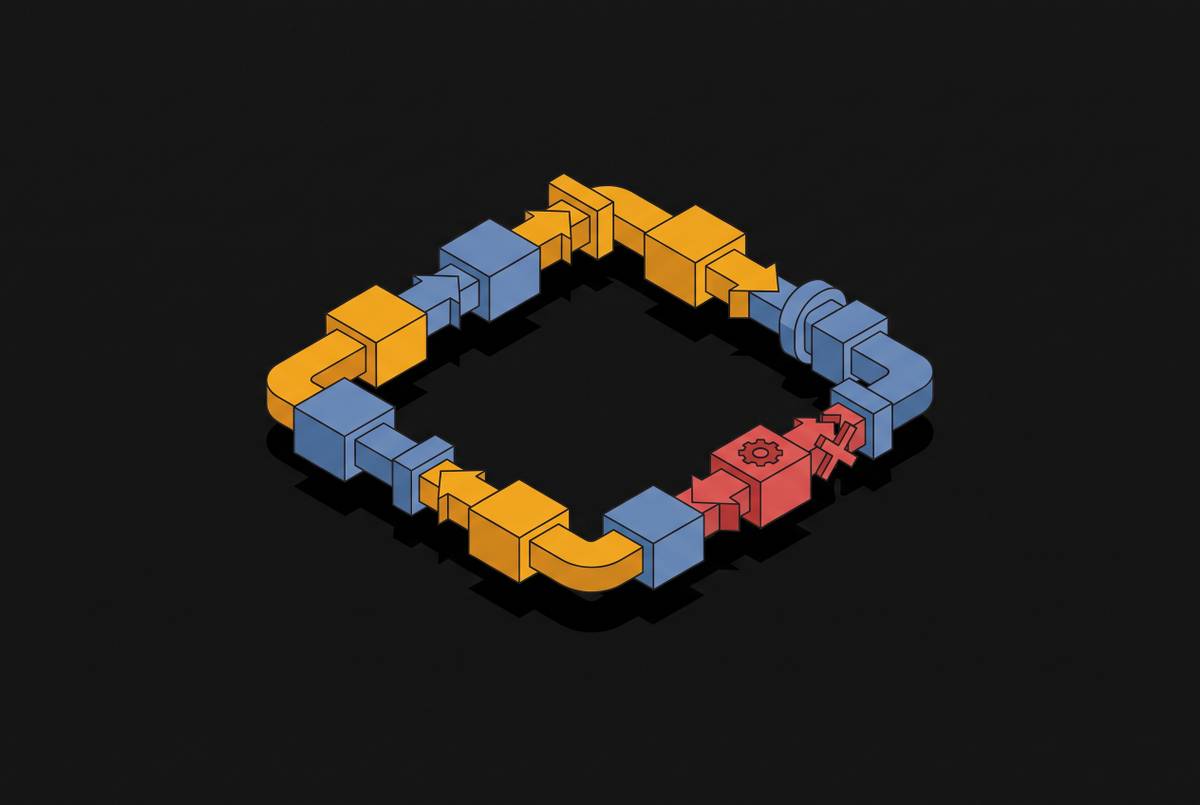
Three structural conditions account for most of the collapses that occur in conditional workflows. The first is an enforcement gap, where a routing or safety flag fires correctly but the controller executes the branch anyway, as if the flag had never been raised. The second is world-model erosion, where the agent's in-context representation of task state degrades to the point that it can no longer evaluate a branch condition correctly, even though nothing in the control flow is broken. The third is a self-loop trap, where the agent is asked to judge its own circuit-breaker status and, under the stress of an already-degrading state, produces a verdict that cannot be trusted.
Research on the enforcement gap specifically (from Fudan University) separates detection probability from enforcement probability as two different quantities a system has to get right. If that gap stays open, improving the auditor, the prompt, or the base model buys nothing, because a flagged branch still runs.
If you treat branch collapse as a control-flow problem, rather than a shortfall in the model's reasoning, an engineering team can actually fix it. The sections that follow take each of these three conditions in turn, work out how they present in a live trace, and then build toward a method for tracing a collapse back to its layer of origin and fixing it there.
The enforcement gap and silent conditional-branch collapse
The enforcement gap is the most common proximate cause of branch collapse precisely because it removes the value of good detection.
The Fudan University research states this with useful precision: detection probability (p_d) and enforcement probability (p_e) are separate quantities, and across every framework tested, p_e is effectively zero unless the flag is explicitly wired to a halt. In a conditional agent workflow, this gap appears constantly outside of adversarial or security scenarios: a routing check determines a sub-agent should not proceed on a given branch, a safety gate determines an output doesn't meet a threshold, a branch-condition evaluator returns a negative result, and in each case the controller carries on to the next step as if the check had passed.
The research also distinguishes three residues of this failure, each with a different cause and a different fix. Malformed or hedged verdicts, which a simple rule-based parser can't interpret cleanly, require a learned enforcement controller trained to handle ambiguous output. Which of the three is present in a given collapse determines which fix applies, and treating all enforcement failures as the same problem leads to the wrong repair being shipped.
A common objection is that reflection loops already exist in most agent architectures, so a better reflector should catch this on its own. The fix has to happen in the control flow that decides what happens after the flag fires, not in the quality of the flag itself.
How world-model erosion degrades branch conditions from the inside
Enforcement can be fully intact and a branch can still collapse, because the agent is evaluating the condition against a state representation that no longer matches reality. An LLM agent holds its dynamic sense of where a task stands primarily in its in-context state, with static world knowledge sitting separately in the model's weights. Anything that degrades that in-context representation, whether from a bloated context window, truncation, or small errors introduced step by step, undermines the agent's ability to evaluate a branch condition correctly, independent of whether the control flow around it is sound.
Research on world-model collapse frames this degradation as a phase transition, not a steady drift. They become uncoupled from the actual state of the task, producing confident-looking decisions that have stopped tracking what's actually true. That framing explains why erosion feels sudden to the engineers reviewing the trace even though the underlying degradation built up over many steps: the workflow looked fine until a specific point, and after that point every branch decision downstream is working from a representation that no longer corresponds to the task.
Research on automata built from agent traces adds a useful constraint here: behavioral topology across agents is shaped more by the deployment harness than by the underlying model, to the point that the same finite-state machine achieves near-perfect fitness across every model tested. It follows a pattern set by the harness, so the pattern is predictable, and an orchestration-layer intervention can catch a predictable pattern before it compounds.
Self-loop traps are the sharpest version of this failure. A threshold enforced at the orchestration layer, independent of the agent's own self-assessment, avoids this specific trap. A branch that collapses after a fixed number of steps points to world-model erosion; a branch that collapses at an identifiable tool call or routing decision points to an enforcement gap.
Tool schema drift, prompt ambiguity, and routing errors
Tool schema drift and prompt ambiguity get treated as tool-layer or prompt-layer problems, but their real damage happens at the level of branch routing, because the agent's conditional logic has no way to tell a structurally broken tool response apart from an ordinary transient failure. It routes on whatever signal it gets, whether or not that signal means what the agent assumes it means.
Schema mismatch is the most dangerous version of this. The tool returns data, but that data doesn't conform to the contract the agent was promised: a field has the wrong type, a required key is missing, the JSON is malformed, or the payload got cut off mid-response. Research on agent-environment failure modes (the Aegis taxonomy) organizes this kind of breakdown into six categories spanning exploration, exploitation, and resource exhaustion, and the underlying point is the same across all of them: the failure is in the harness's ability to present a consistent environment to the model, and not in the model's reasoning about what it received.
Research tracing error lifecycles across long-horizon trajectories (the TRAJDEBUG work) makes explicit that error origin and error visibility are often separated by multiple steps. That means the step where a failure becomes visible is often not the step where it started, and treating the visible failure point as the root cause will send an engineer looking in the wrong place.
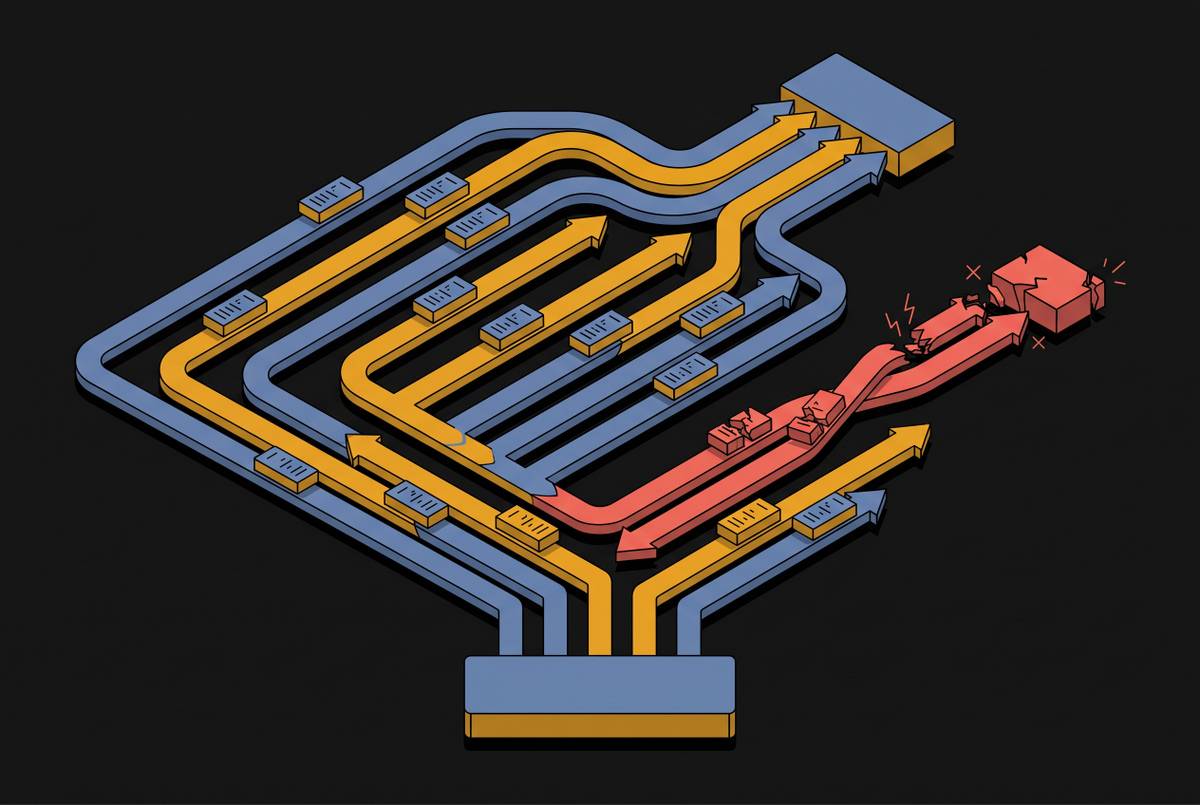
The compounding mechanism follows a recognizable shape. A schema mismatch at step S2 causes the agent to retry with the same bad arguments, burning tokens and racking up error counts without resolving anything. When a trace shows a plausible-looking failure at step SN, check several steps earlier, at step S(N-K), for a schema mismatch or an ambiguous routing instruction. The surface failure is rarely where the collapse actually began.
Workflow loops as a distinct collapse pattern with their own diagnostic signature
Workflow loops look like branch collapse from a distance, but they come from a different structural source and leave a different signature in the trace, and engineers who conflate the two will misdiagnose both. Loops are produced by three specific gaps: no exit condition, so the agent drifts or repeats because the branch condition is never satisfied or never actually enforced; no fallback handling, so the agent halts on the very first tool error because no alternative path exists; and no format specification, so the output is technically correct but unparseable, leaving the conditional logic with nothing it can evaluate.
Research on real-time detection and repair of agent failures runs loop detection during execution so the orchestration layer can step in before the loop has burned through a token budget or hit a rate limit. In shared API tier architectures, a runaway retry loop can exhaust the global rate limit for the whole tier, producing 503 errors for every other system sharing that capacity.
Research on automata built from agent traces shows that per-state behavioral features can predict failure with high AUROC from a partial trace, and that an online monitor built on those features can rank failing runs above passing ones well before the run finishes.
In the trace, one looks like a short path arriving at a bad outcome; the other looks like an expanding sequence of repeated or near-identical steps that never resolve.
A step limit alone doesn't solve this. Semantic repetition detection paired with explicit exit-condition specification is what actually distinguishes the two cases.
Tracing a collapsed branch back to its origin layer by layer
Finding the root cause of a branch collapse is a search problem, because the point where the failure becomes visible and the point where it actually originated are almost always separated by several steps. Research framing root-cause attribution this way describes it as assigning fault to the responsible component, whether that's the model, the harness, the environment, or the grader, and that assignment is what tells an engineer which layer to intervene on. An outcome-level signal like "the run failed" carries none of that information.
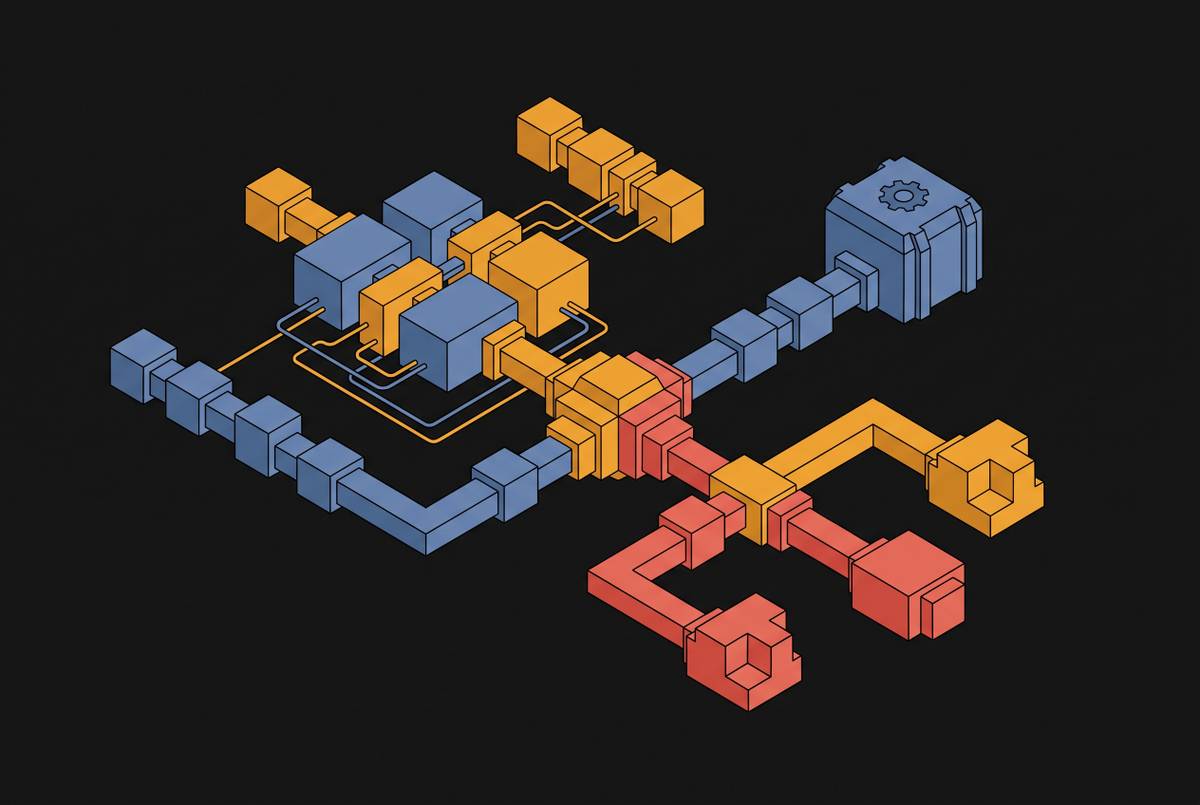
A practical search order moves through the layers in sequence. Start at the orchestration layer and ask if a flag fired without triggering a halt. Move to the workflow layer and check whether an exit condition or a fallback path is missing. Check the tool layer for a schema mismatch at or before the point of failure. Check the prompt layer for an ambiguous routing instruction that could have caused a misinterpretation several steps upstream. Finally, check the memory and context layer for evidence that the world-model eroded at an identifiable point, where the agent's state representation became structurally inconsistent with the task.
None of this works from a summary log. The minimum viable signal is the full step-level trace: the reasoning at each step, the tools considered against the tools actually invoked, the arguments passed, the responses returned, tokens spent, and latency per hop. Pass/fail health checks and aggregated log summaries discard exactly the intermediate state that reveals how a failure propagated, which makes layer-by-layer attribution impossible to do with them.
Why the harness is the right layer to fix
Branch collapse originates in the harness: the prompt, the tools, the workflow definition, and the memory architecture. That has a direct consequence: the fix is available without retraining anything, and the harness is the highest-leverage layer a team can change on a short cycle.
Each of the failure modes covered so far resolves into a harness-layer fix once its origin is located. You address loop collapse through exit-condition specification, fallback handling, and format specification, which are workflow design choices, not anything to do with model capability.
A 2026 framework called Continual Harness formalizes a version of this as an ongoing process rather than a one-time repair: from a minimal environment interface, a Refiner reads the recent trajectory for failure signatures every F steps and applies create, read, update, and delete edits to the system prompt, sub-agents, skills, and memories, closing the loop from an observed failure to a harness edit within the same episode.
The Macaron-V1 architecture draws a related structural line by formalizing three independent release clocks: base model, specialists, and harness. The finding from automata research, that a single finite-state machine achieves near-perfect fitness across multiple different models running on the same harness, reinforces the same point from a different angle: the harness is the stable, controllable variable, and the model is comparatively interchangeable.
This isn't an argument against improving the model. But the evidence from production trace analysis points the other way for the large majority of collapses that are actually attributable: they trace back to the harness, and the harness fixes should be exhausted before anything else is considered.
Validating a harness fix against historical traces before shipping it
A harness fix that hasn't been checked against the traces that revealed the original failure is a guess dressed up as a repair. Replay-based validation against historical traces is the only way to confirm that a given fix actually closes the collapse it was built for, without quietly breaking paths that used to work.
Traditional logs can't reproduce a failure that was never deterministic to begin with, which is the normal condition for LLM output. You need span-based trace replay as the baseline for testing any harness change against the exact conditions that produced the collapse. That points to a two-mode validation setup: live mode, running against real tools and a real network, suited to canary evaluation; and replay mode, running against recorded tool responses in a deterministic environment, suited to CI and to attributing regressions precisely. The deterministic environment in replay mode is what makes the validation repeatable across runs.
A 2026 paper on whether agent optimizers compound their gains establishes a regression constraint worth building into any validation process: within its RELAI-VCL optimizer specifically, a candidate harness edit that improves performance on the newly targeted failure cases but regresses on tasks the agent had previously solved gets rejected.
None of this can be a black box. A fix that only reports an improved pass rate, with no visibility into what traces produced that number, can't be audited, and a fix that can't be audited has no business running in production.
Sources
- Why LLM Agents Collapse Without Oversight:The Enforcement Gap as the Mechanism Behind Emergence World Failures
- World-Model Collapse as a Phase Transition
- Real-Time Detection and Repair of LLM Agent Failures
- Aegis: Taxonomy and Optimizations for Overcoming Agent-Environment Failures in LLM Agents
- Automata from Agent Traces:Failure and Next-Step Prediction
- TRAJDEBUG: Tracing Error Lifecycle to Identify Critical Failures in Long-Horizon Agent Trajectories
- Root-Cause Attribution Is a Search Problem: Continual Search for Long-Horizon Agent Failures