Choosing an Agent Orchestration Framework for Production Reliability
Framework choice determines whether your production agents survive failure or collapse under load.
Most agentic AI projects succeed as demos and fail as production systems, and the gap is not a model quality problem. The missing layer is the orchestration framework: the scheduling, error handling, state durability, and governance that determine whether an agent recovers from failure or collapses under it. Framework choice is the first architectural decision that determines whether a system can cross that gap, because the framework defines how an agent recovers, persists state, and handles failures before the governance layer is even involved.
What an orchestration framework actually controls, and what it leaves to the layer above
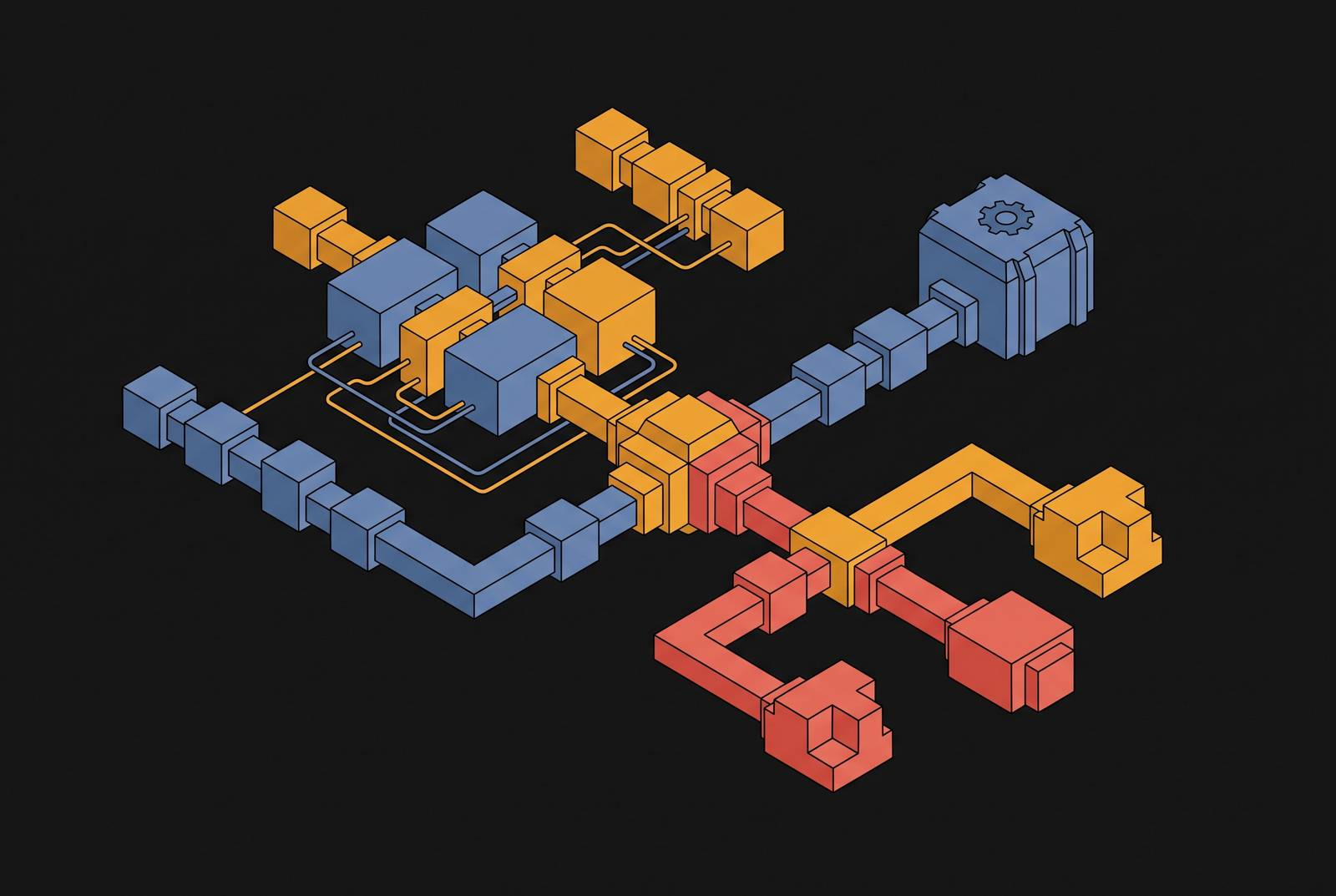
The distinction between an agent framework and an agent orchestrator is not academic. An agent framework defines an agent's internal reasoning, LLM integration, tool use, memory management, and planning. An orchestrator manages the agent's external lifecycle: scheduling, triggers, retries, error handling, and durability. A third layer, the control plane, handles governance and visibility: human approvals, audit logs, cost control, and observability across all agents. TrueFoundry's 2026 framework guide makes the production corollary explicit: a framework decides how agents reason, hand off work, recover from errors, and hold up under load. It does not decide how they are governed, what they can access, or what they cost. Those belong to the infrastructure and governance layer above.
The consequence of conflating these layers is practical, not theoretical. Teams that evaluate frameworks on governance criteria those frameworks cannot deliver will select for the wrong reasons and discover the gap at the worst possible time, in production, when a workflow that requires human approval before a destructive action discovers that the framework offers no native mechanism for it. The correct evaluation surface is narrower and more tractable: how the framework behaves under the five failure modes that actually kill production agents. That is what the next section introduces.
The five failure modes that determine whether a framework survives production
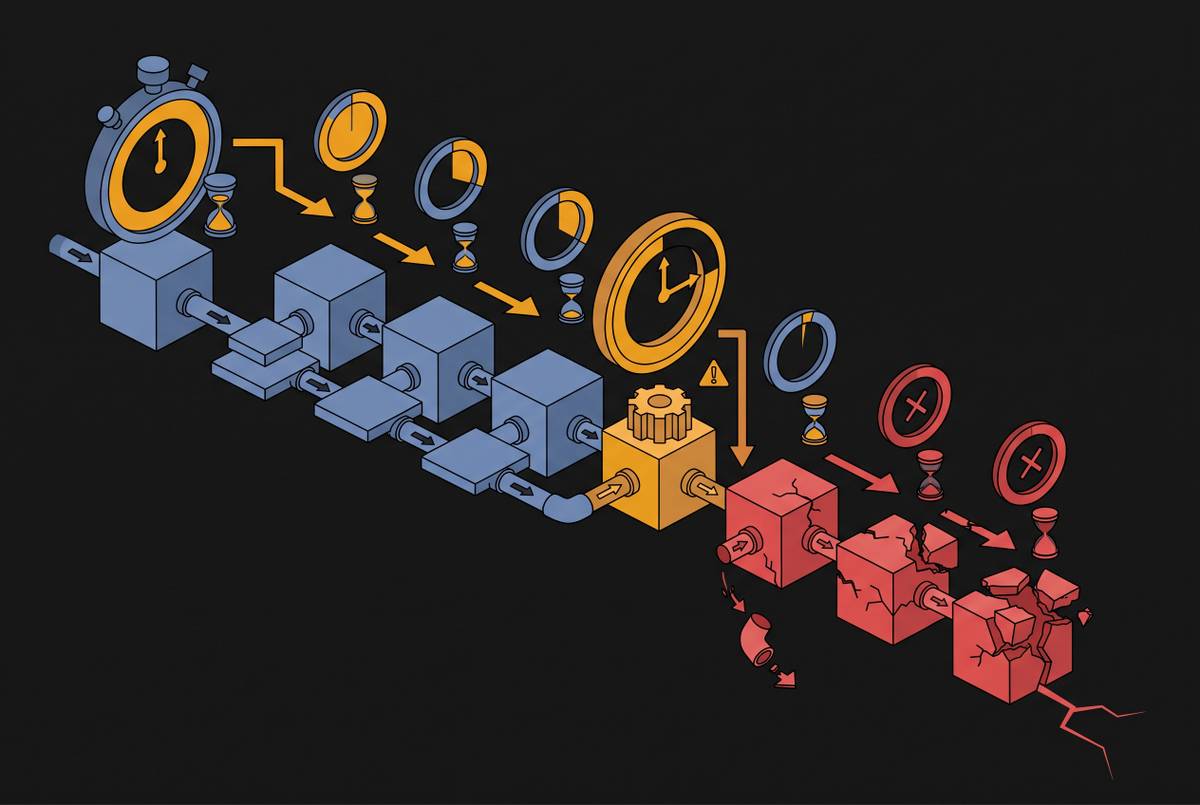
Production agent failures cluster into five canonical categories, and a framework's architecture either addresses them structurally or leaves teams to solve them in application code. The categories are tool-call failures, context overflow, unbounded loops, cascading timeouts, and tool misuse. Each failure mode shows up in its own way and has its own fix, so the framework's design choices around each one matter separately.
A tool call fails when a tool returns malformed output, an API times out, or a schema mismatch leaves the agent with data it cannot parse. The framework must define what happens next: retry, fallback, escalate, or halt. Context overflow happens in long-running workflows when accumulated context exceeds the model's window, causing silent truncation that corrupts downstream reasoning without raising an error the framework can catch. Unbounded loops arise when an agent pursuing an underspecified goal iterates indefinitely. "Improve the code" is a bad loop goal because the agent can never determine when it is done. Tool misuse is the agent calling the right tool with the wrong parameters, or the wrong tool for the task, a failure mode harder to detect than a crash because the workflow completes successfully with incorrect results.
ChromaFlow's 2026 ablation study on GAIA Level-1 tasks shows that these failure modes are not hypothetical. A later recovery configuration with expanded orchestration achieved 27/53 correct answers, or 50.94%, while increasing tracebacks, timeout events, tool-failure mentions, token-line calls, and campaign-log cost estimates. Orchestration overhead itself becomes a failure surface if not bounded.
How orchestration model choice shapes a framework's baseline resilience to these failures
The orchestration model is not a style preference. It determines how much of each failure mode the framework handles structurally versus leaving to the application developer. JetBrains' 2026 agentic frameworks survey identifies three dominant paradigms: graph-based, role-based, and chain-based adaptive orchestration.
In graph-based orchestration, agents and tools are nodes in a directed graph with explicit edges. This gives maximum determinism and makes debugging tractable. When a node fails, the graph tells you exactly where. JetBrains' 2026 blog post on agentic frameworks notes graph-based orchestration is ideal for customer-facing applications, enterprise systems, and regulated environments.
Role-based orchestration assigns agents roles and has them collaborate by passing messages. It is easy to design but hard to constrain, because the same input can produce different outputs, so tool misuse and loop detection get harder to enforce. It suits rapid prototyping, and production use requires adding explicit constraints that the paradigm does not provide natively.
Chain-based adaptive orchestration lets agents operate in dynamic chains, deciding the next step autonomously. This offers maximum flexibility but least predictability. Production systems almost always combine paradigms: deterministic routing for paths that touch money, regulated data, or irreversible actions, and model-driven routing for low-stakes branches.
How the leading frameworks handle the five failure modes in practice
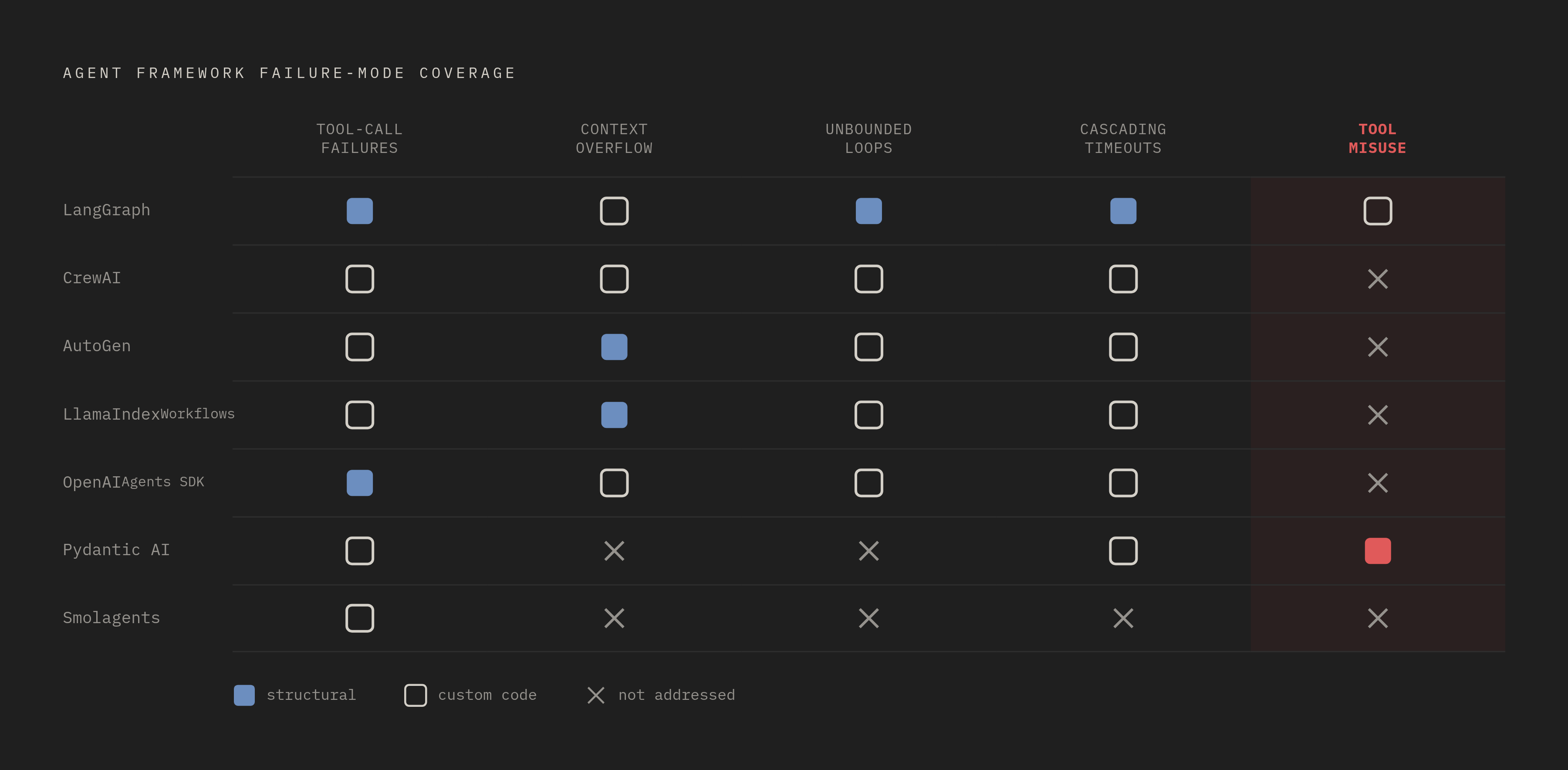
Each framework makes specific architectural bets that either absorb or expose each failure mode. Understand those bets, and you can choose a framework for reasons rather than preference. LangGraph is classified by both Kestra's 2026 comparison and TrueFoundry's 2026 guide as graph-based, MIT-licensed, and Python, with native checkpoints for durable state and native interrupt support for human-in-the-loop. LangGraph is strongest on unbounded loops, cascading timeouts, and tool-call failures, because the graph structure bounds the path, explicit edges allow bulkhead placement, and checkpoints enable resume from the failed node rather than full restart. It is weakest on upfront design cost. Teams must think in state machines and async graph execution, and the steep setup overhead makes it a poor fit for rapid prototyping. It fits regulated workloads, critical pipelines, and any workflow where deterministic, auditable routing decisions are required.
CrewAI is role-based, MIT-licensed, Python, with in-memory state that is not durable, and human-in-the-loop via custom code. It is best at fast multi-agent prototyping, because role and goal assignment maps cleanly onto familiar business-process mental models, and it supports sequential and hierarchical crew patterns. Its state durability is the critical weakness: a crash at step four of a five-step workflow restarts from zero. CrewAI fits prototyping and internal automation where some failure tolerance is acceptable and developer speed matters more than determinism.
Microsoft AutoGen, called the Microsoft Agent Framework in Kestra's 2026 comparison, is event-driven, MIT-licensed, available in Python and.NET, keeps state via an external store, and implements human-in-the-loop via custom code. State durability depends on the external store chosen, not a built-in guarantee. It fits teams already in Microsoft's ecosystem because it integrates natively with the surrounding infrastructure.
LlamaIndex Workflows is event-driven, MIT-licensed, and Python, and it has native state, but human-in-the-loop needs custom code. Native state gives it better crash recovery than CrewAI, but human-in-the-loop and tool-call failure recovery still require custom code. It fits workflows where retrieval-augmented generation is the dominant pattern and context overflow from retrieval is the primary failure risk to manage.
The OpenAI Agents SDK uses hand-offs and sessions, is MIT-licensed, Python, keeps state via an external store, and implements human-in-the-loop via custom code. It is best for OpenAI model-centric development. State durability depends on an external store, and with the hand-off model, cascading timeouts across agent boundaries need explicit handling. Pydantic AI is the most direct structural defense against tool misuse, because strong typing catches a tool parameter of the wrong type before the model's output reaches the tool. It is not designed for long-running multi-step workflows, so context overflow and unbounded loops are not addressed at the framework level.
Smolagents is code-generation based, Apache-2.0 licensed, Python, with no built-in durable state and no native human-in-the-loop. It is best for minimalist, code-first agent creation. The code-generation approach means the agent writes and executes code as its action primitive, so tool misuse and unbounded loop risks are highest here, as the execution surface is broad and not type-constrained by default.
Orchestration layers such as Kestra and Temporal sit above frameworks rather than beside them. Both manage lifecycle, scheduling, retries, and governance. These layers address cascading timeouts and tool-call failures at the infrastructure level rather than the application level, which is the most robust structural defense, but they require a framework underneath them. Kestra's native human-in-the-loop approval gates make it the strongest option for workflows where human review before execution is a compliance requirement.
What production deployments in specialized domains reveal about framework requirements
Osprey was developed at Lawrence Berkeley National Laboratory in 2025 and is a documented production framework deployment at the Advanced Light Source accelerator facility, where it manages real-time operations across hundreds of thousands of control channels. The four architectural decisions Osprey made to reach production reliability map onto the five failure modes one for one. The plan-first orchestrator generates complete execution plans, including all dependencies, for human review before any hardware is touched. That is a structural defense against tool misuse and cascading timeouts in irreversible actions. A safe, containerized execution layer isolates generated analysis code and enforces mandatory approval for hardware writes, which is a hard architectural constraint against unbounded autonomous action.
Every architectural choice Osprey made was a direct response to a failure mode, not a feature added for completeness. Production-critical systems cannot afford framework-level gaps that they will patch later in application code. Osprey also integrates Model Context Protocol for automated capability creation, and this shows that protocol-standard tool integration reduces the custom glue code that is itself a failure surface.
Why adding more orchestration without bounding it creates its own failure mode
The ChromaFlow ablation result is the clearest empirical warning against treating orchestration as an unbounded good. A subsequent strict-provider diagnostic reached 56.60% under explicit integrity controls, but it cost substantially more in token-log terms. The correct response to orchestration noise is tighter constraints, not more layers.
The failure pattern is systemic. The practical rule is that every orchestration component you add to handle a failure mode needs its own bound. Bounding is a design discipline, not a setting to tune later.
How production trace analysis closes the gap between framework capability and runtime behavior
No framework evaluation against synthetic benchmarks or documentation tells you how the framework behaves on your specific workload. Only production traces do. Production agents fail in multi-turn, multi-step sequences where the root cause of a wrong answer at step ten traces back to a tool call at step three or a context retrieval at step one. That causal chain is only visible in traces, not in final outputs.
Standard APM tools cannot capture this without agent-aware instrumentation. The five failure modes have distinct trace signatures. Tool misuse appears as completed tool calls with outputs that do not match task intent, and this last is the hardest to detect without an eval layer. Root-cause attribution from traces is a search problem, not a local inspection. If you sample the most signal-rich interactions for evaluation, you can afford continuous quality monitoring.
Matching framework choice to the specific failure profile of your production workload
Framework selection is not a ranking exercise. It is a matching exercise between the framework's structural failure-mode coverage and the failure profile of the specific workload being deployed. Step one is to characterize the workload's failure tolerance by failure mode. If the workflow includes irreversible actions such as hardware writes, financial transactions, or regulated data changes, tool misuse and tool-call failures require structural rather than application-level defenses, so favor graph-based frameworks with typed schemas and mandatory approval gates. If the workflow is long-running with many steps, context overflow and cascading timeouts are the dominant risks, so favor frameworks with native durable state, like LangGraph checkpoints or LlamaIndex native state, rather than in-memory state. If the agent goal is underspecified or open-ended, unbounded loop risk is highest, and any framework choice must be paired with a hard iteration budget and a testable termination condition at the application level. If the tool surface is large and evolving, tool misuse and tool-call failures from schema drift are the dominant risks, so favor frameworks with strong typing, like Pydantic AI, or dynamic tool selection, like Osprey's capability classifier pattern, to keep prompts compact.
Step two is to evaluate each candidate framework against the failure modes that matter for the workload, using the criteria from the comparison: structural versus application-level handling, native versus custom human-in-the-loop, and built-in versus external state durability. Step three is to determine whether the framework alone is sufficient or whether an orchestration layer like Kestra or Temporal is needed to handle the lifecycle, scheduling, and governance requirements the framework leaves to the layer above. Step five is to set up a replay-based eval against a stable sample of production traces before you ship any framework configuration change, prompt update, or tool schema change. Silent drift from any of these sources is the most common path from working demo to broken production system. The teams that reach production, the 11%, are not the ones who picked the most powerful framework. They are the ones who matched framework capability to workload failure profile and built the instrumentation to validate that match continuously.
Sources
- Top Agentic Frameworks for Building Applications 2026 - The JetBrains Blog
- ChromaFlow: A Negative Ablation Study of Orchestration Overhead in Tool-Augmented Agent Evaluation
- Osprey: Production-Ready Agentic AI for Safety-Critical Control Systems
- Root-Cause Attribution Is a Search Problem: Continual Search for Long-Horizon Agent Failures