Output Integrity Checks That Catch Silent Tool Failures Downstream of the Orchestrator
Output integrity checks at tool boundaries catch silent failures agents miss on their own.
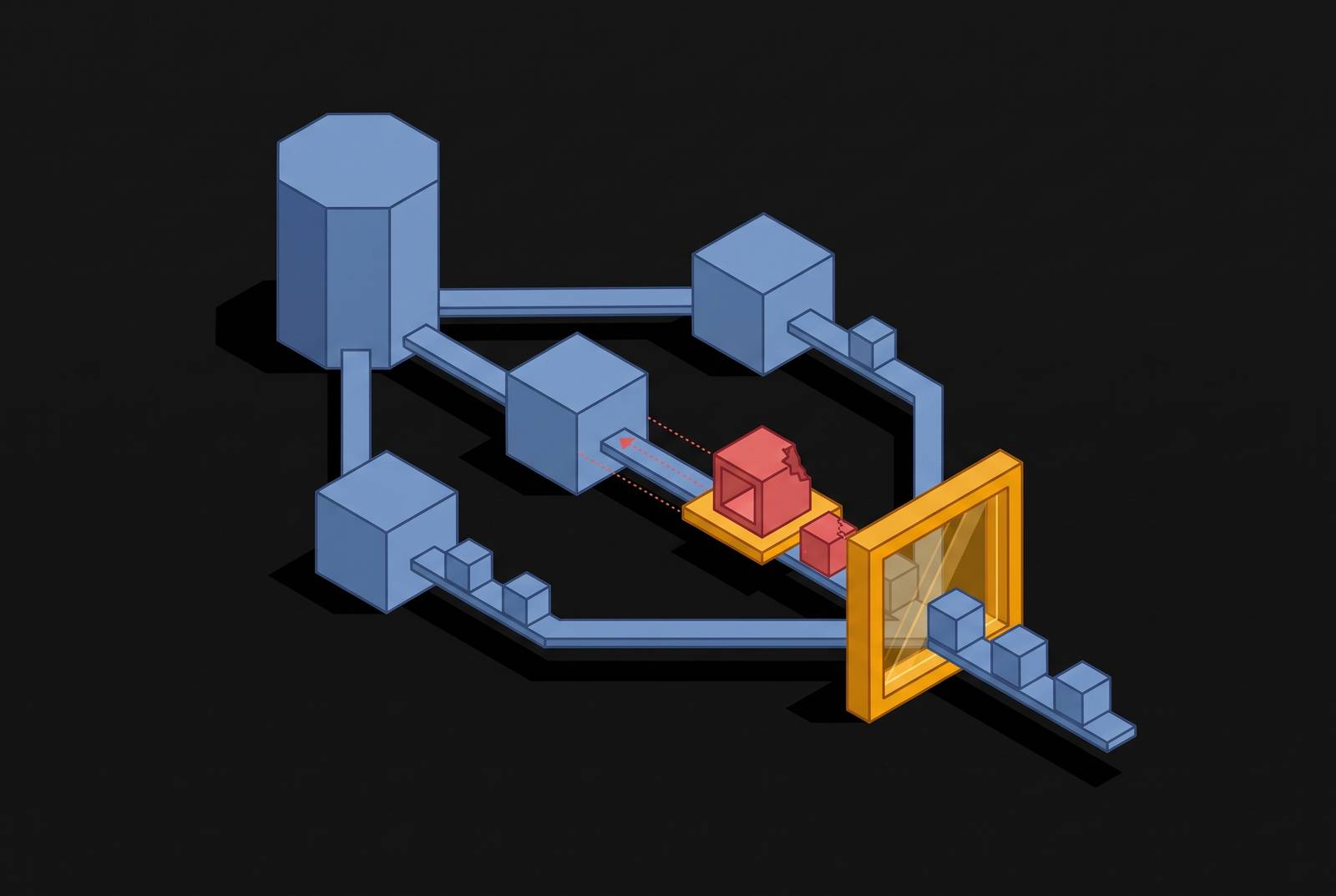
To detect silent tool failures in production multi-agent pipelines, teams need output integrity checks at the tool boundary as well as successful-call logs. These checks test returned values against machine-verifiable outcome contracts before the orchestrator consumes them as fact. When a contract is violated, an advisory receipt preserves the result, names the discrepancy, and identifies available recovery tools without choosing the agent’s next action.
Why silent tool failures are harder to catch than explicit ones
Wu’s 2026 account of a production incident describes how the system turned a failure into made-up analysis and gave it to the user as fact. The system did not merely suppress an error. It converted the error into fluent, plausible narrative content, a behavior Wu calls “fail-plausible.” Unlike a gray failure that starves a detector of signal, this behavior gives the human a counterfeit signal of success.
The underlying defect is an interface and contract problem. A plausible, well-formed response contains no exception to catch, status code to branch on, or field distinguishing it from a legitimate result. Kraishan’s 2026 study, Loud Failures, Quiet Failures: Fault Detection and Recovery in Tool-Using Language Model Agents, found that agents treated explicit tool errors as problems in 91.3% of trials. They were far less likely to spot wrong values that looked plausible. Without a visible distinction, the orchestrator passes the result downstream unchallenged.
The three categories of silent failure and how each one hides
Tool schema drift hides constraints outside the machine-readable interface. SilentProbe’s 2026 audit of parameters across 2,501 OpenAPI documents found that only a small share had any machine-checkable constraint, while a large share had constraints written only in prose. Constraint form predicted detection better than vendor identity. Machine-checkable constraints led to honest errors in every case tested, while prose-only constraints led to silent failures in most cases by far. A vocabulary described only through examples was missed by every tested model on every attempt, whereas fully written-out vocabularies were used correctly at high rates.
Prompt ambiguity and tool interface failures can leave a call looking usable even when it hides uncertainty. Ambiguous schemas, poorly ranked tool candidates, weak argument validation, and unactionable error messages create different routes to a result the agent accepts as correct. The call can look valid without being well specified. In this category, the interface fails to communicate enough about the intended operation or its failure for the agent to distinguish success from misuse.
Workflow lifecycle failures instead hide in the execution trajectory. A workflow may repeat ineffective actions, enter retry loops, finalize prematurely, lose task state, or delegate without verification. Each response can look fine on its own. Bajaj’s 2026 formalization calls the shared mechanism “evaluation blindness,” where a measurement is indistinguishable from a non-failing state and no auxiliary signal exposes the discrepancy. The study found that no standard metric detected more than two of six documented production failure modes.
Why standard observability misses these failures even when traces exist
HTTP status, latency, and token count show how a call ran but do not show whether the value it returned is legitimate. A completed request is not a verified outcome. Standard APM tooling and unit tests can therefore remain green while the agent consumes a wrong value, because their checks cover transport or output shape, leaving the relevant semantic property unchecked. Even a trace containing the response does not automatically test that property. Agent-aware instrumentation must show what happened at the tool boundary, including tool-call failures, context truncation, and runaway loops.
Wu’s account found that a human reading the output eventually caught roughly 70% of silent failures, even though there were extensive unit tests and hundreds of declarative governance checks. The governance layer had no ex-ante prevention rate. Across 22 documented incidents, the recurring pattern was an error signal that never reached a human in actionable form. Incident duration correlated with failure mechanism rather than code complexity, with the longest-lived failures occupying seams between components where no test ran.
Pandey’s 2026 account describes how accuracy stayed steady across evaluation windows while output diversity fell sharply. Kraishan found that reasoning variants spotted silent failures less often and changed plans more often than their instruct siblings, but recovery stayed the same. The missing capability is a boundary check that distinguishes legitimate output before downstream reasoning or aggregation obscures the discrepancy.
What outcome contracts are and how they draw the tool boundary precisely
Outcome Monitors’ 2026 paper defines outcome contracts as machine-verifiable relationships between tool calls and their results, mined from nominal executions or derived from public schemas. A contract states an invariant that a legitimate result must satisfy, and the monitor evaluates it after the tool returns but before the result enters the orchestrator’s reasoning context. That placement preserves an inspectable boundary between returned data and accepted fact.
The two derivation paths provide different foundations for the check. Task-disjoint traces of nominal executions supply relationships observed in legitimate results, while public schemas supply explicitly declared constraints. The property must support a concrete diagnostic witness. For an inventory lookup, the paper gives “expected ≥ 0, observed -3,” which identifies both the expectation and its violation.
A gate restricts action, while the monitor preserves the returned value and issues a nonbinding advisory receipt naming the violated property and available recovery tools. The agent retains its full action set. This separates detection from recovery, so an improvement can be inspected without confusing the agent’s decision with a repair selected by a runtime guard.
What the evidence shows about outcome contracts catching failures the agent missed
Outcome Monitors reported substantial ToolMaze completion improvements across multiple models in two provider families, with replication in a third, under frozen, prespecified evaluations with injected failures. In τ-bench retail, completion improved by 14.0 and 12.0 points on two tiers. The ablation identified the active ingredient in the receipt. Removing the recovery-tool list eliminated the measured gain entirely, and restoring it recovered the effect. Adding more diagnostic detail or extending the reasoning budget made no detectable difference.
However, the benefit was not universal across environments. AppWorld showed no net effect, and clean ToolMaze controls included both rescues and harms. Most of the gains came where the injected fault kept the agent from completing the task.
Far fewer failures were caught outside the mined contract vocabulary, so nominal traces did not automatically provide checks for incidents the system had never seen. Extending that vocabulary remains an open problem. FlowFixer’s 2026 approach applies related assertion logic at workflow scale, assigning each node a suspicious score that combines behavioral abnormality from assertion violations with potential downstream influence. Higher assertion violation rates raise suspicion, helping localize a problem within multi-node orchestration.
How to implement output integrity checks at the tool boundary in practice
For engineering teams implementing this approach, the work begins with contract derivation. Promote vocabulary and range constraints from prose documentation into machine-readable schema fields. Then mine nominal production traces for deterministically checkable invariants, including value ranges, type patterns, cardinality expectations, and referential relationships. Good candidates for these checks include negative inventory counts, values outside declared vocabularies, and returned IDs that are missing from a cross-checked store. Subjective quality does not belong in this deterministic detector.
Next, check for violations after the tool returns and before its result enters the agent’s context window. Evaluate each result against its contract and produce a binary outcome, violated or not, without an LLM in the detection step. Input validation serves a complementary role here. Schema validation rejects nonexistent tools or bad arguments on the input side, while outcome contracts inspect returned values on the output side. To prevent loop amplification, hash repeated tool-call sequences and enforce a hard iteration cap, because wrong returns that keep repeating can form a pattern that can be detected even without a content contract.
On violation, preserve the raw result and append the advisory receipt. Include the name of the property, the condition expected, the value observed, and the recovery tools available. Do not replace the original result with the warning. The agent needs both to reason about the discrepancy, and the receipt must neither select a repair nor restrict its action set. Separately, a reviewer subagent with read-only tools can verify a “done” signal before closure, providing workflow-level protection against false completion.
Finally, capture each tool call, its arguments, raw return, contract evaluation, and any receipt as structured spans in the execution trace. Record decision branches as well as tool outputs. These records make violations auditable and support later attribution, rather than merely showing that an HTTP request completed. The implementation remains incomplete without a maintenance process, because a contract can become stale as the tool layer changes.
Keeping contracts current as tool schemas and production behavior drift
Parameter names can change in minor releases, vendor vocabularies can expand or shift, and range formats can change without the tool reporting a failure. An outdated contract can then miss the discrepancy it was designed to expose. Contract coverage therefore needs a known-good reference. Wu’s account found that declarative governance had an 87% ex-post regression-blocking rate, though it provided no ex-ante prevention. Contracts serve as regression checks against known behavior and cannot predict novel failure modes.
To maintain that reference, curate a golden set of traces with known-legitimate outputs and run it through the current production pipeline on a schedule. A contract that flags those outputs is miscalibrated. A sustained increase in false-positive violations can signal that nominal behavior has shifted. Production sampling adds a comparison with live traffic: when violations rise there but stay steady on the golden set, they point to a real change in tool behavior.
To keep coverage in place over time, teams need unit evals for each tool-call step, regression suites for output quality, and ongoing sampling of production traces. Contracts operate at the first layer but inform all three. AgentDebugX’s 2026 framework formalizes a maintenance loop in which Detect identifies step-level errors, Attribute locates root causes, Recover proposes ranked fixes, and Rerun regenerates the trajectory around the failure point. Hard cases escalate to a multi-round diagnosis agent that produces an auditable report with evidence and a recommended fix. The loop connects a detected violation to a repair that can be evaluated.
Attributing a silent failure to its layer before deciding what to fix
A violated contract identifies a discrepancy. Attribution must locate the responsible layer, whether schema, prompt, tool logic, or workflow, before the team chooses a repair. AgentRx’s 2026 framework defines the critical failure as the first unrecoverable failure by any agent in the execution trajectory. Locating that step and classifying its failure enables root-cause attribution beyond the fact that the overall run failed. FlowFixer groups causes into node capability, node orchestration, and node execution, with sixteen types that constrain the repair space.
For practitioners, the consequence is a layer-specific repair process. A schema-drift violation calls for a schema fix, while prompt ambiguity calls for tool-schema narrowing or documentation repair. The harness determines how those interfaces behave. Context rot, missing guardrails, absent state persistence, and feedback loops that never close are harness defects, and attributing them to the model leaves the underlying failure intact. Teams that use the same model can get sharply different results because of how they design their harnesses.
Harness engineering deserves the rigor of code review and testing across prompts, tools, schemas, workflows, and memory. The working sequence is a violated contract, an attributed root cause, and a validated fix. Each step answers a different engineering question. Where a component seam has neither a test nor a declared contract, the next plausible wrong result can remain invisible long after the tool call has completed.
Sources
- Outcome Monitors: Recovery Affordances for Silent Tool Failures
- SilentProbe: Measuring Silent Failure in Production APIs Used as Agent Tools
- When Errors Become Narratives: A Longitudinal Taxonomy of Silent Failures in a Production LLM Agent Runtime
- Loud Failures, Quiet Failures: Fault Detection andRecovery in Tool-Using Language Model Agents
- Evaluation Blindness: How Silent Measurement Failures Corrupt AI Systems from Training to Deployment