Ablation Testing Across Harness Layers in Production Agents
Layer-by-layer testing pinpoints which agent component caused a production failure.
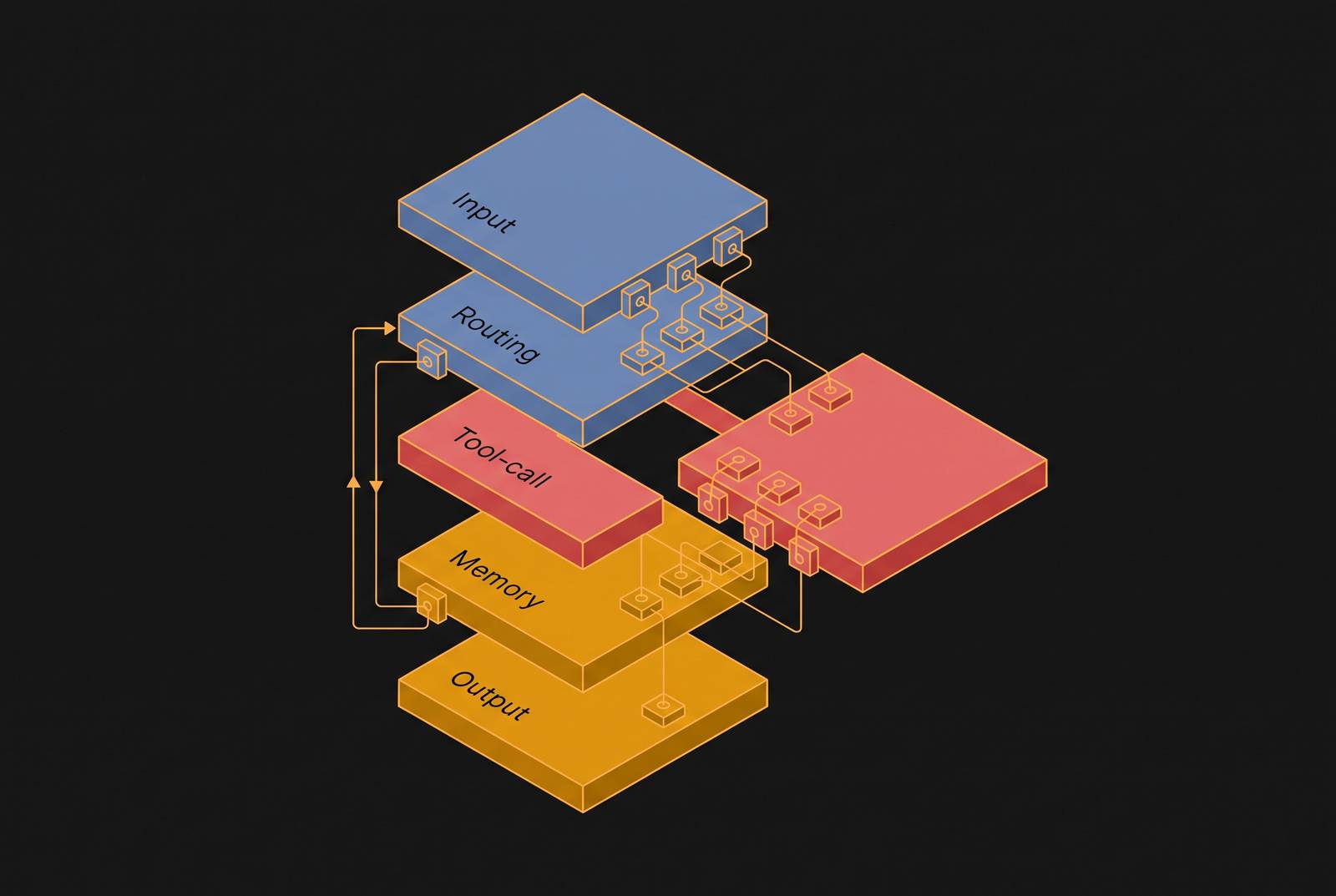
Ablation testing across harness layers isolates agent failures by removing or degrading one layer at a time while holding the rest constant. Before deploying an agent change, teams should replay it against a golden set of real production traces and compare layer-specific assertions alongside final task success. This makes prompt edits, tool changes, memory updates, and routing revisions attributable and testable before shipping.
Why aggregate pass/fail scores hide more than they reveal for production agents
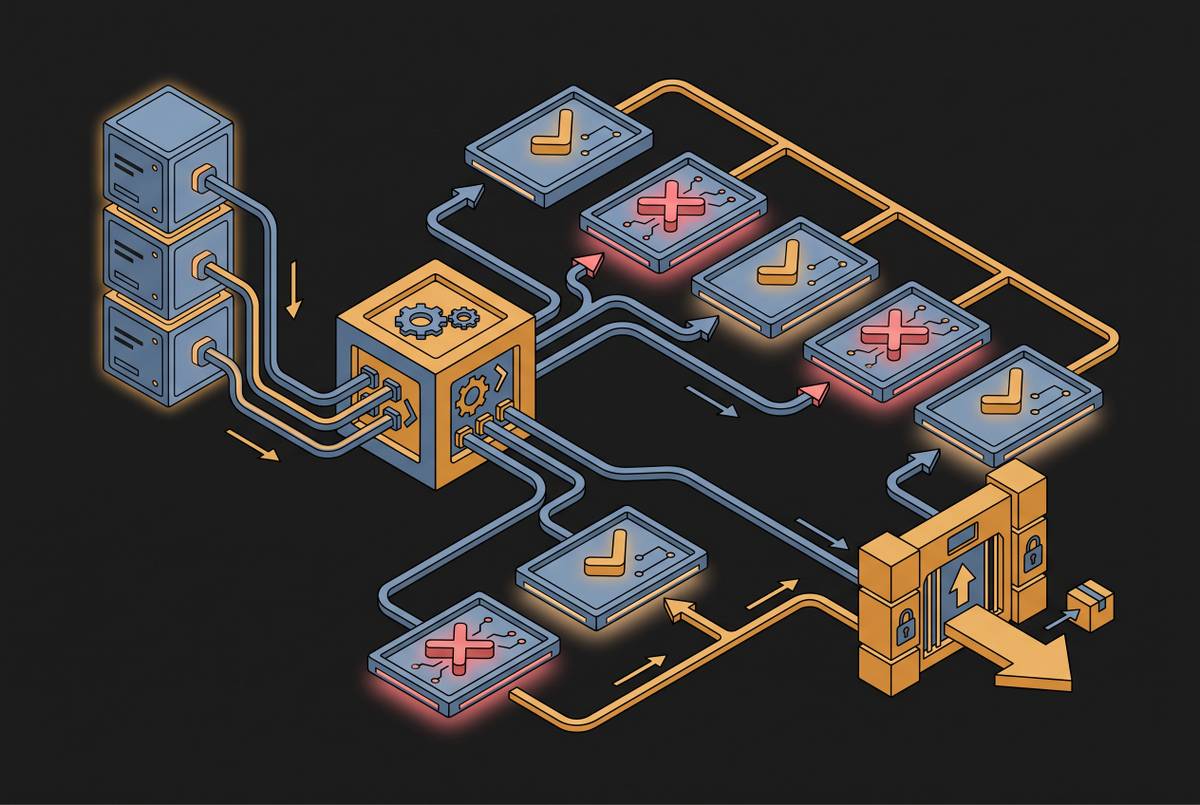
A production dashboard drops overnight, but the number cannot tell the team whether a prompt, tool schema, routing decision, or memory retrieval caused the decline. End-to-end task-success reduces the run to a binary outcome. The final score hides the decisions made along the way. A failed task therefore directs attention to the agent as a whole, even when the defect belongs to one subsystem.
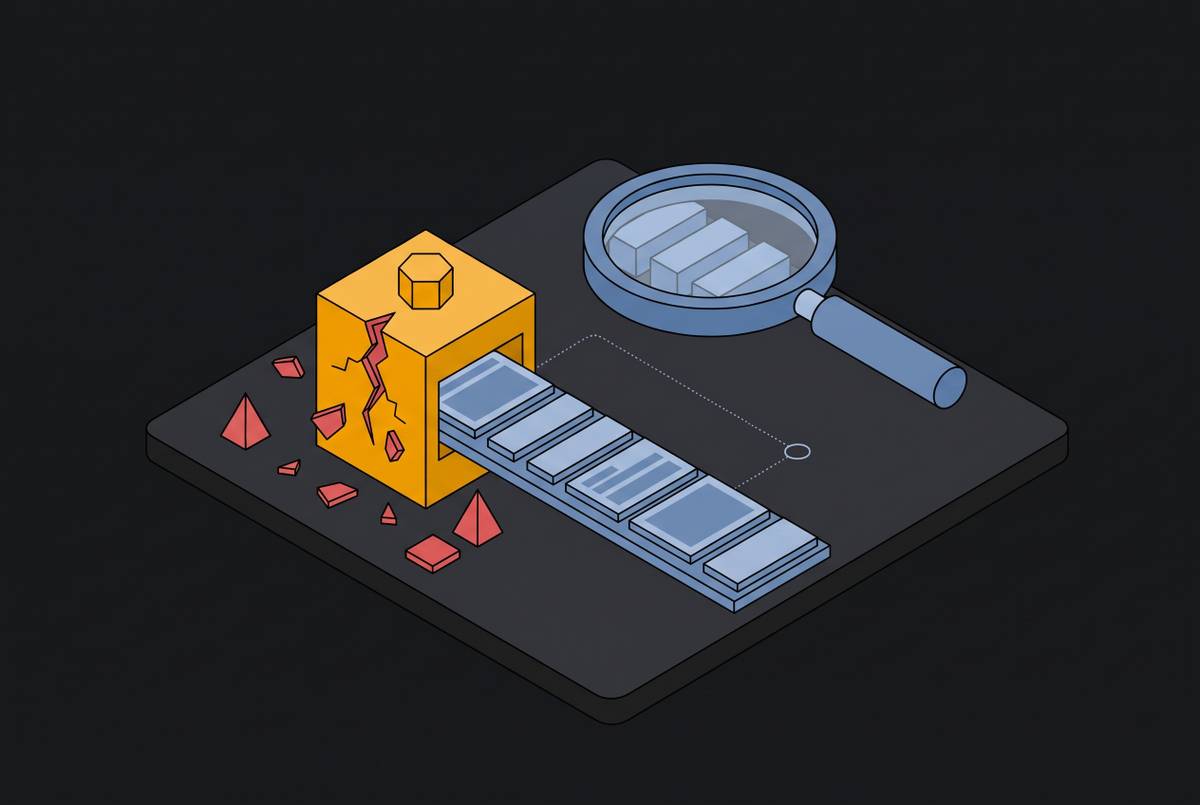
Lumivate's layer-isolated evaluation paper describes the cost of finding that subsystem through live reruns. Teams must rerun a stochastic, minutes-per-episode agent and bisect its behavior, making diagnosis slow and noisy. Each rerun introduces uncertainty of its own. Without a signal that identifies where execution first went wrong, teams spend time choosing a layer to investigate and risk shipping a fix addressed to the wrong subsystem.
What the harness actually is and why it is the right unit of analysis for failures
The harness is the stateful program around a language model that decides what the model sees and how execution proceeds. It constructs context, mediates tools, validates actions, and handles recovery. It sits above the model. Jung and Son's harness decomposition study cites prior research showing that changing this wrapper around a fixed model can change end-to-end performance by as much as six times on the same benchmark. That finding makes the wrapper a necessary unit of analysis.
In practice, production harnesses often bundle belief tracking, action selection, reflection, and revision into one LLM-orchestrated loop. That bundling obscures which part contributes useful behavior. Lumivate decomposes its deployed ordering agent into ontology pre-resolution, intent signals, routing, decomposition, escalation, safety, memory, and cross-cutting envelope/defense. Each layer has behavior that can be checked with assertions on its own. Once those responsibilities are externally measurable, the model's contribution can be measured as a residual.
What layer-by-layer ablation means in practice for a production agent
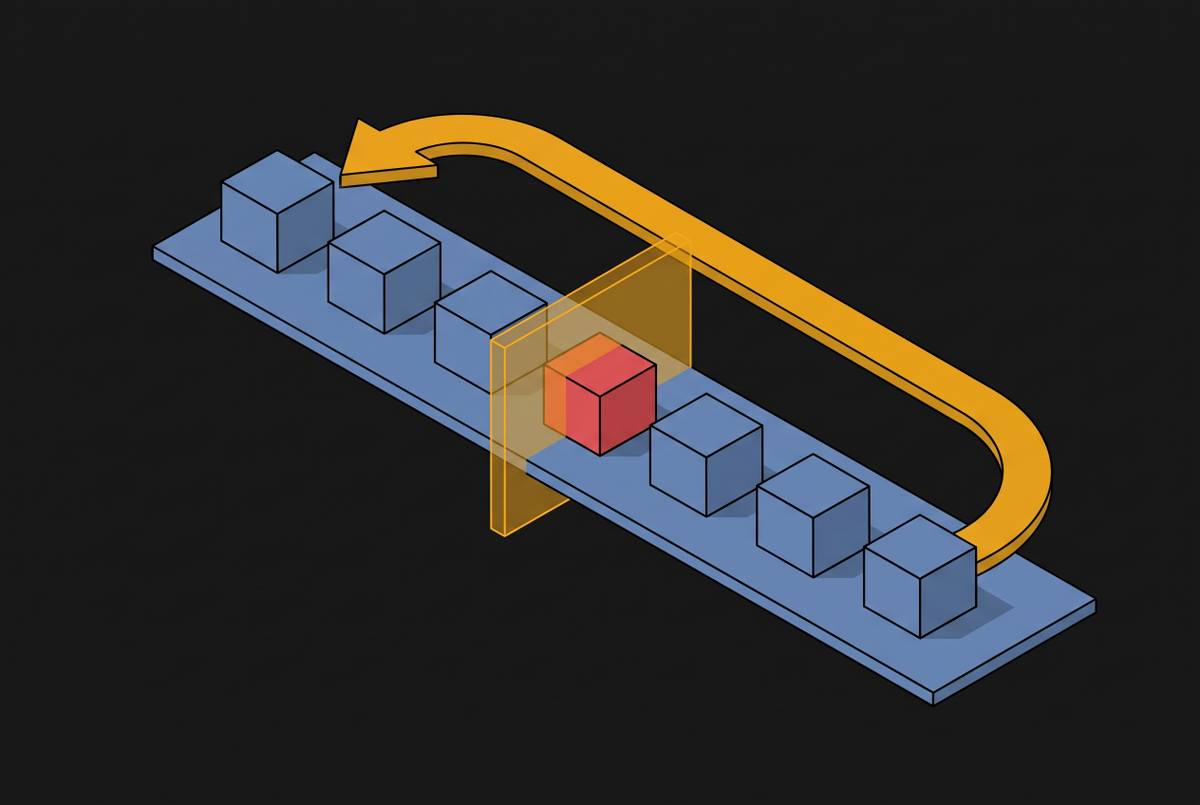
Layer-by-layer ablation systematically removes or degrades one harness layer and measures the resulting marginal performance change while holding everything else constant. A prompt-layer intervention might change the prompt template, while a tool-layer intervention removes a tool and a memory intervention disables retrieval. The intervention must have a defined architectural target. Changing several layers together would defeat the attribution the test is meant to provide, because an observed difference would no longer identify a single cause.
Jung and Son make this separation concrete through four progressively richer layers, namely posterior belief tracking, declarative planning, symbolic in-episode reflection, and an LLM-backed revision gate. Their inspectable declarative runtime exposes each layer's marginal contribution. Declarative planning raises the win-rate well above belief tracking alone without making LLM calls. By contrast, LLM-backed revision activates on only a small fraction of turns and has a bounded, non-monotonic effect.
Lumivate applies the same attribution logic through controlled regression injection across seven non-safety layers. It degrades one layer at a time and observes which assertion slices respond. Its deterministic “pure” mode makes those assertions repeatable without model calls. This separates the deliberate regression from sampling variance. The method therefore tests not only whether behavior worsens, but whether the evaluation can identify the deliberately damaged layer.
The masking problem: why aggregate metrics actively hide layer-specific failures
For six of seven local regressions, the aggregate drops only a small number of percentage points, while the matching slice drops between roughly a quarter and nearly all the way to zero. That is not merely a localization problem. A dashboard can make a serious defect look like everyday noise, so the overall result looks acceptable even with a broken layer.
The matching slice is the single worst-hit slice in five of seven cases and ranks in the top three in all seven. Damage largely stays out of the other slices. The same experiment on a structurally different tenant, Starbucks SG, finds that all seven matching slices crater and that the local-versus-foundational signature holds. This replication supports localization beyond a single catalog. It does not establish that every agent will show the same degree of masking.
Assertions written for a layer should respond to damage in that layer, so part of the localization is by construction. The aggregate stays nearly flat even with real regressions, and the off-diagonal stays nearly flat because the damage stays out of unrelated slices.
How do you test agent changes against real production traffic before deploying?
Teams should run layer-isolated tests against a golden set of production traces that hold actual user inputs, tool responses, and context windows. Synthetic benchmarks exercise situations the team anticipated. Production traces keep the situations users actually created, including the conditions at the time of failure that staging left out. The distinction is especially important for historical-conversation regression tests. Testing the conversation text alone does not preserve the tool responses and context that shaped the original run.
However, a historical corpus can age too. Dataset drift brings in new intents, while user-distribution drift shifts the mix of traffic away from the mix in the test set. Tool-API drift changes schemas, error codes, or rate limits, and retrieval-corpus drift changes the index used to supply context. With prompt drift, the rubric stays tied to an older version of the prompt. Agent-step compounding makes end-to-end reliability lower still, because per-step success rates multiply over the steps in a sequence.
A real endpoint changes its schema or error shape, the agent retries until the loop times out, and it fabricates a reasonable-sounding answer. The mock still returns the old payload. Lumivate positions scheduled replay of a golden trace set against current production as an early warning for such silent drift. Production-derived tests are therefore not a frozen alternative to synthetic benchmarks, but a corpus that must evolve with deployment.
How each harness layer produces its own failure signature in production traces
At the prompt and intent layer, the agent can misidentify the request at the first step and then execute correctly against the wrong intent. The trace looks coherent but ends incorrectly. A targeted ablation degrades intent resolution and checks for divergence at both the routing decision and the final output. This locates the initial error before downstream behavior makes it harder to distinguish.
At the tool and API layer, invalid arguments produce an error followed by repeated attempts or a silently fabricated result. Response-code monitoring alone misses invalid arguments. An ablation that removes a tool tests how much the agent depends on it, while argument-construction assertions check whether calls follow the tool's definition. When the live endpoint has changed but the definition has not, the trace connects the failed call to tool-API drift.
Routing and decomposition require separate tests even when their failures look similar at the end. A request can reach the wrong sub-agent, or it can be split into steps that do not fit the task. The tool calls themselves may still work in either case. Degrading routing while holding decomposition constant tests the former responsibility, while a separate decomposition intervention tests the latter. Lumivate's taxonomy permits a routing fault to appear without necessarily depressing the decomposition slice.
Memory and retrieval failures can appear as context truncation, with critical instructions or retrieved documents silently dropped when the prompt reaches the context window. The answer may remain plausible but incomplete. Disabling retrieval or capping context tests where trace steps begin to lose fidelity. Workflow failures leave a different pattern, namely repeated calls with incrementally varying arguments and no terminal transition. Jung and Son's symbolic reflection layer also shows that control-flow activity can help or hurt depending on calibration, with effects that can cancel on aggregate.
Escalation failures occur when terminal states differ from the ground-truth routing decision. The agent may exceed its authority or escalate a case it handled correctly. Degrading escalation tests those decisions against their expected outcomes. Safety remains a separate architectural responsibility in Lumivate's taxonomy. Its regression-injection experiment excludes safety, so the measured localization findings should not be presented as evidence from injected safety failures.
Running ablations without an LLM: the case for deterministic, no-LLM assertion slices
Stochastic, LLM-in-the-loop ablation mixes layer behavior with model variance. A poor run may come from a prompt defect or a sampling artifact, and it takes costly live reruns to work out what happened. Deterministic assertions remove that particular source of ambiguity. Ontology pre-resolution, routing logic, tool argument construction, and escalation thresholds can be checked without model inference.
Lumivate runs its pure-mode slices against locked per-slice baselines in CI. The baseline makes the test a gate. A regression in one slice must be explicitly acknowledged and updated even when the aggregate remains acceptable. Coverage must also be reported honestly, with a slice containing zero cases returning null, never 100%. An unexercised layer provides no evidence of correctness, regardless of the dashboard's color.
Input validity is a prerequisite to interpreting those results. Atlan's six-layer testing framework places data source validation at Layer 0, before harness evaluation. This helps avoid blaming the harness for upstream retrieval or schema-conformance problems. Deterministic tests and end-to-end replay consequently answer different questions. The former isolates assertable behavior, while the latter validates the proposed change against the production conditions represented in the trace corpus.
Translating ablation findings into targeted harness edits, validated before shipping
A collapsed routing slice shows where to look for the fault, but a proposed repair still needs to be tested. Teams should turn the finding into a targeted, reviewable harness edit and test that edit against the same production traces before release. This preserves a direct connection between the observed failure, the changed responsibility, and the outcome used to judge the repair.
Harness-R1 from Shanghai Jiao Tong University and Xiaohongshu demonstrates a method for converting batches of target-agent failure trajectories into validated executable patches. Its 2026 study reports a gain of +9.3 percentage points over baseline. Reruns of the frozen target provide outcome rewards. The edits are therefore optimized for realized task success.
For teams applying replay validation, reproducibility requires pinning the prompt, tool schema, retrieval index, workflow code, and evaluator version. Otherwise, the comparison can include changes beyond the intended edit. Reviewability is equally necessary before a patch ships. A team must be able to inspect and audit what changed, because an opaque repair restores the guesswork that layer isolation was intended to remove.
Making layer-isolated ablation a standing engineering practice, not a one-off diagnosis
A one-off ablation diagnoses a particular state of the agent, while a standing practice detects when that state changes. For production agents, the base model, specialist adapters, and harness each have their own release schedule. Harness edits can ship independently of weight updates and thus more often, increasing the risk of silent drift in harness behavior even between model revisions.
Lumivate's 2026 study reports that its full deterministic suite completes in 2.39 seconds and gates every pull request against per-slice baselines. That runtime makes CI gating practical for its agent and suite. It is not a universal speed guarantee. Teams should keep layer-isolated checks close enough to the release process to catch a regression before deployment and investigate it then.
As real user intents evolve, the production traces feeding the assertion slices must evolve with them. Degradation can be visible in an assertion slice before the aggregate moves. Harness engineering earns reliable releases through the same discipline as other software engineering, with changes versioned, reviewed, gated, and continuously monitored.
Sources
- Layer-Isolated Evaluation:Gating the Deterministic Scaffold of a Production LLM Agentwith a No-LLM, Regression-Locked Test Harness
- How Much Heavy Lifting Can an Agent Harness Do?: Measuring the LLM's Residual Role in a Planning Agent
- Harness-R1: Learning to Edit Executable Runtime Harnesses from Agent Failure Trajectories
- Layer-Isolated Evaluation: Gating the Deterministic Scaffold of a Production LLM Agent with a No-LLM, Regression-Locked Test Harness
- How Much Heavy Lifting Can an Agent Harness Do?: Measuring the LLM’s Residual Role in a Planning Agent